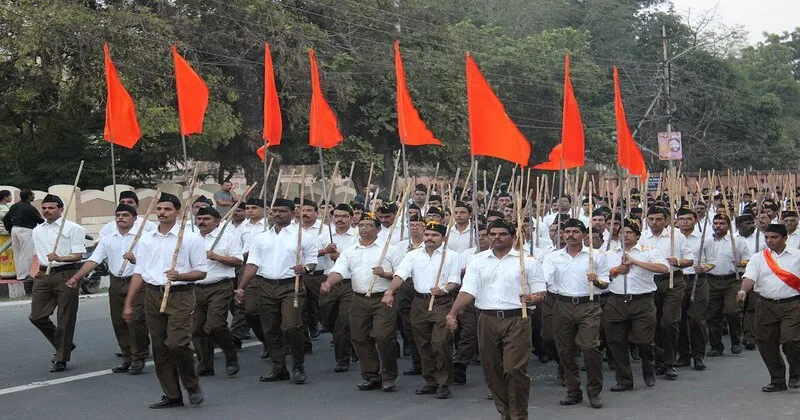
Today, not only in India but on the global stage, the Rashtriya Swayamsevak Sangh (RSS) has carved out a distinct identity. Established on September 27, 1925 in Nagpur by Dr. Keshav Baliram Hedgewar, the RSS has, over nearly a century, profoundly influenced India’s politics, society, culture, and service initiatives. Dr. Hedgewar’s vision was not merely to create an organization but to establish a form of cultural nationalism deeply rooted in Indian traditions, free from colonial mindset and Western dominance.
This raises an important question: What would India’s cultural, social, and political landscape look like if a service-oriented organization like the RSS had never existed? The answer can only be understood by analyzing both its contributions and the possible vacuum that would have been created in its absence.
After independence, when the nation was searching for an ideological direction, the RSS strengthened the stream of cultural nationalism. The second Sarsanghchalak, sri Madhav Sadashiv Golwalkar, “Guruji,” stated: “Whoever comes to India must embrace its culture; only then can they become a part of this land” (Golwalkar, We or Our Nationhood Defined, 1939). This outlook demonstrates how the RSS viewed Indian culture as the soul of the nation and brought it alive through organized efforts. Without the RSS, cultural nationalism might not have evolved into a powerful force, leaving society more susceptible to Western influences. In this context, Dr. Mohan Bhagwat’s words are striking: “Ram is ours, Vishwakarma is ours, Bheem is ours.” This reflects the inclusive vision of the Sangh.
The RSS’s contribution to social service is equally remarkable. Millions of volunteers have worked in education, healthcare, rural development, and particularly in tribal and forest-dwelling regions. They also instilled pride in India’s ancient knowledge traditions. As the current Sarsanghchalak Mohan Bhagwat said: “We believe in an India where no one is excluded; everyone is taken along” (Bhagwat, Nagpur Vijayadashami Address, 2016). This philosophy has become the foundation of the Sangh’s community-based service networks and social harmony. According to Dr. Bhagwat, “The pain of society itself inspires the dedication of our volunteers.” Without the RSS, this vast tradition of social service and the fight against social inequity would have been significantly weaker.
The readiness of RSS volunteers in times of natural disasters is also noteworthy. Whether it was the Odisha cyclone of 1999, the Gujarat earthquake of 2001, the Kedarnath disaster of 2013, or more recent floods and landslides, the RSS and its affiliated organizations were among the first to provide relief and rehabilitation. Volunteers offered food, medical aid, shelter, and assistance in reconstruction. Without such an organization, social cooperation during disasters would have been severely limited.
The RSS has also played a pioneering role in addressing the challenges of religious conversion. Through campaigns like Ghar Wapsi and broader social awareness efforts, it strengthened its roots in tribal and rural communities, inspiring people to preserve their Sanatan traditions. This not only prevented conversions but also safeguarded self-respect and cultural identity.
Protecting and promoting India’s Sanatan culture and values has been the Sangh’s core mission. By emphasizing the significance of Bharat Mata (Mother India) and Gau Mata (the cow), the RSS presented them not merely as symbols, but as the soul of national life. Through its shakhas and social campaigns, the Sangh organized Hindu society and provided protection and support to religious monasteries, temples, and ashrams. As Dr. Mohan Bhagwat notes: “The Sangh is the organization of society built on the spirit of belongingness.” Without the RSS, Hindu society might have remained fragmented, and religious-cultural institutions more vulnerable to external pressures.
It is also incorrect to claim that the RSS had no role in India’s freedom movement. From its inception, the Sangh worked to unite society, instill self-confidence and patriotism, and prepare the nation for independence. Some members contributed directly, others indirectly, not only aiding the freedom struggle but also strengthening the moral and cultural atmosphere of the country.
In politics, the RSS’s impact has been indirect but decisive. The ideological foundations of parties like the Bharatiya Jana Sangh (1951) and the Bharatiya Janata Party (1980) are deeply rooted in the Sangh. Political analyst Walter K. Andersen writes: “The RSS works on a long-term strategy beyond momentary politics” (The RSS: A View to the Inside, 1972). Without the RSS, Indian politics might have remained dominated by Congress, weakening the balance of democratic plurality.
During the Emergency (1975–77), the Sangh was banned, yet thousands of volunteers operated underground to defend democracy. This is a shining chapter in Indian history. Without the RSS, organized opposition to the Emergency might not have been possible, potentially deepening the threat to democratic institutions.
RSS shakhas are more than physical training centers, they are instruments for cultivating discipline, patriotism, and service. Dr. Bhagwat states: “The Sangh is the most democratic organization, where decisions are made by consensus.” He also emphasizes: “Be a fist, because open fingers can easily be bent, but a closed fist cannot.” This collective discipline and leadership training have become a powerful tool for nurturing national pride and leadership skills among youth.
Whether it was helping refugees during Partition or organizing people during the Ram Janmabhoomi movement, the RSS has played a leading role in societal organization. Critics like Ramachandra Guha argue that “After 1947, the RSS strengthened its position by exploiting communal tensions” (India After Gandhi, 2007). Yet, even this critique highlights the Sangh’s continued influence amidst social challenges. In this regard, Dr. Bhagwat’s statement resonates: “Social harmony is essential, but the law must not be misused.”
The contributions of the RSS extend far beyond organizational activities. It has shaped India’s cultural stream, social service network, and political balance. Without it-Cultural nationalism might have been weaker; India Without the RSS: A Vision of Absence. Today, not only in India but on the global stage, the Rashtriya Swayamsevak Sangh (RSS) has carved out a distinct identity.
In conclusion, the contributions of the RSS extend far beyond organizational activities. It has shaped India’s cultural stream, social service network, and political balance. Without it—
- Cultural nationalism might have been weaker.
- Social service and harmony would have remained limited.
- Community cooperation during natural disasters would have been fragile.
- Efforts to curb conversion and cultural erosion might have lacked strength.
- Politics could have been one-sided and imbalanced.
- Democracy’s defense during the Emergency might have been weaker.
- Youth would have lacked discipline and national pride.
- Sanatan culture and religious institutions would have been vulnerable.
Clearly, the presence of the RSS has given India a new ideological, social, and political dimension, while its absence would have left the country far more unbalanced, fragile, and directionless.