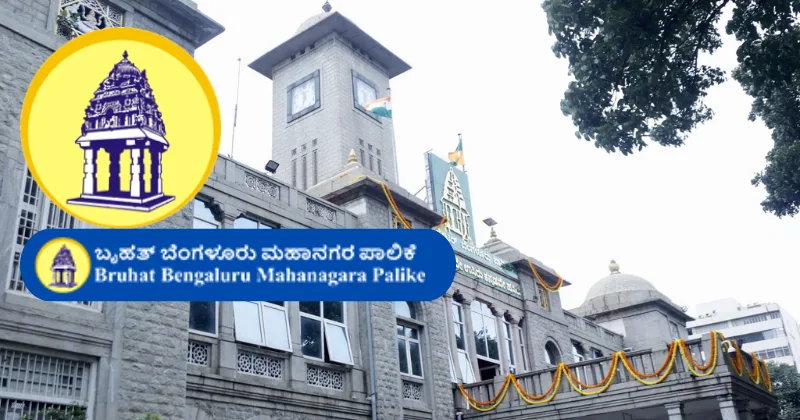
The Bruhat Bengaluru Mahanagara Palike (BBMP), Bengaluru’s sole municipal body for 18 years, was dissolved and replaced by five new corporations on Tuesday, September 2, 2025. This restructuring is part of the Greater Bengaluru Governance Act, 2024, which creates a three-tiered system with a Chief Minister-led Greater Bengaluru Authority (GBA) at the top, the five new city corporations, and ward committees.
The five new corporations are Bengaluru Central, Bengaluru East, Bengaluru West, Bengaluru North, and Bengaluru South. They collectively cover an area of 720.9 sq km, roughly the same as the former BBMP. The number of wards will be capped at 150 per corporation, with a delimitation committee tasked with redrawing boundaries based on factors like population and revenue potential. Bengaluru Central is at the heart of old Bangalore with its neat division of the city and cantonment areas, filled with parks, lakes, temples, churches and a few mosques—and a clean demarcation of vegetarian and non-vegetarian areas in a manner totally unknown anywhere else I have visited in India. It is in this area that Kannada, English and a peculiar but distinctive type of Urdu and Urdu-ised Kannada is spoken, and where everyone lived amicably with each other in a smallish town with a salubrious climate, the envy of everyone else in India who did not live here. It was quite literally a pensioner’s paradise and the most common greeting here in central Bangalore is still the Kannada greeting, “Aramāgidheera?”, literally meaning “Are you calm and at peace?” This is old Bangalore.
Fast forward to 2025, and Namma Bengaluru is practically unrecognisable from former times. The four other corporations cover areas that were unremarkable countryside till just thirty years back. These have now become vast urban sprawls where slums lie cheek by jowl with high rise apartments, and where every building is topped by an ugly water storage tank; the latter is inevitable because most areas outside Bengaluru Central are not served by a municipal water supply. Residents, even in posh apartment buildings, need to depend on water drawn from borewells, and horror of horrors, rely on water tankers that bring in water from who knows where. There is a fundamental geographical issue here—Bangalore is at an altitude where the chief water supplying bodies, namely lakes and rivers, are at an altitude roughly 200 to 300 metres below that of the city itself. Water needs to be pumped up against gravity if there is to be a centralized water supply system, and hence the reliance on borewells that need to go below this 300 metre level. This urban sprawl is simply unfit to hold the 13 million population it does; Bengaluru is a mega city gone wild.
The primary justification for this division into five corporations was supposedly to improve governance and civic service delivery through decentralization. With the city’s population being what it is, the single BBMP was seen as being too large and unmanageable. The new, smaller administrative units are now expected to enhance accountability, streamline services, and bring municipal governance closer to the residents. Each corporation will be headed by an IAS officer as Commissioner and will have its own budget. The GBA will handle large-scale, city-wide projects, while the individual corporations are supposed to manage day-to-day civic amenities like roads, garbage, and health services, many of which are practically nonexistent today, and where present, have seen their funding drop to negligible levels in the face of freebies-led bankruptcy.
Yet, this hope for better governance might just be a smokescreen for deeper political undercurrents. Real estate is the ruling currency in Bengaluru and the nexus between builders, developers and sadly enough, politicians, has resulted in the establishment of various political power centres to the north, west, east and south that are based on land holdings and real estate development. These are the bailiwicks of our top political netas and if any disinterested educated citizen cares to join the dots, these new corporations merely signify the areas of control of this political neta or another—a civilised division of the spoils, shall we say?
Besides, such an idea of having multiple municipal corporations has been tried before, and it failed. For reasons similar to Bengaluru, the lumbering colossus known as the Municipal Corporation of Delhi was trifurcated. After 10 years, the Corporation was quietly reunified in 2022. The triplication of bureaucracy only compounded issues instead of resolving them.
Another depressing feature of the new peripheries to the north, west, east and south is that each of these seem to be dominated by certain linguistic groups based on geography. Telugu is spoken in the northern areas, Kannada in the west and south and Tamil in the east. The south eastern areas are the most bewildering for it is here that the big computer based companies, call centre back offices and cyber startups are located, drawing towards them large communities from West Bengal, Odisha and North India, even Kashmir. These migrant communities live in closed communities and entire building complexes are filled with flats mostly occupied by, say Biharis, Odias or Bengalis. Stepping into any of these areas, one cannot be blamed for imagining that you are not in Bangalore anymore, forget Karnataka. Can anyone really find fault with the original inhabitants of the city when they get mildly upset that these new Bangaloreans do not seem to speak in Kannada or even want to learn a few words? Some of the original inhabitants do feel that their city has been snatched away from them. I do not see this feeling in say, Chennai, Hyderabad or Delhi which also house large numbers of immigrants from distant parts of the country. This febrile cultural anxiety needs careful and dispassionate study.
Why, one supposes, is this the case? Unlike other big cities in India, the old Bangalore was largely the creation of the Wodeyar ruling house who have done more than any other royal family in India to improve the overall industrial and other development of their kingdom. Most important landmarks of Bangalore whether it be IISc, HAL, Minto Eye Hospital, the Kannada Sahitya Parishat, Central College, College of Engineering and the Sandal Oil Factory owe their inception to the Wodeyars and their far seeing diwans, Seshadri Iyer, Visvesvaraya and Mirza Ismail. The core of Bangalore is Kannada and dharmic and it is for this reason that Maharaja Krishnaraja Wodeyar IV, who began all these projects, is still known as Rajarishi here. Kishen Shastry calls this phenomenon “Kannada conservatism” and this is one of the reasons why Karnataka is the only Southern state that attracts a large number of BJP voters. It is only in Karnataka that a lasting dharmic way of life and thought has not only survived but fostered cutting-edge innovation and disruptive progress through technology—a lesson for the rest of the country.
Attempts by the BJP central leadership to consolidate the party in Karnataka through some sort of linguistic homogenisation through Hindi, or by the Congress leadership to increase their influence here by allowing their netas to form money driven satrapies in the city outskirts or by opening state coffers to all sorts of dubious affairs such as the promotion of Urdu, or even by both parties turning a benign eye at the sprouting of regional ghettos all over the peripheries, cannot but have an ill effect on the city, the state and in the end, the economic health of the country. It is expected that the BJP national leadership will view Karnataka and Bengaluru with a sensitive eye. The South is different from the North. It is prone to the formation of regional parties. Particularly in Karnataka, a fear of the loss of something that seemingly belongs only to Kannadigas, masquerades as xenophobic and aggressive statements of cultural supremacy.
The delicate balance in old Bangalore is now a thing of the past—neat, interactive but respectfully distinct quarters of the European type have given way to a cacophony of competing turfs and land grabs. If it is further disrupted by tughlaqi firmans from the State, or any coercion from centre the situation would be ripe for the formation of a regional, Kannada centric party in Karnataka. The TDP, DMK, TMC and NCP are prime examples of this in the past; in all these cases there was a perception of high handed behavior from Delhi. If such a regional party brings together various castes that presently owe their respective loyalties to the Congress, the BJP or the JDS—ostensibly in the name of Kannada pride but really over the dilution of both cultural and economic norms—this writer at least is sure that it will sweep the polls in the next Assembly elections, whenever they are held. Let us note that internal dissensions in Karnataka in both the Congress and the BJP are, at best, metastable now if not outright unstable.
We, the residents of Karnataka, live in interesting times. May Devi Chamundeshwari, the Goddess of War whose temple very much belongs to Hindus, protect us as She has always done.
Aparna, Chandika, Chanda-Mundasura Nishudini ||145||
Sri Lalita Sahasranama Stotram
The author is Emeritus Professor in IISc, Bengaluru.