I am often invited to speak on the Indian knowledge tradition at various forums. At almost every such event, I make it a point to mention Professor Angus Maddison — a renowned British economist who authored several influential books on the global economy. Through detailed data and references, he convincingly demonstrated that, at one time, Bharat was the world’s wealthiest and most prosperous nation. Bharat accounted for one-third of the world’s trade and held more than 30 per cent of its total wealth. These facts clearly prove how wealthy and advanced Bharat was before foreign invasions.
Bharat—The Pioneer of Technology
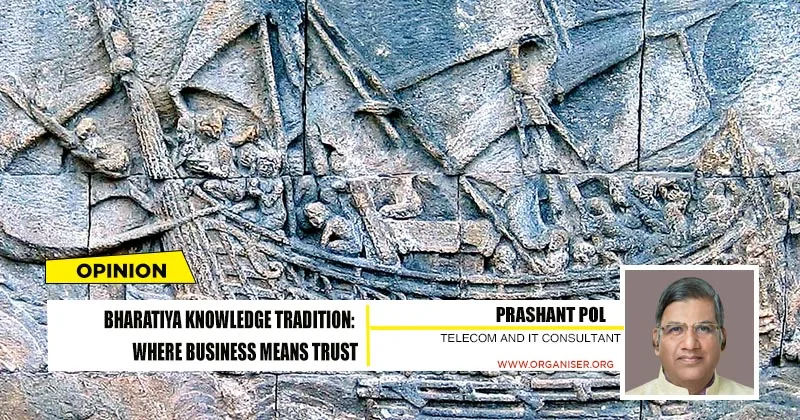
When we look at such historical evidence, a natural question arises: How did we manage all this so efficiently? We dominated global trade; our ships reached as far as Latin (South) America. The demand for Bharatiya goods was high, thanks to their exceptional quality. The textiles we produced were so exquisite that kings and nobles from distant lands competed to acquire them. Our ancestors constructed astonishing temples, palaces, and monuments that still leave experts in awe of their craftsmanship and ingenuity. The grandeur of Angkor Wat, for example — one of the largest temple complexes in the world — is a testament to that brilliance. We pioneered metallurgy, mastered water management, and were technologically far ahead of our times.
Master of Business Management
But how did we “manage” such a vast, efficient, and ethical system without formal management education? Today, we believe that only MBA graduates and business school alumni are capable of running organisations and industries. Was it the same back then? Did institutions like Takshashila, Nalanda, Ujjayini, Vikramashila, Vallabhi, or Suloṭgi offer courses in management? Historical evidence shows that formal education in “management” as a subject didn’t exist in ancient Bharat. There were no departments or universities teaching it in the way we know today. And yet, our ancestors achieved incredible feats — building the world’s largest ships, conducting international trade, innovating across disciplines, and upholding ethical business practices.
To understand how they did it, we must set aside modern management theories and look at ancient practices through a different lens.
During that golden period, management was not a part of curriculum directly, hence not taught as a subject. Yet, the principles of management were deeply ingrained — not through structured courses, but indirectly and very effectively through lived experiences, value-based learning, and cultural transmission. One powerful medium for this was the Upanishads — ancient texts written 4000 to 6000 years ago by our ancestral sages and seers. Of those 108 Upanishads, ten were widely studied and taught. Today, we tend to see sacred texts like the Gita, the Upanishads, and the Bhagavatam as religious scriptures meant for retirement years. But that was not the case in ancient times.
Back then, the meaning of ‘Dharma’ was different. Rituals were less. Dharma referred to a noble, value-driven lifestyle. Boys and girls went to gurukuls (traditional schools) to study, where they would get introduced to these texts early in life. Far from being boring or abstract, the Upanishads were filled with insightful stories and lessons — practical guidance on how to live with integrity, responsibility, and purpose.
Modern Meaning of Management
The modern wave of management thinking largely originates from America — a country shaped more by commerce than by spiritual or philosophical roots. The indigenous wisdom of the Red Indians (Native Americans) was largely wiped out by European settlers. Hence, material success and wealth naturally became dominant themes in American management philosophies. Therefore, in America, whenever anyone gets the slightest success in management, the Americans run behind him like a flock of sheep.
During the sixties – seventies, different thinkers and approaches took center stage in the U.S. — from Dale Carnegie’s “How to Win Friends and Influence People” to Transactional Analysis (TA) of the “I’m OK, You’re OK” model, and even Shiv Khera of Bharatiya origin, whose motivational ideas found wide appeal. Each of these systems emphasised aspects of human behaviour and productivity. But what’s truly fascinating is that all these ideas were already written in detail in Bharatiya sacred texts thousands of years ago, articulated in unique and profound ways by our sages and seers in Upanishads, Gita etc.
The Foundation of Management
The foundation of the Gita and the Upanishads is built upon ethics, integrity, and authenticity. These weren’t just idealistic values to be admired from afar, they were expected to be practiced and lived. Truthfulness, ethical conduct, and personal integrity were seen as essential to every aspect of life, including trade and governance. As a result, deceit and manipulation found little room in our societal and economic systems.
This Shanti Mantra from the Mandukya Upanishad says: Om Bhadram Karnebhih Shrunuyaama Devaaha |
Bhadram Pashyemaakshabhir Yajatraaha ||
Meaning, “May we hear with our ears what is auspicious. May we see with our eyes what is auspicious” The word “Yajatraa” here refers not only to those who perform fire rituals (yajnas), but — as explained by the Upanishadkars — to those who live their lives with a spirit of sacrifice, knowledge, and purpose. True yajna lies in doing selfless work for the greater good, with awareness and commitment.
Another profound verse from the Mundaka Upanishad says: Satyameva Jayate Naanrutam Satyena Panthaa Vitato Devayaanah|
Kramantryushayo Hyaaptakaamo Yatra Tatsatyasya Paramam Nidhaanam ||
Meaning, “Only truth triumphs; falsehood can never win.” Satyameva Jayate, a part of this Shloka, was adopted as Bharat’s national motto on 26th January 1950.
The 14th Mayurav of Narayana Upanishad has a Shloka that states:
Dharma Iti Dharmena Sarvamidam Parigruheetam |
Dharmaannaatidushaashcharatam Tasmaaddharme Ramante ||6||
Meaning, Everything is sustained by Dharma. Righteous conduct, integrity, and trust are all parts of Dharma. Faith in scriptures is the soul of Dharma.
These teachings. through gurukulas, universities, institutes, family values, trickled down to the bottom, embedding them in daily life in schools, homes, and communities. These values seeped deep into the consciousness of children growing up in ancient Bharat. As a result, truthfulness and ethical conduct were seen even in business.
This trust and reliability became Bharat’s hallmark. Hence, international merchants and rulers blindly trusted Bharatiya traders not just because of product quality, but because of their integrity. In modern
management language, this would be called a strong ethical code of conduct.
(Excerpt from the book “Khazane Ki Shodhyatra” — “The Quest for Hidden Treasures”)