





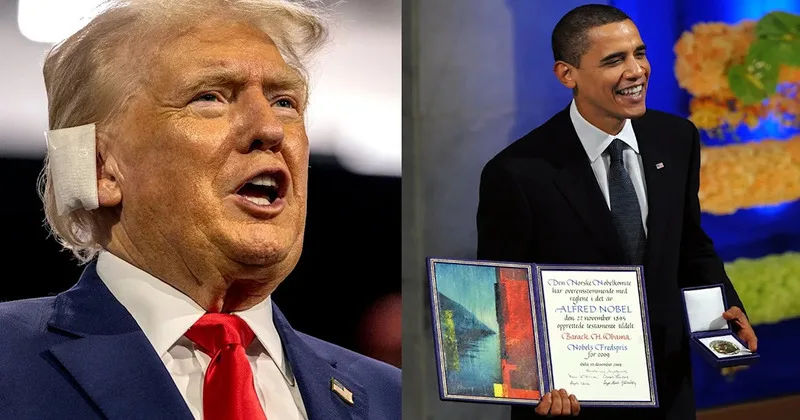
Some psychologists have suggested that Donald Trump exhibits symptoms of a condition known as “dead ringer’s tail,” which is associated with a brain disorder. Such concerns are understandable when a person who has held the office of US President seeks the Nobel Peace Prize with the enthusiasm of a child. These doubts intensify when combined with Trump’s unpredictable style of work.
Since assuming office, Trump has traveled extensively around the world portraying himself as a messenger of peace. During his first term, he focused on direct talks with heads of state, including figures as prominent as North Korean communist autocrat Kim Jong-un. In his second term, he declared his intent to work for global peace by intervening in multiple conflicts. Trump has claimed that he ended seven major conflicts during his presidency, citing India-Pakistan, Azerbaijan-Armenia, Israel-Palestine, and Russia-Ukraine among them. While he repeatedly argues that the U.S. economic crisis lies at the heart of the import tariff wars, it can be noted that his personal interests are also deeply involved.
When Humiliation Fueled Trump’s Drive for Power and Recognition
At the core of his Nobel Prize ambitions is a long-standing personal rivalry, which has shaped much of Trump’s political trajectory. A notable episode in this rivalry occurred during the 2010–11 period concerning former President Barack Obama’s birthplace. Trump emerged as a leading figure in these campaigns, driven in part by his opposition to Obama’s environmental policies, which conflicted with his own interests as a major real estate developer. During this period, Trump publicly claimed that Obama was not born in the United States, questioned the legitimacy of his presidency, and demanded the release of his birth certificate.
However, a pivotal incident on April 30, 2011, dramatically shifted the situation. At the White House Correspondents’ Dinner, hosted by President Obama, Trump was present as a guest. During his speech, Obama ridiculed him: “Donald Trump is here tonight! No one is happier, no one is prouder to put this birth certificate matter to rest than the Donald. And that’s because he can finally get back to the issues that matter, like, did we fake the moon landing? What really happened in Roswell? And where are Biggie and Tupac?” Obama’s mockery painted Trump as someone obsessed with exaggerated American stories.
The president also mocked Trump’s television appearances, quipping, “These are the kinds of decisions that keep me up at night.” The ridicule extended beyond Obama. Comedian Seth Meyers later added to the public jest, highlighting Trump’s repeated statements about a potential presidential run. Trump, visibly upset but largely silent as the audience erupted in laughter, became the focus of media attention the following day.
David Remnick, editor of The New Yorker and attendee of the dinner, later commented, “He was being treated as a piata by the president of the United States, and I think he felt humiliated”. Former New Jersey Governor Chris Christie noted that Trump seemed “beside himself with fury.” It is widely agreed that this public humiliation played a crucial role in Trump’s decision to run for president in 2016. Roger Stone, a longtime Trump advisor, recalled, “I recognised at that point that he really was going to run. I could see the clench of his jaw as he sat there.” Four years later, Trump ran and won the presidency, but the sting of the humiliation persisted, feeding his subsequent fixation on the Nobel Peace Prize awarded to Obama in 2009. This obsession has driven Trump to frame himself as an ambassador of global peace.
President Obama roasting Donald Trump at the White House Correspondents Dinner will never not be funny.
It’s said that he was so humiliated by this that it spurred Bone Spurs Donnie to run for office.
If Obama’s remarks made him cry so much, then how he’s handling all those… pic.twitter.com/8DCSu7h483
— Art Candee 🍿🥤 (@ArtCandee) May 27, 2024
When Global Diplomacy Turns into a Stage for Trump’s Nobel Ambitions
Recent reports suggest that Trump’s foreign policy decisions often intertwine with personal interests. An analysis by the international financial institution Jefferies indicates that his decision to impose double tariffs on Indian products stems from personal resentment. The report explains that Trump’s actions are not primarily motivated by India’s refusal to buy Russian oil, as he claims, but by India’s rejection of his mediation in the India-Pakistan conflict. The New York Times also notes that Modi’s refusal to endorse Trump for the Nobel Prize played a role in the additional tariffs. Trump’s inability to secure a Nobel Peace Prize for ending the Russia-U.S. conflict appears to have heightened his personal frustration.
Trump has a history of leveraging foreign policy for personal or commercial gains. He met Pakistani Army Chief Asim Munir twice within two months, demonstrating sustained engagement with Pakistan. His public support for Pakistan and disparagement of India align with the new business agreement signed on April 26, 2025, between the Trump family’s crypto venture, World Liberty Financial (WLF), and the newly formed Pakistan Crypto Council (PCC). Trump has been nominated for the Nobel Prize twice in connection with Pakistan. Similarly, his interventions in conflicts such as Israel-Palestine, Armenia-Azerbaijan, and Ukraine-Russia are linked both to his Nobel ambitions and commercial interests.
The Nobel Peace Prize announcement this year is scheduled between October 6 and 10. The likelihood of the current committee awarding the prize to Trump is extremely low. Nonetheless, the global community watches with curiosity and concern, raising questions about the potential consequences of his actions. Analysts speculate whether Trump might provide additional weapons to Ukraine to escalate the conflict with Russia, extend support to Israel to intensify operations in Gaza, push for U.S. intervention in Greenland, or channel more financial resources into Pakistan and Bangladesh to weaken India.
Trump’s quest for the Nobel Peace Prize, rooted in both personal rivalry and political strategy, highlights the complex interplay between individual ambitions and global diplomacy. From his public humiliation in 2011 to his strategic use of foreign policy in recent years, his actions reflect a continuous effort to assert his influence and pursue recognition on the world stage. While the outcomes remain uncertain, the combination of personal vendettas, business interests, and global political maneuvers ensures that Trump’s ambitions will remain a focal point in international discourse.











Comments