





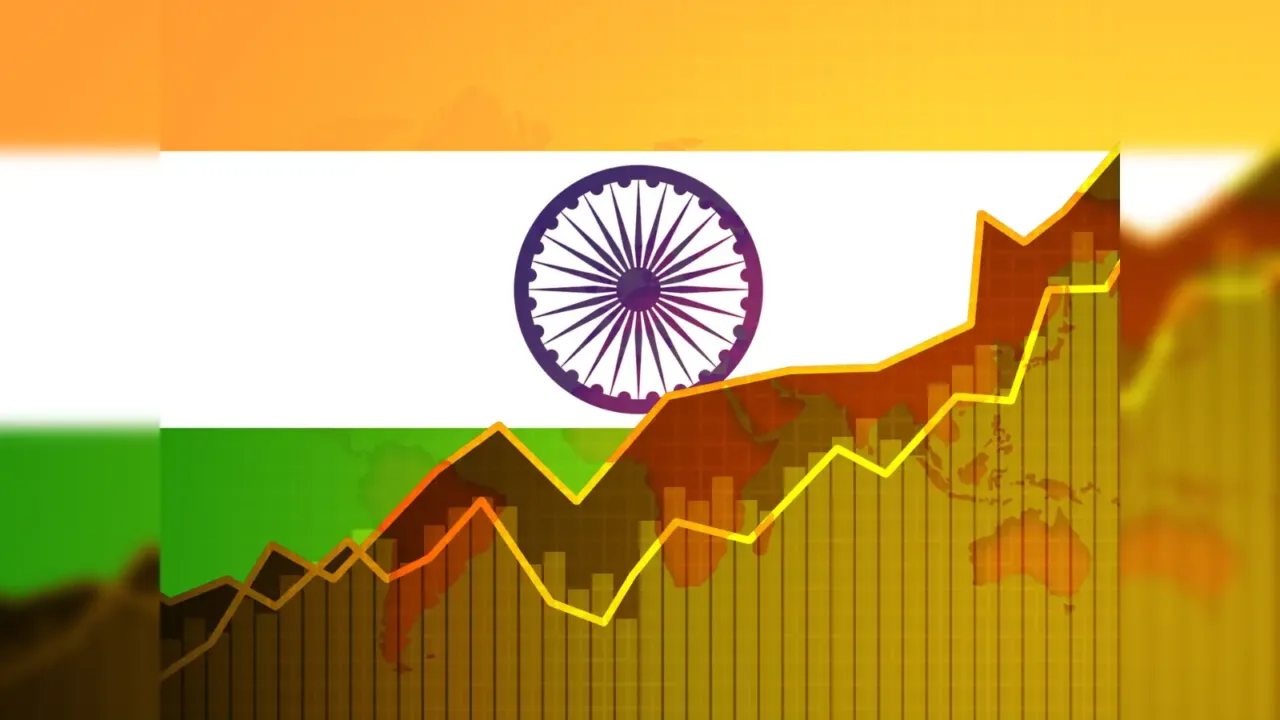
India’s economy continues to stand tall amid global turbulence, with Crisil projecting a 6.5 per cent GDP growth rate for FY26, supported by strong domestic private consumption and robust government spending. The report, released on September 1, underlines how Prime Minister Narendra Modi’s economic reforms and policy stability have positioned India as a beacon of growth, even as advanced economies battle tariff wars and slowing demand.
While downside risks remain from the US tariff regime and a weakening global economy, India’s growth engine is expected to run on four major drivers, a strong monsoon, easing inflation, RBI’s monetary support, and fiscal incentives from the government.
Monsoon and agriculture boost rural demand
The report highlights that a healthy monsoon has laid the foundation for strong rural consumption. As of August 28, rainfall stood at 106 percent of the long-period average, with Kharif sowing up 3.4 per cent year-on-year.
This agricultural strength, Crisil noted, will help stabilise food prices and support household budgets, allowing rural families to spend more on discretionary goods. Inflation, which averaged just 2.4 per cent between April and July FY26, is already far below last year’s 4.6 percent, providing much-needed relief to consumers.
This is in line with the Modi government’s push to strengthen agriculture through MSP reforms, irrigation projects, and rural development schemes, ensuring that farmers not only produce more but also earn more.
RBI’s proactive cuts fuel urban consumption
Crisil also underlined the impact of RBI’s 100-basis-point repo rate cut in 2025 and the planned reduction in the cash reserve ratio (CRR), to be executed in four tranches between September and December.
These steps, combined with the government’s calibrated tax reforms, are expected to significantly support urban demand. Already, transmission of rate cuts to bank lending and deposit rates is underway, making credit cheaper for households and businesses alike.
Government’s fiscal support: A pillar of stability
The report praises the Modi government’s fiscal prudence combined with growth-friendly spending. Key highlights include:
1. Income tax relief under the new regime, which has increased middle-class disposable income.
2. Higher allocations to rural schemes, ensuring stronger grassroots demand.
3. A proposed GST restructuring that may cut taxes in select consumer segments, providing a further push to consumption once finalised.
These measures reflect the Modi government’s balancing act, boosting domestic demand while maintaining fiscal discipline, a hallmark of its economic management over the past decade.
Manufacturing, services, and exports on the rise
India’s real GDP growth surged to 7.8 percent in Q1 FY26, the highest in five quarters, powered by both manufacturing and services. Private consumption remained strong despite a high base, while government expenditure and fixed investments rose sharply.
On the trade front, exports recorded a healthy uptick, partly due to front-loading of shipments ahead of US tariffs. Crisil noted that while global demand uncertainties remain, India’s diversified export markets—from Asia and Europe to the Middle East, continue to cushion risks.
Modi govt’s policy continuity inspires confidence
What sets India apart from its peers is policy continuity and reform-driven governance under Prime Minister Narendra Modi. Initiatives such as:
1. Make in India and Atmanirbhar Bharat, which bolstered self-reliance and reduced import dependence.
2. PLI schemes, attracting global manufacturers in key sectors like electronics, semiconductors, and green energy.
3. Infrastructure push, including expressways, ports, and industrial corridors that have improved logistics efficiency.
These reforms have created an environment where both consumption and investment thrive, even when global conditions are adverse.
Resilient economy ready to lead
Crisil’s forecast makes one thing clear: India is not merely surviving global shocks, it is emerging stronger with each challenge. With robust domestic demand, easing inflation, proactive monetary policy, and the Modi government’s fiscal support, India is set to remain the fastest-growing major economy in the world in FY26.
As the report concludes, India’s growth story is not just about numbers, it is about the confidence of households, the dynamism of entrepreneurs, and the stability of governance that ensures the economy keeps marching forward.













Comments