






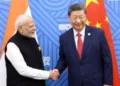
Prime Minister Narendra Modi and Chinese President Xi Jinping came face-to-face after more than three years on the sidelines of the Shanghai Cooperation Organisation (SCO) Summit in Tianjin. The meeting, watched closely by global observers, carried undertones of caution, while Xi attempted to revive old rhetoric, Modi asserted India’s uncompromising stand on dignity, sovereignty, and mutual sensitivity.
The two leaders had last engaged before the 2020 border standoff, which left deep scars on bilateral trust. Despite Xi’s conciliatory gestures, scepticism in New Delhi remains high, given Beijing’s repeated violations of past commitments.
In what many saw as a tactical move, Xi Jinping mentioned the Panchsheel agreement, a Nehru-era framework first drafted in the 1950s, to present China as a proponent of “peaceful coexistence.” He projected the agreement as a “guiding framework” for future ties between the two Asian powers.
However, Beijing has often cited Panchsheel when convenient, while simultaneously disregarding its very essence, especially the principle of mutual respect for sovereignty, repeatedly challenged by Chinese aggression at the borders.
Unlike Xi, Prime Minister Modi avoided empty historical symbolism and instead laid down a contemporary and practical diplomatic doctrine. He stressed “mutual respect, mutual interest, and mutual sensitivity” as the true basis of stable ties, an articulation that subtly underscored India’s insistence on respect for territorial integrity and security concerns.
PM Modi’s participation in the SCO marks his first visit to China in seven years, underscoring the significance of his message. The two-day summit brought together leaders from Russia, Central Asia, South Asia, Southeast Asia, and the Middle East, with a focus on regional security and multilateral cooperation.
At a time when Beijing is facing distrust from many of its neighbours, Modi’s leadership projected India as a voice of balance and stability in the Global South.
The Panchsheel Agreement, signed on April 29, 1954, included five key principles:
Respect for sovereignty and territorial integrity
Mutual non-aggression
Non-interference in internal affairs
Equality and mutual benefit
Peaceful coexistence
Though once hailed as a model for diplomacy, the pact remains marred by history, barely eight years later, in 1962, China launched a war against India, violating every principle it had endorsed.
Xi’s invocation of Panchsheel at this stage seems more a tactical gesture than a genuine commitment. With border tensions still festering, trade heavily skewed in Beijing’s favour, and China’s track record of disregarding its own promises, New Delhi has every reason to view Xi’s words with caution.
This moment comes against the backdrop of a rapidly shifting global order. With U.S. President Donald Trump’s tariff wars and economic misadventures destabilising global supply chains, leaving nations scrambling to redefine trade partnerships. Unlike many, India seized the moment, diversifying its energy basket with discounted Russian oil, strengthening outreach to the Global South, and positioning itself as a credible voice against great power manipulation.
In this new geopolitical landscape, India under Modi has emerged as a decisive and independent power. Whether calling out Pakistan’s aggressive manoeuvres at the border, resisting Western pressure on energy policy, or challenging Trump-era protectionism that unfairly targeted emerging economies, New Delhi has shown it will not bow to external diktats.
By holding its ground with China even at a forum like the SCO, India demonstrated once again that it is no longer a passive participant in global affairs but a rising South power shaping the rules of engagement on its own terms.














Comments