Parliament, that august chamber where the collective conscience of a billion souls is meant to find voice, too often resembles a stage for cacophony rather than a sanctuary of deliberation. There is a sanctity to Parliament which no ordinance can confer and no law can replace. It is, in the immortal phrase of Jawaharlal Nehru, the “temple of democracy.” Yet of late, that sanctum has too often resembled a bazaar of noise, a wrestling pit of slogans, or worse, a stage of orchestrated theatrics. Instead of hearing thoughtful arguments, we are forced to hear constant shouting. Instead of meaningful debate, what we see is only chaos and disruption.
It has become a familiar ritual by the Opposition: the presiding officer rises, the order paper is laid, and before the House can draw its first breath of debate, the well is stormed, placards sprout like weeds in a monsoon, and slogans drown out syllables of substance. Important national issues, from protecting our borders to celebrating our scientists, are drowned out by noise that sounds more like a street fight than the proceedings of the nation’s highest law-making body.
Dissent, in its noblest form, is indispensable. The Opposition, in a parliamentary democracy, is not an inconvenience but an institution: the vigilant guardian who questions, scrutinises, and compels accountability. When debate is replaced with drama, and healthy opposition turns into chaos, the result is not democracy but mockery.
The Fiscal Cost of Chaos
The real casualty, alas, is not merely productivity but the public purse. Every adjourned minute is not just a lost moment; it is Rs 2.5 lakh siphoned from the taxpayer’s pocket, according to estimates placed by former Parliamentary Affairs Minister Pawan Kumar Bansal in 2012 during the Budget Session debates. Each day of disruption bleeds the exchequer of crores.
To illustrate: in the opening three days of the Monsoon Session, the Lok Sabha functioned for barely 0.9 hours out of a scheduled 18, and the Rajya Sabha for 4.4 hours. The remainder—1,842 minutes—was devoured by adjournments. Multiplying those minutes by the cost per minute yields a staggering Rs 23 crore of taxpayer money wasted—resources that could have nourished a hungry child, funded a rural school, or fortified a hospital, but instead were squandered to bankroll the theatre of tumult.
Hence, every adjournment is not merely a procedural hiccup—it is a theft from the public. It is money denied to schools, to hospitals, to farmers, to scientists. It is, in effect, the monetisation of misconduct.
Productivity at its stake
The Monsoon Session of 2025 of Parliament has been adjourned sine die as of August 21, 2025. The session provided 21 sittings spreading over 32 days. As per the information provided by PIB, during the session, 14 Bills were introduced in Lok Sabha. 12 Bills were passed by the Lok Sabha, 15 Bills were passed by the Rajya Sabha, and a total of 15 Bills were passed by both the Houses of Parliament. Also, one Bill was withdrawn in the Lok Sabha. Both the Houses witnessed continuous disruptions throughout the session, and as such, the productivity of Lok Sabha has been approximately 31% and that of Rajya Sabha approximately 39 %. In the Lok Sabha, discussions could occur for only 37 Hours out of a total of 120 hours during this session, and in the Rajya Sabha, discussions took place for 41 Hours and 15 Minutes only.
This session will be remembered less for the Bills passed and more for the obstructionism of the Opposition. The official press release by the Ministry of Parliamentary Affairs explicitly mentions the continuous disruptions by the opposition as the reason for low productivity. This is not dissent; it is dereliction. Parliament is not merely a battleground for protest but the place for deliberation.
Procedure of Discipline
Parliament is not without its rules, and disorder is not without its remedies. The Rules of Procedure and Conduct of Business in the Lok Sabha and Rajya Sabha are neither ornamental nor advisory; they are binding instruments designed to ensure that dissent does not descend into mere noise.
Rules of Procedure and Conduct of Business in the Lok Sabha are explicit: Rule 349 prohibits Members from interrupting proceedings by disorderly conduct, Rule 350 restrains Members from approaching the Chair in a disrespectful manner or casting aspersions on its authority, and Rules 373–374A empower the Speaker with disciplinary, including suspension for grave disorder. The Rajya Sabha Rules mirror these provisions, with Rule 256 empowering suspension for disorderly conduct.
To cap it all, the Privileges of the House—a constitutional inheritance under Article 105—render obstruction, insult to the Chair, or attempts to stall business as breaches of privilege, amounting to contempt of the House. In such cases, the Committee of Privileges may recommend penalties ranging from reprimand to expulsion.
And yet, for all this procedural armoury, the true deterrent lies not in Rules but in restraint. As Kaul & Shakdher’s Practice and Procedure of Parliament soberly observes, “The House is supreme in enforcing order, but order rests ultimately on Members’ sense of dignity and responsibility.”
The Habit of Obstruction
So, what explains this sad fall from debate to mere shouting? The problem is that opposition has shifted from being an institution with a duty to hold the government accountable to a reflex—an unthinking habit of opposing simply for the sake of it.
Thus, whether the matter before the House is the revision of electoral rolls in a state, or a scheduled discussion on a national security operation, or even a celebration of a scientific milestone such as India’s maiden astronaut aboard the International Space Station, the reflex is the same: storm the well, shout down the debate, adjourn the House. This is not dissent—it is dereliction. True dissent scrutinises, dissects, and persuades; false dissent shouts, stalls, and sabotages.
Rahul Gandhi assumes office of Leader of Opposition
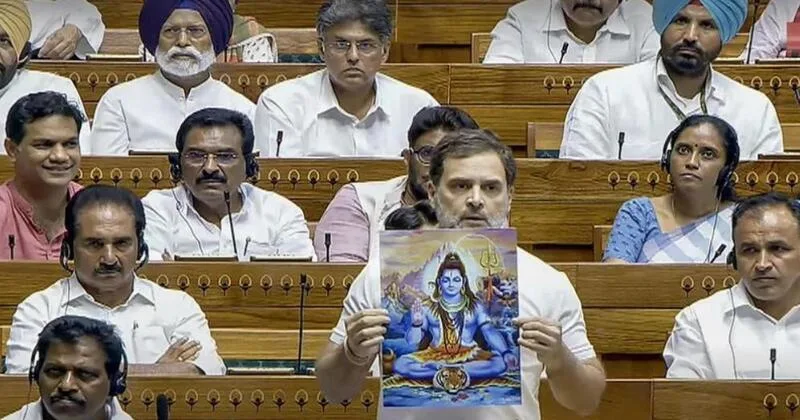
The office of the Leader of the Opposition is no ceremonial decoration; it is a statutory post, recognised by the Salary and Allowances of Leaders of Opposition in Parliament Act, 1977, and carries with it both privilege and profound responsibility. The LOP is meant to be the counterpoise to executive power, the voice of the alternative, and the standard-bearer of responsible dissent. Yet in Rahul Gandhi’s stewardship, the dignity of that office has too often been sacrificed at the altar of theatre.
When the Speaker of the Lok Sabha is compelled to reprimand him for actively urging his colleagues to storm the well of the House—a clear violation of Rules 349 and 350 of the Rules of Procedure—it is not merely an impropriety, but a betrayal of the decorum that underpins parliamentary democracy. Rahul Gandhi’s behaviour, far from elevating the role of the Opposition, reduces it to a chorus of disruption, normalising conduct that is expressly prohibited under the very rules meant to safeguard deliberation.
His behaviour in public only deepens the sense that he takes his role lightly. Leading protests at Parliament’s gates in casual clothes, or sitting with visible indifference inside the House, may generate social media buzz, but they eat away at the dignity his office demands. Parliament is not a stage for political cosplay—it is the heart of the Republic, where seriousness and respect must outweigh spectacle and drama.
Rahul Gandhi’s actions point not to an emboldened opposition, but to a distracted one—content with gestures over governance, and performance over participation. A true Leader of Opposition should marshal arguments, summon facts, and deploy rhetoric in the service of accountability. Instead, we see a troubling abdication: a reliance on noise where nuance is required, on disruption where debate is demanded, and on absence where presence is paramount.
The result is not merely a diminishment of Rahul Gandhi’s personal stature, but an erosion of the very institution he occupies. The LOP is the second-most important figure in the House of the People; when he trivialises his role, the nation loses more than just debate—it loses faith in the possibility of meaningful opposition. For in a democracy, government without accountability is dangerous, but opposition without seriousness is disastrous.
Recalling the Leaders of Opposition time back
One need only recall the conduct of past Leaders of Opposition to grasp the extent of the decline. When Atal Bihari Vajpayee occupied the post, his oratory combined wit with wisdom, so persuasive that even his fiercest adversaries admitted to being disarmed by the sheer force of his argument. Sushma Swaraj, too, brought dignity to dissent, standing firm in opposition yet never sacrificing the sanctity of the chamber to the lure of disruption. Their interventions illuminated debate, challenged government with substance, and reminded the ruling benches that the Opposition’s role is to correct without corroding. Against this backdrop, Rahul Gandhi’s habitual absence from serious debate and indulgence in performative protest appears less a continuation of legacy than a corrosion of it, reducing a once-august office to a stage for slogans rather than a forum for statesmanship.
Democracy in Din
The role of the Opposition is indispensable. A democracy without dissent is a dictatorship; but a democracy where dissent degenerates into perpetual disruption is an anarchy in disguise. Parliamentary privileges are not licences for lawlessness. They are trusts, to be exercised with dignity, lest the very institution be brought into disrepute.
The presiding officers have reminded Members repeatedly that India is the largest democracy in the world, and the world watches its Parliament. When Members wield placards instead of arguments, and storm the well instead of enlightening it, they are not merely shaming their government—they are shaming their people.
What we are witnessing, then, is not merely opposition to government—it is opposition to governance itself. Not constructive dissent but contrived disruption. Not debate, but delay. And when obstruction becomes habitual, democracy itself is held hostage to the politics of perpetual protest.
Parliament is not a battlefield where Members must vanquish one another with decibels; it is a forum where ideas must prevail through dialogue. Disorder does not empower the people; it impoverishes them. For every wasted day is not merely a blot on the record of Parliament—it is a theft from the aspirations of the citizen.
The Call for Decorum
What is at stake is larger than a Bill or a Budget. It is the very credibility of the world’s largest democracy. For democracy dies not only in darkness, but also in disorder. It perishes when Parliament, instead of being a beacon of reason, becomes an arena of rancour.
If Members would but recall that the walls of Parliament are built of dignity as much as of sandstone, perhaps they would rediscover that their greatest weapon is not the slogan but the syllable, not the placard but the principle. Until then, the citizen must endure the tragic irony of seeing crores squandered in the theatre of tumult, when they could have been invested in the promise of progress.