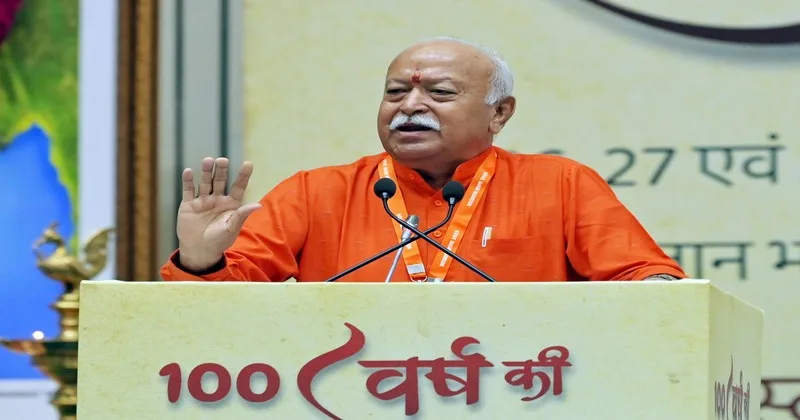
Every family should have three children: Dr Mohan Bhagwat
June 29, 2026
  • Read Ecopy
  • Circulation
  • Advertise
  • Careers
  • About Us
  • Contact Us
Android AppiPhone AppArattai
Organiser
  • ‌
  • Bharat
    • Assam
    • Bihar
    • Chhattisgarh
    • Jharkhand
    • Maharashtra
    • View All States
  • World
    • Asia
    • Europe
    • North America
    • South America
    • Africa
    • Australia
  • Editorial
  • International
  • Opinion
  • RSS @ 100
  • More
    • Op Sindoor
    • Analysis
    • Sports
    • Defence
    • Politics
    • Business
    • Economy
    • Culture
    • Special Report
    • Sci & Tech
    • Entertainment
    • G20
    • Azadi Ka Amrit Mahotsav
    • Vocal4Local
    • Web Stories
    • Education
    • Employment
    • Books
    • Interviews
    • Travel
    • Law
    • Health
    • Obituary
  • Subscribe
    • Subscribe Print Edition
    • Subscribe Ecopy
    • Read Ecopy
  • ‌
  • Bharat
    • Assam
    • Bihar
    • Chhattisgarh
    • Jharkhand
    • Maharashtra
    • View All States
  • World
    • Asia
    • Europe
    • North America
    • South America
    • Africa
    • Australia
  • Editorial
  • International
  • Opinion
  • RSS @ 100
  • More
    • Op Sindoor
    • Analysis
    • Sports
    • Defence
    • Politics
    • Business
    • Economy
    • Culture
    • Special Report
    • Sci & Tech
    • Entertainment
    • G20
    • Azadi Ka Amrit Mahotsav
    • Vocal4Local
    • Web Stories
    • Education
    • Employment
    • Books
    • Interviews
    • Travel
    • Law
    • Health
    • Obituary
  • Subscribe
    • Subscribe Print Edition
    • Subscribe Ecopy
    • Read Ecopy
Organiser
  • Home
  • Bharat
  • World
  • Operation Sindoor
  • Editorial
  • Analysis
  • Opinion
  • Culture
  • Defence
  • International Edition
  • RSS @ 100
  • Magazine
  • Read Ecopy
Home Bharat

Every family should have three children: Dr Mohan Bhagwat expresses concern over declining birth rate among Hindus:

Rashtriya Swayamsevak Sangh (RSS) Sarsanghchalak Dr. Mohan Bhagwat has voiced concern over the declining birth rate among Hindus, calling it a matter of demographic imbalance

WEBDESKWEBDESK
Aug 29, 2025, 01:30 pm IST
in Bharat, RSS News, Delhi, RSS in News
Follow on Google News
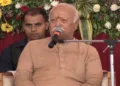
Dr Mohan Bhagwat

RSS Sarsanghchalak Dr. Mohan Bhagwat reiterated the message that all Bharatiya languages are national languages

FacebookTwitterWhatsAppTelegramEmail

New Delhi: Rashtriya Swayamsevak Sangh (RSS) Sarsanghchalak Mohan Bhagwat has said that every Indian citizen should consider having three children in their family, saying that population growth can serve as both an asset and a burden, but a stable birth rate will help keep the population in control while maintaining an acceptable level.

“Our country’s population policy recommends 2.1 children, on average. But when one has children, then they don’t have 0.1 children. In maths, 2.1 is 2, but with the birth of children after 2, it is 3, which is why 2.1 means 3. Every citizen should see that there should be three children in his/her family,” Bhagwat said on Thursday during the centenary celebrations of RSS in New Delhi.

Dr Bhagwat’s comments come amid the government’s preparation for the 2027 census, which will give updated demographic data across the country since 2011, including the birth rate.

However, a recent United Nations Report on the state of the world’s population has warned that India’s birth rate has declined to 1.9, less than the aim of maintaining 2.1.

Also Read: Demographic imbalance is a matter of concern: Dr Bhagwat calls for curb on infiltration and conversion

“This is a vision for the country. Secondly, there is a concern too. Population is an asset, but can be a burden too. We have to feed everyone, which is why the population policy recommends this. In one way, the population is controlled, and on the other hand, it is sufficient; that is why 3 (children) should happen, but after that, it should not increase too much, looking at giving them a good upbringing. This is a thing to be accepted by everyone,” Dr Bhagwat added.
He said that a decreasing birth rate has been happening across communities, including Hindus.

“A decreasing birth rate is happening for everyone. For some time, the birth rate of Hindus has been falling, and it is happening even more. Others did not happen to have such a change, so it is being shown prominently, but theirs is also decreasing. Nature does this often. If resources are less and population is more, then this happens,” he said.

He further urged that the future generations should be prepared for this, while the current generation should help with population control efforts too, adding, “For this, the new generation should be prepared; whoever has it in their hands should also do it now.”

The National Population Policy 2000 is a policy framework which aimed to “achieve a stable population by 2045, at a level consistent with the requirements of sustainable economic growth, social development and environmental protection”.

The policy vigorously promoted small family norms to achieve “replacement levels of Total Fertility Rate (TFR).” The policy aimed to achieve a TFR of 2.1 per cent by 2010, to be reduced from 3.3 in 1997.

According to the 2011 census data, the age-specific fertility rate at the National level for women in the age group 15-49 in five-year age groups declined in 2011 as compared to 2001. The TFR at the National level declined from 2.5 to 2.2 during 2001-11.

According to a recently released United Nations (UN) Report, titled “State of World Population 2025: The real fertility crisis”, India’s population is expected to grow to about 1.7 billion people by 2045 before it starts declining. The report estimates that the TFR has declined to 1.9 this year, falling below the 2.1 target. The report also mentioned India as “the world’s most populous nation” having nearly 1.5 billion people.

However, the 2027 census, which collects demographic, economic, and caste enumeration exercises across the country, will help with updating figures of birth rates, maternal mortality, and population growth, among others. (With inputs from ANI)


 

Topics: Rashtriya Swayamsevak Sangh (RSS) Sarsanghchalak Mohan BhagwatRSSRashtriya Swayamsevak Sangh
ShareTweetSendShareSend
✮ Subscribe Organiser YouTube Channel. ✮
✮ Join Organiser's WhatsApp channel for Nationalist views beyond the news. ✮
Previous News

Bihar electoral revision: 3 lakh individuals served ‘notices over discrepancies’ in voter documents

Next News

Tamil Nadu: Madras HC slams DMK govt, says temple funds not public money; stalls plan to divert them for commercial use

Related News

Historic Sheetalnath: Centre of gravity for RSS in Kashmir

One Nation, Many Paths: The message of RSS Ekatmata Stotra

Amid rising global conflicts and uncertainty, the idea of ‘Swa’ offers Bharat a foundation for self-reliance, resilience, and civilisational confidence

The Geopolitics of Selfhood: Why the idea of ‘Swa’ is emerging as Bharat’s strategic compass in a turbulent world

PM Narendra Modi disguised as a Sardar during 1975 Emergency (This is an AI generated image)

Emergency 1975: How young Narendra Modi worked underground to support families of jailed satyagrahis

Fifty years after the Emergency, India reflects on a defining test of democracy, freedom and citizen resilience

The Emergency at Fifty: Democracy’s darkest hour, India’s finest test

RSS struggle to defend the Constitution during the Emergency

Samvidhan Hatya Diwas: Revisiting RSS’s role in defending India’s Constitution & democratic freedoms during 1975-77

Load More

Latest News

Prime Minister Narendra Modi addressed Seychelles National Assembly

PM Modi addresses Seychelles Parliament; Advocates climate justice, maritime security & Global South prosperity

Cloud Burst in Arunachal Pradesh leads to massive destruction and landslide

Arunachal Pradesh Cloud Burst: BRO restores Kimin–Potin road amid heavy flood crises 

Keralam: CPM reviews collapse in Assembly but avoids leadership accountability

Renaming the Indo-Pacific Command as US Pacific Command: Decoding the strategic calculus of US & stakes for India

From a Mass Leader to a Global Statesman: PM Narendra Modi at the centre of Indian politics for more than a decade

Varanasi to emerge as world’s second vegetarian city, reviving its vedic roots & centuries-old sattvic culinary legacy

PM Modi in Seychelles: Connectivity, climate action to UPI & Indian Ocean security; Bilateral ties gather momentum

Odisha | Snana Yatra: The sacred bathing festival of Mahaprabhu Jagannath & the spiritual prelude to Rath Yatra

Indian-origin student from Telangana found dead in London

Indian student from Telangana found dead in London under mysterious circumstances; Family seeks early repatriation

A representative image

Ashtalakshmi Rising: How India’s Northeast became the engine of connectivity, growth and strategic transformation

Load More
  • Privacy
  • Terms
  • Cookie Policy
  • Refund and Cancellation
  • Delivery and Shipping

© Bharat Prakashan (Delhi) Limited.
Tech-enabled by Ananthapuri Technologies

  • Home
  • Search Organiser
  • Bharat
    • Assam
    • Bihar
    • Chhattisgarh
    • Jharkhand
    • Maharashtra
    • View All States
  • World
    • Asia
    • Africa
    • North America
    • South America
    • Europe
    • Australia
  • Editorial
  • Operation Sindoor
  • Opinion
  • Analysis
  • Defence
  • Culture
  • Sports
  • Business
  • RSS @ 100
  • Entertainment
  • More ..
    • Sci & Tech
    • Vocal4Local
    • Special Report
    • Education
    • Employment
    • Books
    • Interviews
    • Travel
    • Health
    • Politics
    • Law
    • Economy
    • Obituary
  • Subscribe Magazine
  • Read Ecopy
  • Advertise
  • Circulation
  • Careers
  • About Us
  • Contact Us
  • Policies & Terms
    • Privacy Policy
    • Cookie Policy
    • Refund and Cancellation
    • Terms of Use

© Bharat Prakashan (Delhi) Limited.
Tech-enabled by Ananthapuri Technologies