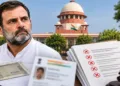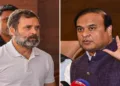
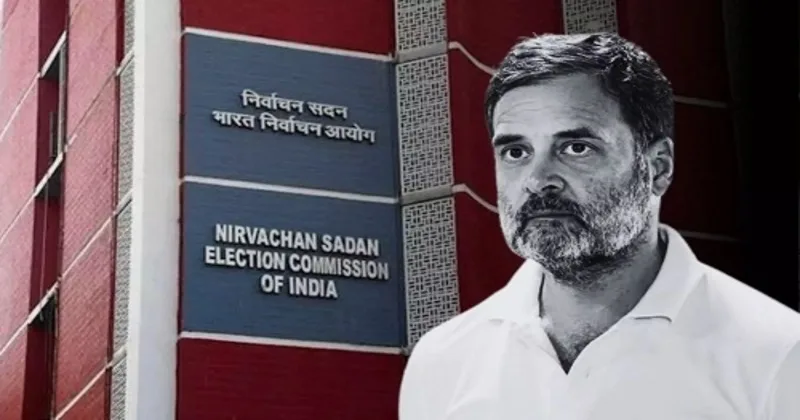
The pattern followed by Rahul Gandhi and a few other opposition leaders in targeting constitutionally established institutions since Narendra Modi assumed power in 2014 raises serious concerns. The Constitution allows the opposition to raise questions and doubts about government policies, laws, and actions, but targeting democratically established institutions with false narratives to create a negative image in people’s minds is a major concern. The question arises: is the attack on various institutions and democratically elected PMs carried out on the orders of deep state global market forces who want to weaken our great nation? The opposition needs to respond. The current issue is election fraud.
The election debate, which was initially sparked by the unhappy I.N.D.I. Alliance’s inability to accept its humiliating defeats in consecutive elections and blaming EVMs, has once again risen to prominence. However, it is now starting a new phase, albeit with the same old rhetoric of electoral fraud, this time dubbed as “stolen elections.” The Congress-led bloc’s proclivity for baseless allegations about EVMs is neither new nor unusual. This is a method that has been proven useless on numerous occasions, but it is still used in the expectation that the Indian people will accept their ridiculous claims and rally behind them.
Doubts about the electoral process began with attacks on EVMs not only during Lok Sabha elections, but also during state assembly elections. The BJP’s triumph in the state assembly elections last year sparked a new surge of claims from Congress and the opposition. Notably, in a manner typical of previous incidents, the dispute developed only after the BJP won. The unchecked broadcast of false information poses a severe threat to the integrity of public policy, social harmony, and the election process in a democracy like India, where the right to free expression is guaranteed by the constitution. In India, the spread of fake news on social media platforms has sparked major worries about its impact on public opinion and political debate.
Surprisingly, they do not target the electoral process or EVMs, where the BJP has lost. If the BJP committed voter fraud, how come they only have 240 Lok Sabha seats in the 2024 election, down from 303 in the 2019 election? West Bengal, Punjab, and southern Indian states are critical for the BJP to win; why are they not winning if they are engaging in vote fraud or EVM manipulation?
How did Congress feed this problem using the false data provided by CSDS’s Sanjay Kumar?
The dispute began on August 18th, when Congress spokesperson Pawan Khera posted a graphic on X claiming huge anomalies in the 2024 Lok Sabha and Maharashtra Assembly electoral registers. However, on August 19th, within 48 hours of posting on social networking platform X, Sanjay Kumar offered a public apology. He admitted that the data were incorrect. He claimed that his “data team misread rows” when comparing datasets. He also stated that the initial message was deleted and that there was “no intent to spread misinformation”. However, the harm had already been done, with erroneous figures spreading extensively and remaining in political forwards and social media posts. Using Lokniti-CSDS data, he stated that the Ramtek and Deolali constituencies lost over 40% of their electorate in six months. Nashik West and Hingna, on the other hand, grew by almost 45%. He insulted ECI by writing, “Next, they will announce that 2 plus 2 equals 420.” The figures were first pushed by Sanjay Kumar.
On August 19, the Indian Council of Social Science Research (ICSSR), a body under the Ministry of Education that sponsors the Centre for the Study of Developing Societies (CSDS), publicly condemned the phony data scandal involving CSDS’s Sanjay Kumar. In a statement, the ICSSR stated that Kumar’s fraudulent assertions on Maharashtra’s electoral records and subsequent amplification against the Election Commission of India (ECI) constituted a “gross violation of the Grant-in-Aid rules”. The council announced that CSDS would be given a show cause notice for its actions.
Is it necessary to pass legislation to prohibit the dissemination of fake news in order to protect against the intent of damaging democracy and the nation?
In India, which has the world’s largest number of social media users, the ramifications of this unrestrained flood of misleading information are particularly concerning. Fake news has been linked to swaying public opinion, polarizing communities, and even inciting violence, particularly during politically heated events such as elections. India’s democratic structure is based on the ideas of free speech and open discourse, but the unchecked spread of fake news threatens to erode these very foundations. False narratives frequently exploit societal divides, distort political discourse, and undermine trust in institutions. Whether it’s false claims about political candidates, rumors that exacerbate communal tensions, or faked information during a crisis, the influence of fake news on India’s democratic processes is evident and complex.
Fake news is defined as false or misleading information that is purposely created and distributed in order to mislead or affect the general audience. It typically spreads through the media, particularly social media platforms, and may seem as false headlines, misinterpreted facts, or fabricated stories.
how can India strike a balance between the growing worries about the detrimental effects of false news on society and the necessity to protect freedom of speech, which is a vital constitutional right? There is tremendous pressure on the government, social media firms, and civil society to address this issue, yet their strategies frequently diverge. Fake news has a significant impact on social media because it spreads quickly and readily due to its viral nature and ease of sharing, making it more difficult for individuals to distinguish between fact and fiction. Because of India’s rich and complex social milieu, the negative impacts of false news are significantly more visible and troubling for the health of its democracy. The negative repercussions include division and polarization, deterioration of public health and safety, manipulation of voter behavior, instigating violence and social unrest, weakening journalism’s credibility, and decreasing faith in democratic institutions.
Why is Special Intensive Revision (SIR) required in all states?
The SIR initiative is really intended at reducing false voters and facilitating voting for legitimate citizens, hence boosting the democratic process. More crucially, the constitutional body raised the issue, as did research papers from prestigious IIM institutes, which found that Bihar and West Bengal have a high percentage of bogus voters. The campaign also highlighted the presence of unlawful foreign immigrants, notably Bangladeshis, with Indian credentials such as Aadhar cards.
These types of techniques to tarnish democratically established institutions should be sternly dealt with by the government and the Supreme Court of India, as they undermine the ordinary man’s faith in democracy and constitutional bodies. Citizens of our great nation should reject such false narratives on all platforms, using constitutional means, to protect this wonderful nation from being broken up by anti-India forces.