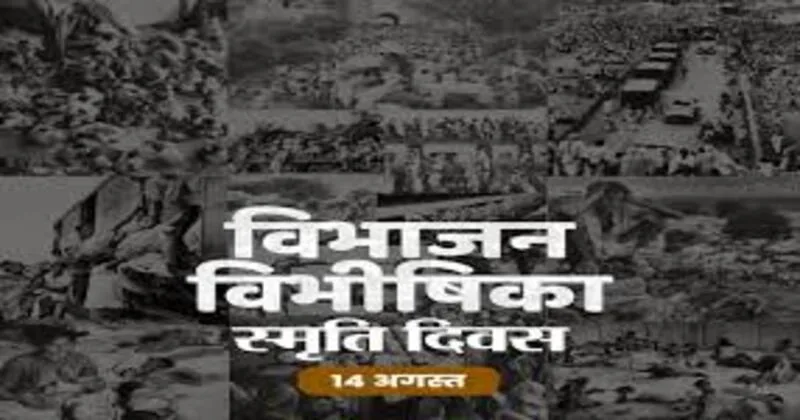
August 14th is commemorated as Vibhajan Vibhishika Diwas
June 13, 2026
  • Read Ecopy
  • Circulation
  • Advertise
  • Careers
  • About Us
  • Contact Us
Android AppiPhone AppArattai
Organiser
  • ‌
  • Bharat
    • Assam
    • Bihar
    • Chhattisgarh
    • Jharkhand
    • Maharashtra
    • View All States
  • World
    • Asia
    • Europe
    • North America
    • South America
    • Africa
    • Australia
  • Editorial
  • International
  • Opinion
  • RSS @ 100
  • More
    • Op Sindoor
    • Analysis
    • Sports
    • Defence
    • Politics
    • Business
    • Economy
    • Culture
    • Special Report
    • Sci & Tech
    • Entertainment
    • G20
    • Azadi Ka Amrit Mahotsav
    • Vocal4Local
    • Web Stories
    • Education
    • Employment
    • Books
    • Interviews
    • Travel
    • Law
    • Health
    • Obituary
  • Subscribe
    • Subscribe Print Edition
    • Subscribe Ecopy
    • Read Ecopy
  • ‌
  • Bharat
    • Assam
    • Bihar
    • Chhattisgarh
    • Jharkhand
    • Maharashtra
    • View All States
  • World
    • Asia
    • Europe
    • North America
    • South America
    • Africa
    • Australia
  • Editorial
  • International
  • Opinion
  • RSS @ 100
  • More
    • Op Sindoor
    • Analysis
    • Sports
    • Defence
    • Politics
    • Business
    • Economy
    • Culture
    • Special Report
    • Sci & Tech
    • Entertainment
    • G20
    • Azadi Ka Amrit Mahotsav
    • Vocal4Local
    • Web Stories
    • Education
    • Employment
    • Books
    • Interviews
    • Travel
    • Law
    • Health
    • Obituary
  • Subscribe
    • Subscribe Print Edition
    • Subscribe Ecopy
    • Read Ecopy
Organiser
  • Home
  • Bharat
  • World
  • Operation Sindoor
  • Editorial
  • Analysis
  • Opinion
  • Culture
  • Defence
  • International Edition
  • RSS @ 100
  • Magazine
  • Read Ecopy
Home International Edition Asia South Asia

Vibhajan Vibhishika Day: Division of Resources of British Indian Army at the time of partition

One aspect of Partition which is less known pertains to the division of British Indian Army at the time of Partition. The British Indian Army was divided between India and Pakistan based on the principle of religious majority. Most Hindu and Sikh personnel of the Army came to India while most of the Muslim troops went to Pakistan

Lt Gen (Retd) MK DasLt Gen (Retd) MK Das
Aug 14, 2025, 10:20 pm IST
in South Asia, Bharat
Follow on Google News
August 14th is commemorated as Vibhajan Vibhishika Smriti Diwas

August 14th is commemorated as Vibhajan Vibhishika Smriti Diwas

FacebookTwitterWhatsAppTelegramEmail

One aspect of Partition which is less known pertains to the division of British Indian Army at the time of Partition. The British Indian Army was divided between India and Pakistan based on the principle of religious majority. Most Hindu and Sikh personnel of the Army came to India while most of the Muslim troops went to Pakistan. This division was overseen by Field Marshal Claude Auchinleck, Commander-in-Chief India then and later Supreme Commander of all British forces in India and Pakistan until late 1948.

At the end of World War II in 1945, the Indian Army had become the largest volunteer army in history, with a strength of 25 lakh personnel in August 1945. A bulk of this Army fought for the British in three continents in Africa, Europe and Asia. The largest strength of the Indian Army fought against the Japanese till their defeat in Burma. Field Marshal Auchinleck said that the “British could not have come through both the World Wars if they hadn’t had the Indian Army.” But the British knew that their days are numbered in India and thus disbanded most of the soldiers in the period 1945-1947.

At the time of Partition, British Indian Army numbered approximately 4.0 lakh personnel. Most of the Army consisted of Infantry regiments but also had elements of Cavalry, Artillery and logistic elements. The basic principle of division was agreed upon a division on 60:40 ratio between India and Pakistan. India received 2.60 lakh troops and Pakistan got 1.40 lakh troops. The weapons, ammunition and other military hardware were similarly divided. Some believe that this division should have been in the ratio of 70:30 considering the size of India. The near parity in both the armies after Independence emboldened Pakistan to launch an offensive into Kashmir in October 1947.

The first two chiefs of the Indian Army were British officers till General KM Cariappa became the first Indian Commander-in-Chief on 15 January 1949. The first three chiefs of the Indian Air Force were   also British officers till Air Marshal Subroto Mukherjee became Chief of Air Staff on 1 April 1954. Indian Navy had to wait till 22 April 1958 to have its first Indian chief in Vice Admiral Ram Dass Katari. Such delays indicate that the Indian government of that era could not ensure faster integration of own officer leadership. The British hangover on the Indian armed forces has continued for decades where we followed the British customs and traditions. PM Modi urged the Indian armed forces to shed colonial traditions and imbibe Indian customs. Today, Indian armed forces are following the Indian customs and traditions, which reflect pride in our warrior history.

Also Read: India warns Pakistan of ‘Painful consequences’ over repeated war threats and anti-India rhetoric

During the Partition of India in 1947, the Indian Army played a crucial role in maintaining law & order amidst challenging communal violence. Indian Army was tasked to assist the civil administration, which itself was finding its feet. Surmounting numerous challenges of controlling widespread riots, protect refugees and manage movement of people between two newly formed nations, Indian Army troops did a most commendable job. But for their intervention, the death toll during the Partition would have been much higher. A dedicated force called ‘Punjab Boundary Force’ was created to manage the violence in the Punjab region, which saw maximum violence during the Partition. Even with limited resources and under a complex political situation, Indian Army won the hearts & minds of the people with their professional conduct.

It is interesting to note how both the armies have conducted themselves after gaining independence. Indian Army has continued to remain apolitical and has served the country with utmost professionalism under civilian government of the day. Pakistan, on the other hand had the first experience of Martial Law in 1958. Since then, Pakistan has been under Martial Law for almost half the period of its existence as an independent nation. Even when not under Martial Law, Pakistan Army Chief is de facto ruler of the nation with a puppet Prime Minister and a sham democracy. This is amply clear from the role of General Asim Munir when he is representing Pakistan in talks with the US, China and other nations. The latest nuclear sabre rattling by General Munir from the American soil reflects how unprofessional and irresponsible Pakistan Army leadership has become over the years.

It is alarming to note that most of the Pakistani officers and soldiers are highly radicalized now. This process of radicalization of Pakistan armed forces commenced from late 1970s under the regime of General Zia-ul-Haq who was the Army Chief and later President in the period from 1976-1984. Successive Pak Army chiefs have encouraged this sort of Islamist mindset among the officers and soldiers of the Pakistani Army. Unlike Indian armed forces which fights to defend the nation, Pakistan forces fight for the cause of Islam. It is not surprising that the utterances of General Munir many times sound like that of a religious fanatic obsessed with Islamist radicalization. The world at large has to understand the dangers of such religious extremism emanating from Pakistan. In times to come, we may find many such mercenaries from Pakistan operating with terrorist organizations in different parts of the world.

During Operation Sindoor, Indian armed forces once again proved to be most professional in their conduct. Even when PM Modi gave them full operational freedom, the forces responded in a calibrated and in a non-escalatory mode, taking care not to target the civilian population of Pakistan. Pakistani Army on the other hand targeted our civilian population near the LOC. The civilizational superiority of the Indian armed forces is clearly evident. The Partition of undivided India remains etched in the memory of Indian Army. Newly formed Indian Army rose to the occasion then to control violence and thereafter defeated Pakistani Army in the first war in Kashmir in 1947-48. Thereafter, Pakistan has suffered humiliating defeat from India in every war and conflict till Operation Sindoor. As a former soldier, I am proud of the Indian Armed Forces. Happy Independence Day. Jai Bharat!

Topics: Vibhajan Vibhishika DiwasPakistanIndiaIndian ArmyPartition
ShareTweetSendShareSend
✮ Subscribe Organiser YouTube Channel. ✮
✮ Join Organiser's WhatsApp channel for Nationalist views beyond the news. ✮
Previous News

Patriotism should be a way of life rooted in responsibility, unity and action

Next News

Bhubaneswar Marks Partition Horrors Remembrance Day: Without learning from history, we cannot move ahead

Related News

(Left) Russian President Vladimir Putin (Right) Prime Minister Narendra Modi (Image Credit: ANI)

Russia Day 2026: The ancient civilisational bond between India and Moscow

Radical Islamists forced to stop the construction of Bhagwan Ram idol in Bangladesh

Bangladesh: Construction of Bhagwan Ram murti halted amid threats by Islamists; Reflects spiking anti-Hindu hostility

French President Emmanuel Macron and Prime Minister Narendra Modi(File Photo)

India-France Rafale Deal: Paris backs Make-in-India; Assures tech transfer & weapon integration ahead of PM Modi visit

Russian President Vladimir Putin and Prime Minister Narendra Modi(File Photo)

Russia Day: From Buddha Dhamma to BrahMos, Why India-Russia Friendship Has Endured Every Geopolitical Storm

Surendran Bojji, All India Organising Secretary of the Bharatiya Mazdoor Sangh(BMS) speaking at Geneva

India’s new labour codes impart security & social protection: BMS Secretary Surendran Bojji at Int Labour Conference

US: Anshul Kuncha’s death exposes anti-India racist racket; Assaulting the community that powers American economy!

Load More

Latest News

(Left) Russian President Vladimir Putin (Right) Prime Minister Narendra Modi (Image Credit: ANI)

Russia Day 2026: The ancient civilisational bond between India and Moscow

After the conclusion of the 11th Governing Body meeting of NITI Aayog, the Chief Minister of Tamil Nadu, Joseph Vijay, met Prime Minister Narendra Modi in Delhi

Tamil Nadu: At first NITI Aayog meet, CM Joseph Vijay charts cooperative course with Modi govt unlike DMK

Keralam ex- CM Pinarayi Viajayan and his daughter Veena Vijayan

Keralam: Former CM Pinarayi Vijayan’s daughter Veena Vijayan gets fresh ED summons in Rs 2.78 crore CMRL case

Radical Islamists forced to stop the construction of Bhagwan Ram idol in Bangladesh

Bangladesh: Construction of Bhagwan Ram murti halted amid threats by Islamists; Reflects spiking anti-Hindu hostility

Subash Chander of Bajrang Dal Telangana

Telangana Shocker: VHP demands strict punishment for Md Ghouse in Khammam 12-year-old girl sexual assault case

Rare Rashtrakuta-Era inscription unearthed in Karnataka

Karnataka: Rare Rashtrakuta-Era inscription unearthed, reveals extraordinary bond between king and servant

RBI revokes registration of 135 NBFCs over regulatory violations; 125 financial entities were from West Bengal

Prime Minister Narendra Modi

Even the US bows to PM Modi’s long-standing leadership!

A representative image

A Decade of Revolution: 25 crore out of poverty, 15.8 crore homes with tap water – How Govt schemes changed lives

India–Myanmar Civilisational Connect: Significance of President U Min Aung Hlaing’s visit to India

Load More
  • Privacy
  • Terms
  • Cookie Policy
  • Refund and Cancellation
  • Delivery and Shipping

© Bharat Prakashan (Delhi) Limited.
Tech-enabled by Ananthapuri Technologies

  • Home
  • Search Organiser
  • Bharat
    • Assam
    • Bihar
    • Chhattisgarh
    • Jharkhand
    • Maharashtra
    • View All States
  • World
    • Asia
    • Africa
    • North America
    • South America
    • Europe
    • Australia
  • Editorial
  • Operation Sindoor
  • Opinion
  • Analysis
  • Defence
  • Culture
  • Sports
  • Business
  • RSS @ 100
  • Entertainment
  • More ..
    • Sci & Tech
    • Vocal4Local
    • Special Report
    • Education
    • Employment
    • Books
    • Interviews
    • Travel
    • Health
    • Politics
    • Law
    • Economy
    • Obituary
  • Subscribe Magazine
  • Read Ecopy
  • Advertise
  • Circulation
  • Careers
  • About Us
  • Contact Us
  • Policies & Terms
    • Privacy Policy
    • Cookie Policy
    • Refund and Cancellation
    • Terms of Use

© Bharat Prakashan (Delhi) Limited.
Tech-enabled by Ananthapuri Technologies