




“I have been asked for a message on this great occasion, [August 15, 1947] but I am perhaps hardly in a position to give one. All I can do is to make a personal declaration of the aims and ideals conceived in my childhood and youth and now watched in their beginning of fulfilment, because they are relevant to the freedom of India, since they are part of what I believe to be India’s future work, something in which she cannot but take a leading position. For I have always held and said that India was arising, not to serve her own material interests only, to achieve expansion, greatness, power and prosperity,—though these too she must not neglect,— and certainly not like others to acquire domination of other peoples, but to live also for God and the world as a helper and leader of the whole human race”. – Sri Aurobindo, the Fifteenth of August 1947 Message, Complete Works of Sri Aurobindo, Vol. 36, pp. 474-475
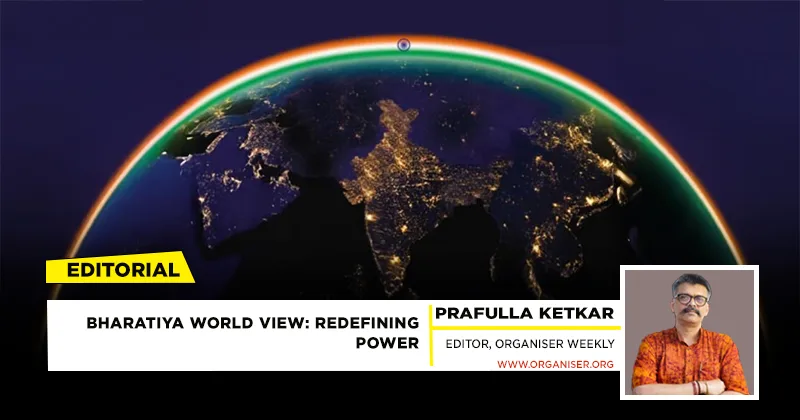
The world is in turmoil. All the promises of ‘free’ and ‘democratic’ liberal world order are proving to be elusive. The unruly world order monopolised by the United States and based on military might and economic exploitation is crumbling down. International institutional decay, global conflicts and tariff wars have become normal. While celebrating the seventy-ninth Independence Day, we should churn over the role of Bharat in the global scenario.
After the inhuman destruction during the World Wars, there was an imminent decline of European supremacy, and what emerged was the world, defined broadly as the liberal world order. The emergence of the United States of America was seen as a positive event for democracy and a peaceful world. The United Nations, World Bank and International Monetary Fund became the carriers of American values and systems across the world. Though the competitive and conflictual ideological positioning during the Cold War remained as a new form of instability, American strategists justified it in terms of the balance of power – another theoretical construct to ensure peace. After the end of the Cold War, it was assumed that the liberal world order had triumphed forever, leading to the spread of democracy, stability and peace across the world.
What we are experiencing today is drastically different from the strategic presumptions. The American unipolar world is in decline and challenged at multiple levels. The international institutions, from the United Nations to the World Trade Organisation, are proving to be irrelevant and inefficient in managing the relationships between different nations across the continents. We are witnessing trade wars, unnecessary tariffs, sanctions, and regime change operations. America of Washington and Lincoln is known for exceptionalism based on democratic and constitutional values. After seeing the America that hosts unconstitutional authority like Asif Munir, the mind perplexes with a question whether it is the same United States that claims to be the protector of human rights and democracy. The emerging option is also not very encouraging for global peace. China is emerging as a major challenger to the existing system, with a debt trap, and lacks credible options for stable institutions. Russia-Ukraine War, Israel-Hamas War and Israel-Iran conflicts are the symptoms of this crumbling international order – the clear sign of this crumbling world – which was never orderly.
The oil and gas continue to remain a point of contention in global tensions. Defence manufacturing and supply chain have been encouraging conflicts. Trade wars and tariffs are new tools of interference and undermining sovereignty. Islamic radicalism has emerged as a challenge to democratic values and systems. Artificial Intelligence, data monopolisation and space technology have emerged as the new frontiers. These are just a continuation of the experimentations done for over two millennia in the name of religion, science, industrialisation and development. Since the emergence of Abrahamic religions, happiness and peace were ensured through material progress and at each stage, it turned out to be a mirage. Bharat is the only exception that has survived the onslaught of all aggressions, colonisations and exploitations. The freedom struggle based on the ideals of Swadharma, Swadeshi and Swaraj proved to be a unique battle to reclaim and restore the true legacy. Unfortunately, the elite of Independent Bharat lost their resilience and succumbed to the binary of capitalism and communism, although the common masses continue to cherish the cultural heritage and are expected to preserve the Dharmic traditions while adopting the modern structures of democracy.
In the last few decades, the spirit of cultural resurgence has engulfed the Bharatiya mind. The desire to galvanise the internal strength and intent to contribute to realising the national destiny is visible among the masses. Actions like Surgical Strikes, Operation Sindoor, and continuous assertion to ensure strategic autonomy through prudent foreign policy options are a symbol of the same national consciousness. The forces in favour of the status quo, driven by vested interests, continue to bully the world based on economic and military might. The new assertive Bharat is a bête noire for them. They are using all the neo-colonial machinations to suppress this instinct. Unfortunately, some players within Bharat, for short-term political interests, are acting as agents of neo-colonisers. How should Bharat respond to these internal manipulations and external pressures amidst the global turmoil?
The challenge of global uncertainties based on the realist paradigm of might is right is not new. Bharat has the potential and destined role to provide the righteous alternative based on the values of Vasudhaiva Kutumbakam – the familial globalisation. All proposed globalisations – whether American market globalisation, Islamic religious globalisation or ideology-driven Communist globalisation – are nothing but the forms of colonisation imposing a one-size-fits-all approach across the world. The Bharatiya world view, a perspective that values diversity and interconnectedness, on the contrary, accepts the uniqueness of each culture and allows everyone to have their own models of development while remaining interconnected to the universal values of oneness. Realising inherent unity, while celebrating apparent diversity, is the unique message of Bharat to the world, which should be reflected in the universal systems. All victims of Western colonisation, rooted in the realist paradigm, are looking at Bharat as the oldest living civilisation on the planet to provide solutions to the recurring challenges of economic uncertainties, military conflicts, technological monopolies and environmental degradation.
To come up with the alternative global system based on Bharatiya values, we need to rekindle the spirit of our freedom struggle based on Swadharma, Swadeshi and Swaraj. Instead of being a preacher, we should practice and present a model that is sustainable and inclusive. The current principles of realism cannot be overlooked and immediately replaced. Hence, we will have to face the competition and conflicts based on the current parameters for which we need to be economically prosperous, technologically advanced and militarily self-sufficient. All of us should be clear about the shared heritage and destiny of Bharat. Incarnating the spiritual knowledge to the world, while sustaining the material prosperity, is the destiny of Bharat, as Yogis like Swami Vivekananda and Sri Aurobindo envisaged. That destined role has to be internalised by each individual, institution and organisation of Bharat. Every crisis provides an opportunity. The current phase of institutional decay, global conflicts, and tariff war provides an opportunity to rethink the power dynamics from a realist to a righteous one on the Bharatiya principles of Vasudhaiva Kutumbakam. Contribute to realising this destined role of Bharat for sustainable global peace and prosperity should be our Independence Day resolve.










Comments