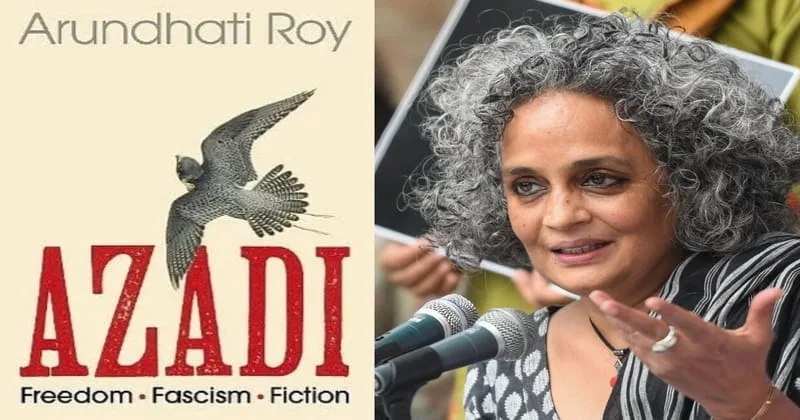
The J&K Home Department, under the Lt. Governor’s administration, has banned 25 books, including one by communist author Arundhati Roy, citing the promotion of false narratives and secessionist content in the Union Territory. The government has ordered the forfeiture of all copies under Section 98 of the Bharatiya Nyaya Sanhita (BNS) to prevent their circulation.
According to the Home Secretary, the ban follows an investigation supported by credible intelligence, revealing a “systemic dissemination of false narratives and secessionist literature” disguised as historical or political analysis. The department’s order stated that the banned books were found to incite secessionism and pose a threat to India’s sovereignty and integrity, thus invoking Sections 152, 196, and 197 of the Bharatiya Nyaya Sanhita, 2023.
The J&K Home Department has found evidence indicating that the circulation of banned literature played a key role in radicalising local youth and encouraging them to join terrorist activities.
According to the department’s order, investigations and credible intelligence confirm that the systematic spread of false narratives and secessionist content—often disguised as historical or political commentary—has been a major factor in inciting violence and glorifying terrorism. “The available evidence clearly shows that such literature has significantly contributed to youth participation in terrorism by misguiding them and promoting hostility against the Indian State,” the order stated.
In its order, the J&K Home Department emphasised the role of certain literature in the radicalisation of local youth. “These publications have contributed to the radicalisation of young minds through various means, including the distortion of historical facts, glorification of terrorists, vilification of security forces, religious extremism, promotion of alienation, and incitement to violence and terrorism,” the order noted.
Banned titles include works by Leftist, Fundamentalist, and Foreign Authors
The list of 25 banned books features works by leftist thinkers, Islamic fundamentalists, and several foreign authors. Among them are Azadi by Arundhati Roy, The Kashmir Dispute, 1947–2012 by A.G. Noorani, Kashmir at the Crossroads and Contested Lands by Sumantra Bose, In Search of a Future: The Kashmir Story by David Devadas, and A Dismantled State: The Untold Story of Kashmir after Article 370 by journalist Anuradha Bhasin.
Several foreign publications have also been banned, including Hafsa Kanjwal’s Closing Kashmir, Haley Duschinsky’s Resisting Occupation in Kashmir, Victoria Schofield’s Kashmir in Conflict, Stephen P. Cohen’s Confronting Terrorism, and Christopher Snedden’s Independent Kashmir.
Some books authored by Islamic fundamentalists have also been included in the list of banned titles. These include Al Jihad Fil Islam by Maulana Abul Ala Maududi and Mujahid ki Azan by Hassan al-Banna. Other banned publications are Law and Conflict in Kashmir by Piotr Balcerowicz and Agnieszka Kuszewska, USA and Kashmir by Dr. Shamshad Shan, and Tarikh-e-Siasat Kashmir by Dr. Afaq.
UAPA case against Arundhati Roy for Anti-India remarks
Prominent among the banned authors is Arundhati Roy, who is already facing prosecution under the Unlawful Activities (Prevention) Act (UAPA). In June 2024, Delhi Lieutenant Governor VK Saxena approved legal action against her under the UAPA for a controversial speech delivered at a conference titled Azadi – The Only Way, held at LTG Auditorium in Delhi on October 21, 2010.
According to the complaint, Roy stated during the event that J&K was never a part of India and had been forcibly occupied by Indian armed forces. She also reportedly called for “every possible effort” to secure J&K’s independence from India. A recording of her remarks was submitted as evidence, following which an FIR was registered on the order of the Metropolitan Magistrate in Delhi. Earlier, in October 2023, VK Saxena had granted approval for her prosecution under other legal provisions.
Arundhati Roy’s secessionist views extend well beyond J&K, with her rhetoric often targeting the very foundation of the Indian Union. During a 2011 lecture at the University of Westminster’s School of Social Sciences, Humanities and Languages in the UK, Roy alleged that post-independence India merely continued British colonial practices. She claimed that the Indian Armed Forces were committing atrocities across the country and that tribal communities, religious minorities, and other special groups were engaged in a struggle against the Indian state.
Roy went further to falsely assert that after 1947, India had “colonised” several regions—including J&K, Telangana, Hyderabad, Punjab, Mizoram, Manipur, Nagaland, and Goa—suggesting that these states were still fighting for their independence. She controversially equated the Indian Army with the Pakistani Army, claiming the Indian forces were more brutal. Additionally, she described India as an “Upper Caste Hindu Nation” and claimed the country had been in a constant state of war since independence.
Roy equates Indian Army with Pakistan, Bangladesh forces
Author Arundhati Roy has repeatedly drawn controversial comparisons between the Indian Army and the militaries of Pakistan and Bangladesh.
In an apparent attempt to appear balanced, Roy stated, “Whatever the Pakistan Army is doing in Balochistan or the genocide it committed in Bangladesh, my opinion on this has never been ambiguous. I’ve written extensively about it. Hindu nationalists are just resurfacing old video clips to create outrage.” Notably, Roy later issued an apology for her remarks regarding the Pakistan Army.
Despite her clarification, Roy maintained that she sees no moral difference between the armed forces of India, Pakistan, and Bangladesh. “Anyone who’s read my work knows I don’t believe in these distortions. Morally, none of the three countries is superior to the others,” she said. She went on to claim that a “fascist atmosphere” is growing in India, where dissenting voices risk being “defamed, jailed, trolled, or assaulted.”
Roy and other leftist figures have long faced criticism for promoting anti-India narratives, particularly on the Kashmir issue. Through provocative statements and publications, they once drew applause in intellectual circles for questioning the unity and sovereignty of India. Their books were celebrated and awarded. However, critics argue that times have changed, and public sentiment no longer supports separatist ideologies or those who advocate them.