
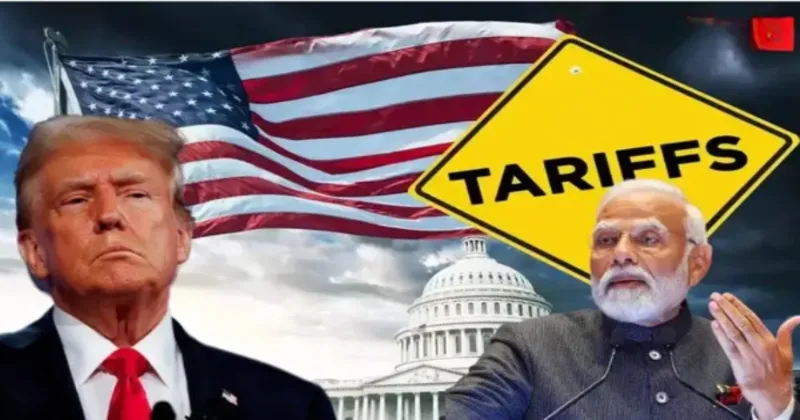
US President Donald Trump’s recent announcement to impose a 50 per cent tariff on imports from India has stirred sharp responses and fresh scrutiny. At first glance, the move appears to be part of his long-standing protectionist agenda. However, a closer analysis reveals a deeper, more politically motivated play—one that seeks to deflect attention from internal weaknesses and the shifting tides of global influence.
Trump, well-known for his aggressive economic nationalism under the banner of “America First,” is now attempting to rebrand this strategy under a newly charged political campaign. His justification? India’s continued import of Russian crude oil. But this rationale crumbles when subjected to factual analysis.
The Bogus Russia Excuse
Trump’s singling out of India for energy trade with Russia lacks coherence. If Russian crude imports were truly the trigger, why hasn’t the same standard been applied to other countries with far larger trade volumes with Russia?
Turkey, a NATO ally, imported nearly $44 billion worth of Russian goods, including oil and gas. The European Union, the US’s closest strategic partner, imported $33 billion worth, primarily in natural gas. Even China, the world’s largest importer of Russian crude, enjoys a 90-day exemption from Trump’s tariff threat. Ironically, the United States itself continues to trade with Russia, purchasing over $3.3 billion worth of goods like fertilizers and uranium.
Clearly, the issue is not about energy imports. It is about optics and selective enforcement. India becomes an easy, high-profile target that serves Trump’s political narrative.
Political Grandstanding Disguised as Policy
The tariff decision reflects more of a campaign tactic than a coherent foreign policy decision. Facing domestic criticism over economic instability and social divides, Trump is reverting to his old playbook—blame foreign countries for America’s woes. During his previous term, he employed similar tactics against China, Mexico, and the European Union. India is merely the latest entrant in this list, and the timing of the announcement—just ahead of crucial electoral milestones—underscores its political utility.
Moreover, by framing India’s actions as a threat to American industry, Trump seeks to energise his base with a false sense of victimhood. The narrative being constructed is not one of geopolitical strategy but of electoral mobilisation.
Misreading India’s Strategic Autonomy
Trump’s criticism also betrays a deep misunderstanding of India’s strategic posture. India’s decision to continue purchasing Russian crude is rooted in energy security and sovereign decision-making, not ideological alignment. As a sovereign nation navigating a complex geopolitical landscape, India has consistently pursued a policy of strategic autonomy—engaging with all major powers without aligning rigidly with any bloc.
India’s partnership with the US has grown significantly over the past two decades, from defence collaboration to technology transfers and shared democratic values. Yet, India remains firmly non-aligned when it comes to third-party conflicts like the Russia-Ukraine war. Trump’s attempt to penalise India for pursuing its national interest reveals either ignorance or willful disregard of this principle.
Weaponising Trade Against Partners
By threatening tariffs on India, Trump is not just straining bilateral ties—he is undermining the very foundations of global cooperation. In the Indo-Pacific, India is seen as a crucial counterbalance to Chinese aggression. Economically, India is a rising power, projected to become the third-largest economy by the end of this decade. Penalising India could push it closer to other power blocs, weakening America’s long-term strategic interests.
Furthermore, this move sends a troubling message to other global partners: cooperation with the US is conditional, unpredictable, and vulnerable to domestic politics. For allies and partners, this erodes trust in American leadership.
India’s Measured Response
India, for its part, has responded with restraint. Prime Minister Narendra Modi’s statement reiterated India’s commitment to mutually respectful and reciprocal relations. India has not engaged in retaliatory rhetoric, instead opting to keep diplomatic channels open. This dignified approach reflects India’s confidence in its global standing and its commitment to multilateral engagement.
India is also likely to use this moment to further diversify its export base, reduce dependency on the US market, and strengthen regional and multilateral trade partnerships. From ASEAN to Africa, and from the Middle East to Latin America, India has already begun expanding its trade architecture.
A Test of Strategic Patience
Trump’s 50 per cent tariff threat is not just an economic measure—it is a political stunt wrapped in nationalist rhetoric. It reveals his insecurity about declining American influence and his need to project strength by scapegoating others. But such tactics may backfire. India, with its growing economic and geopolitical clout, is not a country that can be bullied or browbeaten.
In the larger picture, this episode is a reminder that international diplomacy cannot be governed by domestic populism. The future of India-US relations depends not on electoral cycles, but on mutual respect, shared interests, and strategic trust. And in that test, India has shown maturity, while Trump has once again chosen the path of short-term spectacle over long-term statesmanship.