






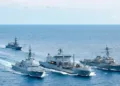
The Indian Navy has conducted a landmark joint military exercise with the Philippines in the contested waters of the South China Sea, marking the first strategic manoeuvre of its kind directly under China’s watchful eye. The exercise was held in a region where the Philippines has an ongoing maritime border dispute with China.
The joint naval drill, which began on Sunday, concluded on Monday evening. India’s warship INS Shakti took part in the exercise, reflecting deepening defence ties between New Delhi and Manila.
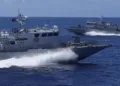
Philippine Navy Chief General Romeo Brawner described the exercise as a significant step forward and stated that the Philippines intends to collaborate more closely with the Indian Navy in the future. According to reports, China deployed two of its naval warships to monitor the exercises, maintaining a distance of about 25 nautical miles (46 kilometres) from the operational area.
Indian Navy ships INS Delhi, Shakti, Kiltan in Manila, Philippines; to hold joint exercises with Philippines counterparts pic.twitter.com/EhoNtCUEbm
— Sidhant Sibal (@sidhant) August 4, 2025
General Brawner emphasized that the presence of the Indian warship was more than symbolic, it was a clear and powerful message of solidarity between two democracies committed to upholding a free and open Indo-Pacific.
China’s Southern Theatre Command claimed its warships were merely on routine patrols, but their close monitoring of the India-Philippines exercise made it clear that Beijing was actively watching the joint drill unfold. Despite maintaining a distance, China’s deployment of naval assets in the area exposed its growing unease over the strengthening of democratic partnerships in the Indo-Pacific. In a thinly veiled warning, clearly aimed at India, China cautioned that the involvement of “external forces” in disputed waters could threaten regional peace, revealing its discomfort with any challenge to its aggressive and unilateral claims over the South China Sea.
The Chinese Foreign Ministry further remarked that border disputes in the region should be resolved only by the countries directly involved, arguing that third-party military involvement was “inappropriate.”
The South China Sea remains one of the world’s most contested and strategically vital maritime corridors. While China claims near-total sovereignty over the area, its claim is disputed by several Southeast Asian nations including the Philippines, Vietnam, Malaysia, Brunei, and Taiwan.
The joint military exercise marks a pivotal moment in the deepening strategic partnership between India and the Philippines, unfolding against the backdrop of rising tensions in the Indo-Pacific. In 2024, India delivered the first batch of BrahMos supersonic cruise missiles to Manila, a fulfilment of the $375-million agreement signed in January 2022. As the first nation to procure the shore-based, anti-ship variant of the Indo-Russian missile system, the Philippines has emerged as a key defence partner in the region.
The recent dispatch of the second batch of BrahMos missiles in 2025 underscores more than just a growing arms trade, it signals India’s assertive entry into the global defence market and its resolve to counterbalance coercive power plays in Asia. By aligning with like-minded democracies and investing in regional security, India is not only expanding its strategic footprint but also reinforcing a rules-based order in a region increasingly threatened by unilateralism and aggression.














Comments