In today’s hyper-connected world, warfare is no longer confined to the battlefield. It now unfolds across digital domains — in newsrooms, on social media platforms, and within global opinion forums. While nations arm themselves with missiles and drones, the parallel war of narratives has emerged as equally decisive.
Biased Narrative to Marginalise Bharat
But what happens when this narrative battlefield is structurally skewed? When the global information order is governed not by veracity but by strategic interests? For Bharat — a civilisational state navigating a volatile multipolar world — this asymmetry is not merely unjust, it is perilous. Recent international developments reveal how biased narratives not only marginalise India’s security imperatives but also distort its global image.
Bharat & Israel Share Similar Security Woes
Consider the recent G7 summit held in Canada. The leaders of the world’s most influential democracies reiterated “Israel’s right to self-defence against Iran as a sponsor of terrorism.” While this reflects a broader geopolitical consensus, it simultaneously reveals the convenient morality practised by global powers. India, too, has consistently upheld Israel’s sovereign right to self-defence — what it opposes is the selective and inconsistent invocation of that right. Indeed, India and Israel share strikingly similar security predicaments: both are surrounded by adversarial neighbours, threatened by asymmetric warfare, and subjected to ideological isolation. At the same summit, Prime Minister Narendra Modi succinctly remarked: “There is no place for double standards on terrorism.”
Trump’s Hypocrisy In Evidence
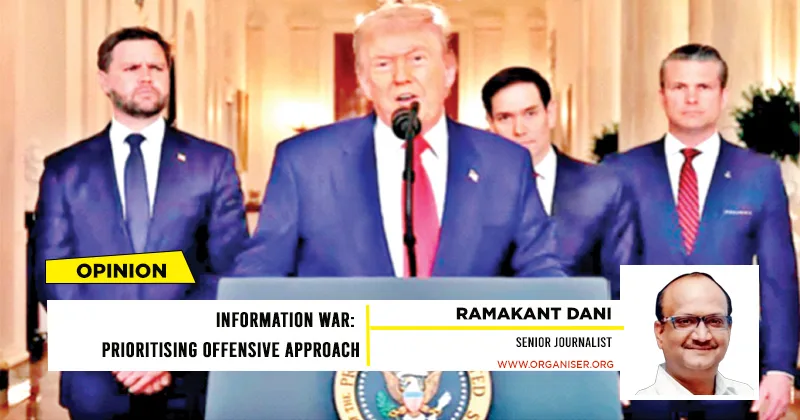
Bharat has, for decades, highlighted Pakistan’s persistent use of terrorism as an instrument of state policy. Yet, the global response has largely oscillated between indifference and opportunism. After the Pahalgam terror attack executed by Pakistan-backed groups, U.S. President Donald Trump offered condolences but failed to directly call out Pakistan’s complicity. He neither acknowledged nor condemned the entrenched infrastructure of terror festering across India’s western frontier. Is this not a brazen display of geopolitical hypocrisy?
Reward for Perpetrating Terrorism?
This deafening silence speaks volumes. As former U.S. Secretary of State, Henry Kissinger, famously remarked, “It may be dangerous to be America’s enemy, but to be America’s friend is fatal.” The statement resonates with India’s strategic experience. Following Bharat’s successful execution of Operation Sindoor, which dealt a significant blow to Pakistan’s military assets, the Trump administration hurried to broker a ceasefire. Yet, there was no comparable urgency to dismantle Pakistan’s terror networks.
Bailing Out Terrorist Nurturing Pak
On the contrary, the United States reportedly played a pivotal role in facilitating an IMF bailout for Pakistan during the same period. How is this not tantamount to rewarding a state that perpetuates terrorism?
More baffling still was the UN Security Council’s appointment of Pakistan as Vice Chair of the Counter-Terrorism Committee. This paradox underscores the deeply embedded double standards that plague global diplomacy. Western media narratives follow a similarly skewed trajectory. In the Israel-Iran conflict, Israel’s defensive actions are widely legitimised. For instance, when an American-made F-35 was downed, global headlines chose silence. By contrast, during India’s Operation Sindoor, when Indian forces neutralised Pakistani air bases with verifiable precision, international media disproportionately focused on India’s supposed losses, such as the speculative downing of Rafale jets — often without substantiating evidence. This isn’t journalism; it is weaponised storytelling.
Why Bias Persists?
The roots of this narrative imbalance lie in Bharat’s principled, non-aligned foreign policy. It has consciously avoided entanglement in the power rivalry between the U.S.-led West and the China-Russia axis. While Bharat’s enduring partnership with Russia stems from historical solidarity, its relations with the U.S. have been punctuated by moments of neglect and strategic ambivalence.
Despite its democratic ethos, the U.S. has rarely extended unequivocal support to India during its crises. Be it the Galwan confrontation or cross-border terrorist incursions, American responses have been tepid at best. Yet, the same U.S. urges India, as a QUAD member, to act as a counterbalance to China. How can India be expected to assume such geopolitical risks when its own existential concerns — like Pakistan’s terror infrastructure — are met with calculated silence?
Every thinking Bharatiya poses a fundamental question. Why does the world persist in ignoring Bharat’s legitimate security concerns? For over four decades, Bharat has been a victim of cross-border terrorism. Despite providing unassailable evidence, engaging through diplomatic channels, and demonstrating strategic restraint, the global community remains largely indifferent to it.
Strategic Takeaways for Bharat
The disquieting reality is that in today’s global order, ethical principles have been superseded by transactional geopolitics. Nations are not evaluated on the righteousness of their cause but on their utility within existing power alignments. India, anchored in a heritage of moral clarity and democratic values, finds itself marginalised — not for any failure of conduct, but for being inconvenient to dominant narratives.
Yet, truth, by itself, is insufficient. In a world shaped by influence and perception, truth must be strategised, amplified, and sustained. India’s story cannot remain confined to national echo chambers. It must stake its claim in the global narrative marketplace.
Factors to Make Offensive Information Doctrine Work
- Deploying real-time fact-checking and rapid-response mechanisms
- Building a cadre of professional communicators to engage global media
- Launching data-driven campaigns to expose international double standards
- Investing in multilingual digital diplomacy for broader outreach
- Empowering narrative architects — storytellers, analysts, and influencers who shape foreign perception
- Mobilising the Indian diaspora as strategic amplifiers of India’s message
Bharat must transition from defensive lamentation to strategic assertion. Narrative sovereignty is not granted; it must be seized.
Not every season bears fruit. The present may seem unfavourable to Bharat, but that does not mean the tide will never turn. Time has its rhythm — and everything in the universe unfolds in accordance with it. Impatience with nature’s law only leads to disillusionment. Wisdom lies in recognising that our moment will come — and preparing for it.
As Swami Vivekananda wisely said:
“The fruit falls from the tree when it gets ripe. So wait for the time to come. Do not hurry… Wait, have patience; everything will come right in time.”