





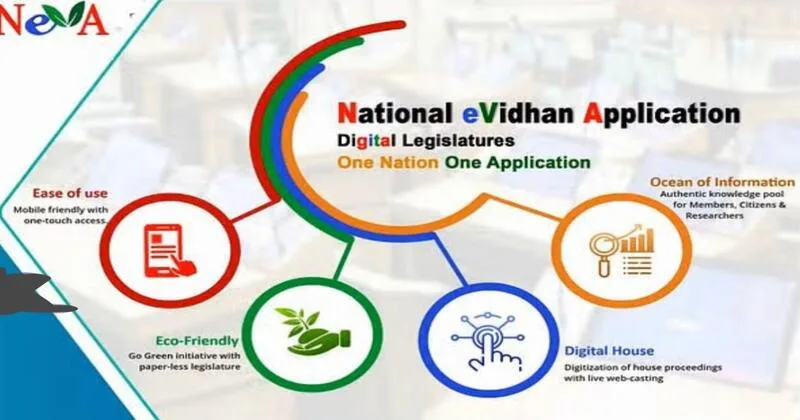
India is moving at a fast pace towards digitisation, and the Indian Parliament and several State Assemblies are also undergoing a digital revolution through the National e-Vidhan Application (NeVA), an initiative aimed at making the legislative process paperless, transparent, inclusive and participatory. At a time when governance is actively increasing digital infrastructure, NeVA stands as a transformative symbol of India’s ambition to build a “One Nation, One Application” platform for legislative functioning.
NeVA: The digital transformation of Indian legislatures
National e-Vidhan Application (NeVA) is a Mission Mode Project (MMP) of the Digital India Programme commissioned by the Ministry of Parliamentary Affairs. It sets about putting all the legislatures of the nation on one digital platform, thus making them a ‘Digital House’. This system enables paperless functioning with Members of Legislative Assemblies (MLAs) and Members of Parliament (MPs) through the use of digital devices to perform all parliamentary tasks. From viewing documents, questioning in Question Hour, to delivering speeches and voting.
Traditionally, Indian legislatures have an over-reliance on large paper documents in all aspects of operations, including bills, rules, proceedings, question hours, committee reports and so on. With the increasing amount of parliamentary business, so did the logistical as well as environmental load. Seeing the importance of bringing legislative processes up to speed with the modern era, the Government of India ideated NeVA.
The journey to NeVA started with ‘e-Vidhan’, a pilot project introduced in Himachal Pradesh in 2014, which eventually became the first State Assembly to become completely digital. The success of the Digital approach led the Ministry of Parliamentary Affairs to launch the National e-Vidhan Application in 2019, as a centralised application for nationwide implementation.
PM Narendra Modi has given a speech on NeVA during the 82nd All India Presiding Officers Conference, where he said, “A real-time detail of the working of all the houses should be available to the common citizen and also to all the houses of the country. For this, a modern digital platform has been developed in the form of the National e-Vidhan Application.
Powering participation and transparency through upgraded technology
NeVA is not merely a digital replacement for paper documents. It is an extensive cloud-based platform that offers robust features to address the sophisticated needs of legislatures. Text-to-Text Machine Translation through the Bhashini platform is one of the new additions to NeVA, a project under the National Language Translation Mission (NLTM). This facilitates the translation of the NeVA public portal (and State Assembly homepages) into 22 constitutionally approved Indian languages and in English, thereby providing linguistic inclusivity across various regions.
For the purpose of facilitating multilingual text input and uninhibited content exchange, NeVA employs a Unicode-based encoding model for its Content Management System (CMS). This provides assurance that information is stored, retrieved and rendered uniformly across all digital platforms and devices while ensuring language integrity.
Every legislator has their own dashboard that contains session agendas, questions, notices, bills and committee reports. Mobile and tablet access enables lawmakers to work from anywhere, increasing flexibility and responsiveness. Live streaming and recorded video of House proceedings are embedded within the platform. Citizens also have access to the session videos, thus increasing transparency and encouraging public participation in government.
The NeVA project is financed under a Centrally Sponsored Scheme (CSS) of sanctioned cost Rs 673.94 crore. The funding for NeVA differs from region to region: for North Eastern and Hilly States, 90:10 (Centre: State), for Union Territories that have Legislatures with 100% Central assistance, and for other states, 60:40.
A total of 28 States and Union Territories have entered into Memoranda of Understanding (MoUs) for adopting NeVA. Of these, till June 2025, 19 legislatures have already fully digitalised Vidhan Sabhas, a huge milestone in India’s digital governance policy.
Nagaland was the first State in the Northeast region to install NeVA, joined later by Tripura. Their adoption has spurred other North Eastern States to implement it, due to the concessionary 90:10 funding model.
Uttar Pradesh Vidhan Sabha came on board with the NeVA ecosystem in 2023 and held its first fully paperless session in 2024. The change minimised printing expenses and maximised the accessibility of legislative information to the general public. It digitally democratises legislative information, closing the distance between voters and their representatives.
Challenges in a digital shift
Although NeVA has been uniformly praised, there are problems. Digital literacy remains a problem; not all MPs and MLAs, particularly senior ones, are familiar with digital tools. Training modules are being organised, but it will take time. States with weak internet connectivity have infrastructure gaps, and they experience disruption in real-time availability and seamless functioning. Another urgent issue is data security, where confidential parliament data gets posted online; strong cybersecurity methods must be put in place to avoid breaches and maintain data integrity.
The Ministry of Parliamentary Affairs is attempting 100% integration of all houses of legislatures into the NeVA platform by 2026, with regular incremental updates being introduced for the enhancement of the user interface, AI-powered translation and automated record-keeping. Such upcoming updates may involve AI-powered summarisation of parliamentary debates, blockchain-supported voting systems for more secure and auditable decision-making and grievance redressal portals integrated with legislative action on public petitions.
The National e-Vidhan Application is a paradigm shift in democracy’s functioning in India. It is not merely an electronic tool but a philosophical shift from paper-driven bureaucracy to responsive governance, from opaque processes to transparent access and from hierarchical processes to participatory decision-making.
By minimising environmental footprints, maximising legislative effectiveness and enhancing citizens’ participation with real-time data, NeVA converges with the Digital India vision and fortifies the world’s largest democracy through the power of technology.
















Comments