





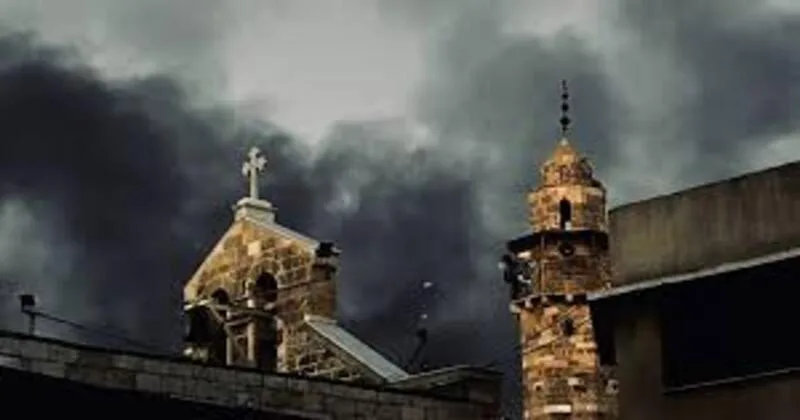
At least 38 Christians were brutally killed in a midnight terror attack by the Allied Democratic Forces (ADF), an ISIS-affiliated Islamist terror group, on a church in Komanda town in the eastern Democratic Republic of the Congo (DRC). The targeted massacre took place around 1 a.m. as dozens of faithful were holding a night vigil inside the church.
Eyewitness accounts and local officials confirmed that heavily armed ADF Islamist militants stormed the church compound, shooting worshippers and setting ablaze nearby homes and shops. More than 20 victims were reportedly shot dead either inside or around the church premises. Many others died from burns, having been trapped in fires deliberately set by the attackers.
Civil society coordinator Dieudonne Duranthabo stated that bodies were discovered both within the church and outside in the surrounding area. “More than 21 people were shot dead inside and outside the church and we have recorded at least three charred bodies and several houses burned,” he said, warning that the death toll is expected to rise as rescue operations continue.
Father Aime Lokana Dhego, a local priest, revealed that at least 31 members of the Eucharistic Crusade movement were killed in the carnage, with six others seriously injured. He also reported that several young people were abducted and remain missing. Additionally, seven more bodies were recovered from other parts of the town. The UN-backed Radio Okapi put the total number of confirmed dead at 43.
The attack is part of a continuing wave of Islamist violence in eastern Congo, predominantly targeting Christian communities. Komanda, located in the conflict-ridden Ituri province, has seen an increase in sectarian attacks in recent years, with the ADF playing a central role in spreading terror and destruction.
ADF: From Uganda to Congo, a Trail of Islamist Violence
The ADF was formed in Uganda during the 1990s, claiming to fight against alleged persecution of Muslims by the Ugandan state. After military defeat in 2001, the group crossed into neighbouring DRC’s North Kivu province in 2002, where it reorganised and gradually re-emerged as a violent militant force.
Under the leadership of Musa Seka Baluku, who took over after the arrest of former leader Jamil Mukulu in 2015, the ADF became increasingly radicalised and pledged allegiance to the Islamic State. Though ISIS officially acknowledged the group’s activities only in 2019, the ADF has since been linked with Islamic State’s Central Africa Province (Iscap), which includes other extremist outfits such as the Mozambican insurgents.
Baluku declared in 2020 that the ADF had “ceased to exist,” referring to its rebranding as part of IS operations. Despite this, IS has never explicitly named the ADF in its propaganda. Nonetheless, attacks in ADF strongholds like Beni and Ituri are often claimed by Iscap, reinforcing the link between the two.
The Rise of ISIS Influence in Central Africa
The ADF’s inclusion in the Islamic State’s Central Africa Province has led to a surge in deadly attacks, particularly against Christian civilians. While military installations remain frequent targets, the most devastating acts of violence are directed at Christian communities. The October 2020 jailbreak in Beni, which freed over 1,000 inmates, stands out as one of the most high-profile operations attributed to the group.
IS has used its sophisticated media machinery to publicise the activities of Iscap in DR Congo and Mozambique. These include attack claims, images of destruction, and periodic infographics celebrating their operations. In one such instance, Iscap released photos purportedly showing its fighters patrolling a village in Ituri after an assault on army positions.
This Islamist expansion into Congo mirrors IS’s strategy in other parts of Africa, exploiting weak state institutions and local grievances to gain influence. In the past year, Iscap has also extended its reach beyond Congo into Mozambique and Tanzania, signifying its broader ambitions on the continent.
A Sectarian Threat in a Predominantly Christian Nation
The Democratic Republic of the Congo is overwhelmingly Roman Catholic, and the church plays a significant role in the country’s social and political life. Muslims constitute only around 10% of the population, and the violence perpetrated by Islamist groups like the ADF has sharply heightened religious tensions.
In Beni, two clerics who openly condemned the group were shot dead in May. Earlier, in 2012, ADF fighters kidnapped three Catholic priests from a convent in the Mbau area, none have been seen since.
Islamic State propaganda continues to single out Christians in DR Congo, portraying the government as incapable of defending them. This pattern of sectarian provocation, aimed at creating communal division, has become a hallmark of IS-linked movements. In areas under their influence, Christian communities have faced the brunt of terror attacks.
Despite efforts by Congolese and Ugandan troops to eliminate the ADF since 2021, Islamist violence remains rampant, with towns like Komanda bearing the devastating consequences of religiously motivated terror. As the international community watches, Christian lives in eastern Congo remain tragically vulnerable to jihadist brutality.












Comments