





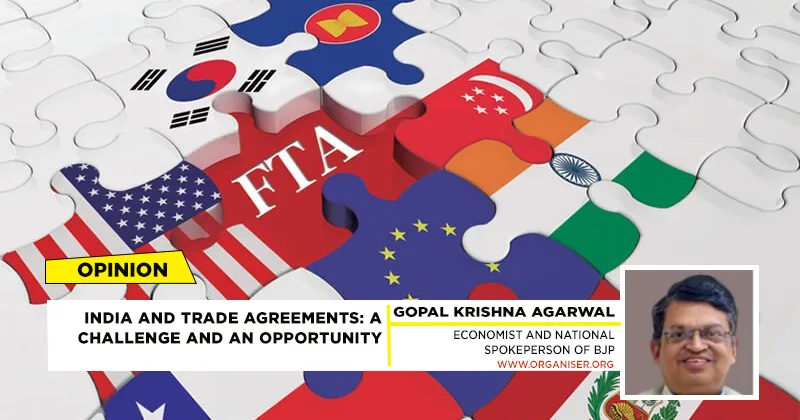
With the emergence of new geo-political realities arising out of unilateral announcement of reciprocal tariff by US President, USA cannot be considered a very reliable trade partner and even if a bilateral trade agreement (BTA) with the US is concluded, uncertainty about future US actions remains. US President had announced a negotiation window till July 9, yesterday it has announced revised tariff for 11 countries and today extended this deadline for India to August 1, shows India’s importance as a trading partner for US. There are other ambiguities around President Trump’s administrative actions and no one is sure of the outcome of US Courts’ and Senate’s interventions. Therefore, prudence demands that we go slow and wait for countries such as China, Japan and Vietnam to negotiate with the US. India, meanwhile, can build strategic partnerships with other countries and blocks to prevent overdependence on the US market. Countries like EU is expected to be stable and predictable in its approach but India has to deftly negotiate EU’s impulse to impose non-tariff barriers under the garb of human and labour rights, environment, climate change etc.
The World Trade Organisation is virtually defunct and rule based trading order looks like a thing of the past. Every country, including India, is negotiating Free Trade Agreements (FTAs) with multiple other countries to protect its export market. India recently concluded Bilateral Trade Agreement (BTA) with the United Kingdom and negotiations with the European Union (EU) and the United States (US) are in advanced stages. However, our approach to FTAs cannot be a simple replication of our past template and must be influenced by outcomes of the not-so-successful FTAs of the past, such as ASEAN countries, RECEP negotiations.
The global trade and financial architecture that emerged in the post WWII period supported a rule based trading system. It allowed several poor countries to overcome the limitations imposed by the small size of their domestic economy and tap into the export market. As a result, these countries- South Korea, Taiwan and China etc. were able to experience above average growth rates for a long period of time. We missed riding the bus of free trade when it was cruising on the expressway due to earlier policy misadventures like quota, license raj of the then Congress led governments. Now our government is committed to make India a manufacturing powerhouse, but the bus of free trade has hit major road-bumps.
India is focusing on ensuring competitiveness of domestic industry right now, as there is absolutely no substitute for building manufacturing sector. The past FTAs, exposing domestic industries to global competition without strengthening of manufacturing ecosystem through infrastructure development, availability of land, power and ease of compliances failed to yield much benefits precisely for this reason. India needs structural reforms to reduce input costs. Modi government focus is on the reduction of costs of land, power, logistics, compliances, raw material etc. to enhance global competitiveness of our manufacturers. Several steps have been taken in the last 11 years at the centre, but lot remains to be done at the states level, as most of these areas are basically dependent on states policies.
Micro small and medium enterprises (MSME) is an important segment for our employment generation and integrating our manufacturing to global and regional supply chain. Therefore before entering into any agreement, the government is ensuring full support to MSMEs. MSMEs also have to do a lot at their end, they find it difficult to meet international standards, limiting their competitiveness. It is important for this sector to build institutional capacity and technical know-how to follow the global trade standards. Quality Control Order (QCO) was brought with this intension, but QCOs have emerged as another challenge for Indian industries. They hinder the import of raw materials and intermediate products required for manufacturing, creating a negative impact on the domestic production of goods, and reducing India’s export competitiveness. Therefore, there is a need for a more sector-specific approach to QCOs.
Our recent experiences with custom duties have shown that there is a conflict between imposition of countervailing duties and the interests of MSMEs. Such duties tend to favor big domestic producer industries at the cost of MSMEs who are the users of products that are subject to countervailing duties. So FTAs provide an opportunity for strategic tariff reduction of intermediate goods for betterment of Indian industries. India will take data-driven approach in determining tariffs to ensure that they don’t disrupt supply chains or discourage innovation and investment.
Agriculture sector protection, Intellectual Property Rights (IPR), and public procurement are critical and are an important part of negotiation and their interest is non-negotiable. Any concession given in these areas will be carefully evaluated and bargain precisely measured. We know that if India gives concession to one country/region, other countries/regions would demand similar treatment and privileges. India should not bend over backwards to seek concessions for movement for its citizens across borders as service providers. The negotiating countries use this demand to get concessions from India. Indian talent is in huge demand globally and other countries would anyway need Indian expertise, otherwise India can harness human resources and potential to its own advantage.
Major economic decisions are not made in the fog of uncertainty. Global economic uncertainties are not fully comprehensible and controllable therefore our focus is on reducing domestic policy uncertainties. It will surely boost private capital formation. India also has to attract massive foreign capital in export-oriented sectors. This is easier said than done. The country’s image as a destination for foreign capital faces challenges due to certain past government decisions, especially the Vodafone tax dispute. Judicial reforms for contract enforcement etc. is an area we still have to do lot of work.
Trade considerations cannot be fully separated from strategic considerations. China + 1 and risk diversion strategy of global manufactures are an opportunity for India to benefit from current geopolitical challenges and therefore our focus in FTA negotiations is to counter China. Since China is a major challenge for India in multiple spheres, teaming up with countries at the receiving end of China’s irredentist and mercantilist policies is a viable option. This also means that India should still work for multilateral trade deals because third- world countries get a level playing field as well as some preferential treatment under multilateral trade platforms such as WTO.












Comments