





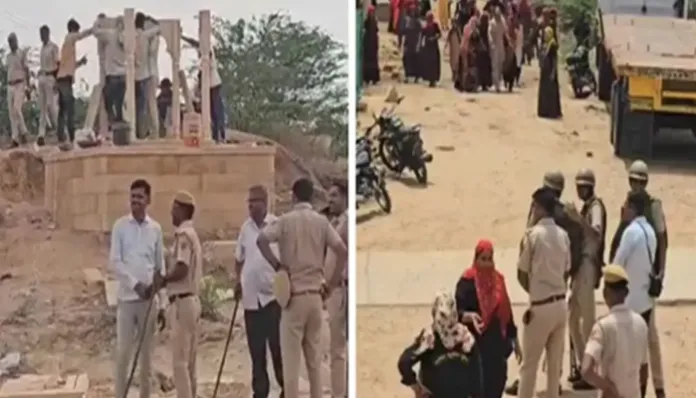
A violent communal clash broke out on July 10 in the Basanpeer village of Jaisalmer district, Rajasthan, after members of the Muslim community attacked Hindus who began reconstruction of historic cenotaphs (chhatris) of two 19th-century warriors. What began as an attempt to restore the cultural and historical legacy of the princely state quickly spiralled into a volatile situation, leading to police intervention, injuries, and arrests. The incident has sparked renewed debate over demographic changes, land encroachments, and rising radicalisation in the sensitive border district.
Background of the conflict
The site in question carries deep historical significance. According to Sharad Vyas, a member of the Jhujhar Dharohar Sanrakshan Samiti, the cenotaphs were originally built in 1835 by Maharawal Gaj Singh of Jaisalmer in memory of two warriors, Ramchandra Singh Sodha and Hadud Paliwal, who were martyred during the 1828 war between Jaisalmer and Bikaner.
“This battle remains etched in public memory,” Vyas stated. “There is even a saying in Bikaner: ‘If you’re so brave, what happened in Basanpeer?’ It reminds them of the valour of these warriors.”
The village, one of the 84 historically Paliwal villages abandoned due to administrative oppression, had seen Muslim settlement around 1985. Locals claim that not only were the chhatris demolished in 2019 by miscreants, but there has also been encroachment on land historically belonging to the Maharawal of Jaisalmer. The village’s name was also altered from Basanpeer (a Hindu name) to Vasanpeer, a move that further agitated local sentiments.
Reconstruction efforts and political interference
Efforts to reconstruct the cenotaphs had begun in 2021. However, according to Amrit Dadya, a senior member of the Seema Jan Kalyan Samiti, all attempts made on August 30, 2021, November 22, 2022, January 2, 2023, and June 21, 2023 were thwarted due to communal tensions and alleged political interference.
The committee alleges that Pokhran MLA and former Rajasthan minister Saleh Mohammad used his influence to stop the construction. With the change in state government, the committee reinitiated efforts. A meeting held on July 1, in the presence of the SDM and Deputy SP, saw Hasam Khan and Bachal Khan give written consent for the reconstruction.
Work resumed on July 4, under police protection, but was soon stopped again. Police withdrew on July 7, assuming peace, only for the project to be again halted. On July 9, police used mild force to allow work to continue. However, the situation escalated dramatically the following day.
July 10 Violence: Stone-pelting, injuries, and arrests
On July 10, members of the Muslim community, primarily women and children, led a stone-pelting attack on workers and the police at the site. Videos surfaced showing schoolgirls among the attackers, throwing stones at police and construction workers.
The attack left over a dozen people injured, including eight police personnel, a tehsildar, and two civilians. Those injured were admitted to the district hospital. Ganpat Singh Nodiyala, from the Junjhar Sangharsh Samiti, was among the wounded. “The administration was present but stood by silently,” he claimed. “The other community used women and children as shields for stone-pelting.”
Police eventually brought the situation under control using mild force and arrested 23 individuals, including 8 men and 15 women. The Superintendent of Police later briefed the press on July 12, declaring the incident a “major conspiracy”, naming Hasam Khan as the prime conspirator.
Political reaction and response
Jaisalmer MLA and BJP leader Chhotu Singh Bhati condemned the violence, stating: “The historical chhatris built in memory of the brave warriors Ramchandra Sodha and Hadud Paliwal are symbols of our glorious past. Their demolition in 2019 was shameful. And now, when reconstruction began, radical elements again tried to obstruct it. The stone-pelting attack injured many and hurt social harmony.”
He added that Jaisalmer’s proximity to the international border makes such disturbances not just a matter of local law and order but also a national security issue. “We are committed to protecting the history, identity, and cultural legacy of Jaisalmer,” Bhati said.
The administration deployed additional police forces to the area to prevent further unrest. Authorities issued warnings to refrain from inflammatory social media posts, stressing that no one will be allowed to disturb law and order.
Link to extremism and changing demographics
Concern is growing over what many locals see as a larger demographic shift in Jaisalmer. Neem Singh Rathore, co-convenor of Seema Jagrana Manch, noted: “Jaisalmer was once peaceful. Communities used to resolve issues amicably. But with the increasing influence of Tablighi Jamaat, radicalisation has grown. This once peaceful border district is turning unsafe.”
He added that investigative agencies have submitted multiple reports to the government regarding the presence and activities of Tablighi Jamaat in the region. Locals now hope that the government will take strong action on these reports and restore stability.
The controversy over Mandhla mosque near Pakistan border
Adding to the region’s concerns is the construction of a large mosque in the sensitive border zone of Mandhla, just 8 km from the Pakistan border and 200 km from Jaisalmer city. Entry into Mandhla requires BSF and administrative clearance.
Sources reveal that a small hut at the site was replaced with a full-fledged mosque between 2008 and 2009, complete with minarets. The BSF had objected, but local Muslim leaders allegedly used political influence to continue the construction.
Now, urs events are held 2-3 times annually, attracting thousands of people. Initially, these events lacked formal permission but later began obtaining permits. However, BSF sources remain concerned that such large gatherings in a sensitive and restricted border zone are a national security risk.
Historic symbols restored despite tensions
Despite the violence, construction of the cenotaphs was completed on July 13. Following the incident, many leaders and citizens gathered at the site, vowing not to allow history to be erased.
Former MLA Sang Singh Bhati, BJP district president Dalpat Hingra, and other leaders were present to express support for the rebuilding efforts. The Seema Jan Kalyan Samiti also submitted a memorandum to Jodhpur’s IG on July 12, demanding strict action and restoration of heritage.
The Basanpeer incident shows the fragile communal balance in India’s border districts and highlights the importance of protecting cultural heritage amid rising radicalisation and demographic shifts. As police investigate the conspiracy behind the July 10 violence, locals continue to call for urgent and decisive government intervention to ensure peace, security, and cultural preservation in the desert frontier of Rajasthan.
Hindu man killed in Jaipur
A brutal stabbing incident in the Jamdoli area of Jaipur has triggered widespread outrage and communal tension, following the killing of a 22-year-old man, Vipin alias Vicky. He was stabbed 14 times by Anas Khan, allegedly over an old rivalry that was believed to have been resolved.
Anas Khan reportedly took to social media shortly after the attack, posting a video of himself brandishing a knife and claiming he had “taken revenge.” Though the post was deleted soon after, the damage had been done, with tensions in the area flaring rapidly.
Soon after news of the murder spread, a large crowd took to the streets in protest. Demonstrators clashed with police forces, pelted stones, and attempted to block the Jaipur-Agra highway, demanding justice and immediate action against the accused.
Authorities have recovered CCTV footage showing Anas Khan fleeing the scene on a motorbike. Superintendent of Police Kunwar Rashtradeep confirmed the presence of crucial visual evidence and said that the police are actively tracking the accused.
A murder case has been registered against nine individuals. So far, four suspects have been detained, and a special police team has been constituted to apprehend Anas Khan. Over 20 people are being questioned in connection with the case, and six individuals have been taken into custody for further investigation.
The victim’s family has refused to accept Vipin’s body for the last rites. They are staging a protest outside the police station, demanding the immediate arrest of Khan and his associates. The family has also sought financial compensation and a government job for a member of the household.
In a heart-wrenching statement, Vipin’s sister, Reena, recounted the tragic events: “Two people came home and called Vipin out. Then I heard the commotion. When I rushed out, I found my brother bleeding. He was still alive as we rushed him to the hospital. They killed him like one would kill a sacrificial animal. And then they gloated about it on social media. This is unacceptable.”
To maintain peace and order in the wake of the unrest, over 200 police personnel have been deployed in the area, including 25 members of the Nirbhay squad and two Zebra companies. Seven senior officers, including the DIG Law and Order, are supervising the situation on the ground.
As Jaipur continues to reel from the incident, the community remains tense. The murder, followed by the provocative social media post, has added fuel to longstanding communal sensitivities in the region. Authorities are urging calm while promising swift justice for the victim.















Comments