





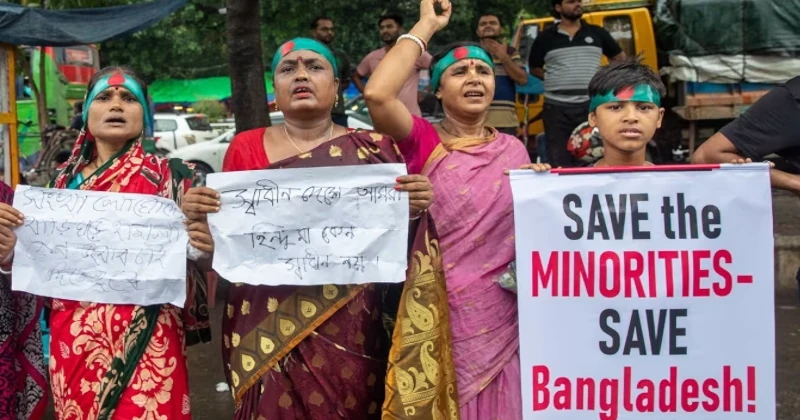
It has been almost a year since Prime Minister Sheikh Hasina of Bangladesh was unseated from power on August 5, 2021. Since then, she has been given temporary refuge in India. The interim government of Nobel Laureate Muhammad Yunus in Bangladesh has only created chaotic conditions in the country. The Hindu minority in Bangladesh, numbering about 1.3 crore (roughly 8 per cent of the total 16.5 crore population), has continuously been persecuted by the radical Islamist forces. There is news of atrocities against Hindus every week. The Hindu temples have been desecrated and vandalised. I suspect that many incidents of violence against the Hindus are not even being reported.
Equally disturbing has been the anti-India stance of the Yunus government. Soon after assuming power, Muhammad Yunus and his administration did everything that was not in India’s strategic interest. Bangladesh re-established its relationship and links with Pakistan, starting with buying arms and ammunition from them. Muhammad Yunus has also sought a close relationship with China. He reportedly has offered Lalmonirhat airport to the Chinese. This dormant airbase is situated just 20 km from the Indian border and is located near the strategically important Siliguri corridor. There is already talk of a China-Pakistan-Bangladesh axis to encircle India from the west, north, and east.
Another challenge for the security establishment in India is the revival of Pakistan’s ISI in Bangladesh as a central pivot of anti-India operations. Some believe that ISI maintained its roots in Bangladesh through the Jamaat-e-Islami in the last decade or so. Now ISI must have revived its links and contacts in Bangladesh much more freely. That is a huge danger to the vulnerable North East of India. In the past, Bangladesh sheltered terror camps of multiple terrorist organisations operating in Nagaland, Mizoram, Manipur and Assam. During Sheikh Hasina’s regime, these camps were dismantled, and India witnessed a relatively peaceful security situation in these states. China aims to entangle the Indian Army in counter-terrorism operations in these states.
So far, India has handled the situation in Bangladesh with dignity and restraint. India is aware of the sensitivities involved with a close neighbour and thus has tried every diplomatic opportunity to find a way to work with the Yunus administration. Yunus has smartly consolidated his position as the head of an interim government and has indicated his political ambitions to someone who may formally stake a claim to power. He has announced elections in Bangladesh for before April 2026. But the next government in Bangladesh is more likely to be friendly to China and Pakistan. With a question mark over the Awami League of Sheikh Hasina contesting the forthcoming elections, a pro-India government in Bangladesh is a remote possibility.
Under these circumstances, India must decide on the future course of action in Bangladesh. India has applied some economic sanctions against Bangladesh, but has been cautious not to impact the common citizens of that country. India has still permitted travel of Bangladeshi people to India for medical treatment and on other humanitarian grounds. Other soft options, such as boycotting the cricket series, are being planned. However, beyond a certain point, these soft measures are unlikely to alter the anti-India stance of the Yunus government. Bangladesh is in the grip of a Jamaat-influenced polity, and the sane voices are few and far between in Bangladesh. India’s connection with the intelligentsia in Bangladesh has also been largely ineffective.
India has established a ‘New Normal’ with Pakistan on terrorism after Operation Sindoor. The red lines against terror have been clearly defined. Today, we have a situation where Bangladesh is back to being East Pakistan. It is feasible that the next set of terror attacks in India may have roots in Bangladesh. Now we are in Bangladesh, where even the memory of Bangabandhu Sheikh Mujibur Rehman has been obliterated. The role of India in the Indo-Pakistan war of 1971, which liberated Bangladesh, has become taboo, and it has also been erased from the history books. So, there is no sense of gratitude for India left in the current Bangladesh administration.
From the security perspective, India has to initiate certain actions. First, it is essential to keep a close watch on the nefarious activities of the ISI on the Indo-Bangladesh border. A certain portion of the border fencing with Bangladesh in Assam and West Bengal is still porous, and the ISI may attempt to revive the dormant terror outfits in India’s North East. In the past, such areas have been used to infiltrate weapons and explosives. Second, it would be to find alternative means of connecting India’s Northeast, even when the Siliguri corridor is compromised. The alternatives include the Shillong-Silchar corridor and the Sittwe Port in Myanmar. In addition, the Bhutan-Bodo territory in Assam and the Bay of Bengal is another proposed corridor. The third is to increase India’s maritime presence in the Bay of Bengal and the Indian Ocean Region.
But the most difficult decision for India is to rein in Bangladesh through direct kinetic action. At one point, the Bangladesh Army was a powerful entity in Bangladesh. At the military level, India also maintained a good relationship with the Bangladeshi military leadership. However, Yunus has smartly reduced the influence of the Bangladesh Army, particularly that of the current Army Chief, General Waker-Uz-Zaman. His situation is more precarious because he is related to the deposed Prime Minister Sheikh Hasina. Bangladesh has a history of martial law; however, the country has not experienced a military coup since December 2008. It is to the credit of the Bangladesh military that they have handed over power to a civilian government after holding peaceful elections. This is in stark contrast with the power equation in Pakistan, where the Pakistan Army chief de facto rules Pakistan.
On August 5 this year, the interim government in Bangladesh is likely to celebrate the day as another sort of liberation day. It is around this time that India should clearly articulate its red lines with Bangladesh. The first red line is about the safety and security of Hindus in Bangladesh. India should mention how it expects the interim government to protect Hindu religious places and how Bangladesh legally prosecute the radical elements. Second, India should seek continuity of Bangladesh’s involvement in ongoing connectivity projects, such as the Akhaura-Agartala rail link and the Bangladesh-Bhutan-India-Nepal (BBIN) road link. Third, India should inform Bangladesh about its sensitivity to the Siliguri corridor and any support to the terror hubs in India’s North East.
Having done this, India should reserve the right to take kinetic action against Bangladesh if the red lines are crossed. I fully understand that kinetic action against Bangladesh should be the last resort, and dialogue and diplomacy should be given one final chance. But India cannot afford another inimical Bangladesh to its east, which compromises its national security. Any further delay on the part of India in planning and taking decisive action is likely to further compound the already chaotic situation in Bangladesh. This is another test of India’s military and diplomatic relations, and Bangladesh cannot be given further space on humanitarian grounds. Sometimes, suo moto action, though unpleasant, is the only option. As a military professional, I sincerely hope that India is not pushed towards a kinetic action against Bangladesh, and its leadership sincerely addresses India’s concerns.















Comments