





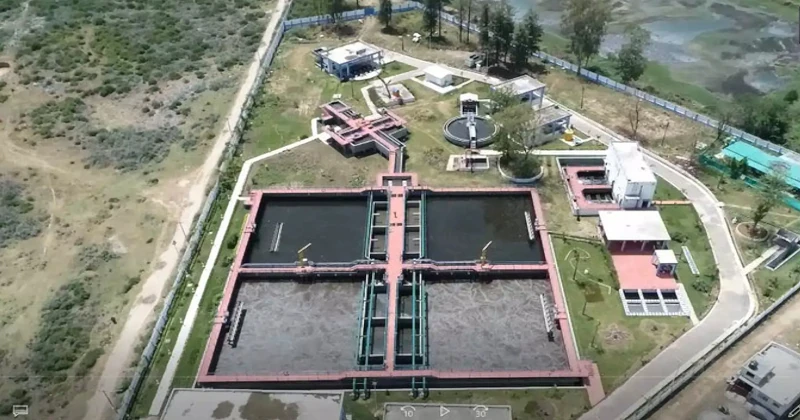
In a significant stride towards protecting the sacred river Ganga, Haridwar has commissioned two new sewage treatment plants (STPs) with a combined treatment capacity of 82 million liters per day (MLD). These plants, developed under the Government of India’s flagship Namami Gange Mission, have more than doubled the city’s sewage treatment capability, raising it to 145 MLD – enough to handle current sewage loads and anticipated growth in the coming years.
The city, which hosts millions of pilgrims annually for religious festivals like the Kumbh Mela and Char Dham Yatra, has long struggled with the untreated sewage flowing directly into the Ganga. The new STPs represent a landmark achievement in pollution control, public health protection and ecological restoration.
The larger of the two facilities is the 68 MLD STP at Jagjeetpur, which holds multiple national distinctions:
- It is Uttarakhand’s largest sewage treatment plant
- It is India’s first STP built under the Hybrid Annuity Model (AHM), a public-private partnership where the private developer is responsible for design, construction, operation and maintenance over 15 years, ensuring high performance
- It is India’s first ‘Pink STP’ with 50 per cent of its workforce comprising women, underscoring a commitment to gender inclusion in environmental management
- The plant uses advanced Sequential Batch Reactor (SBR) technology, known for delivering superior treated water quality that meets stringent discharge standards
“Earlier, all domestic waste used to flow directly into the Ganga. The biggest achievement of our planet is that we are now able to treat all the sewage generated by our community effectively,” said Manoj Kumar Verma, in-charge of the Jagjeetpur STP.
The second facility, a 14 MLD STP located in the Sarai area, is equally critical to Haridwar’s sanitation infrastructure. Beyond treating sewage, it produces high-quality treated water that is safely reused for irrigation. This is providing tangible benefits to local farmers and reducing reliance on rapidly depleting groundwater reserves.
“The water from this STP is being used for irrigation and the difference compared to groundwater is clearly noticeable,” Sandeep Rathore, a farmer, told the media. “The crops grow better and the water quality is excellent. It truly nourishes the fields.”
According to the officials, the treated water meets national standards for safe disposal and agricultural reuse, transforming waste into a resource. In addition to pollution abatement, the plants generate nutrient-rich biosolids that can be processed as soil conditioners, further supporting sustainable agriculture.
These projects align with the Namami Gange Mission’s broader goals of:
- Restoring the Ganga to its pristine, pollution-free state
- Protecting the river’s religious, cultural and ecological significance
- Improving public health outcomes in densely populated riverside cities
- Showcasing future-ready sewage management capable of accommodating rising water volumes
The success in Haridwar demonstrates how infrastructure modernisation, community engagement and technology can come together to safeguard India’s most revered river while creating local employment and improving quality of life.
As Haridwar sets a new benchmark in urban wastewater treatment, the Namami Gange Mission continues to serve as a model for integrated river basin management across India.
















Comments