Is 'going rural' a fantasy?
September 14, 2026
  • Read Ecopy
  • Circulation
  • Advertise
  • Careers
  • About Us
  • Contact Us
Android AppiPhone AppArattai
Organiser
  • ‌
  • Bharat
    • Assam
    • Bihar
    • Chhattisgarh
    • Jharkhand
    • Maharashtra
    • View All States
  • World
    • Asia
    • Europe
    • North America
    • South America
    • Africa
    • Australia
  • Editorial
  • International
  • Opinion
  • RSS @ 100
  • More
    • World Hindu Congress 2026
    • Op Sindoor
    • Analysis
    • Sports
    • Defence
    • Politics
    • Business
    • Economy
    • Culture
    • Special Report
    • Sci & Tech
    • Entertainment
    • G20
    • Azadi Ka Amrit Mahotsav
    • Vocal4Local
    • Web Stories
    • Education
    • Employment
    • Books
    • Interviews
    • Travel
    • Law
    • Health
    • Obituary
  • Subscribe
    • Subscribe Print Edition
    • Subscribe Ecopy
    • Read Ecopy
  • ‌
  • Bharat
    • Assam
    • Bihar
    • Chhattisgarh
    • Jharkhand
    • Maharashtra
    • View All States
  • World
    • Asia
    • Europe
    • North America
    • South America
    • Africa
    • Australia
  • Editorial
  • International
  • Opinion
  • RSS @ 100
  • More
    • World Hindu Congress 2026
    • Op Sindoor
    • Analysis
    • Sports
    • Defence
    • Politics
    • Business
    • Economy
    • Culture
    • Special Report
    • Sci & Tech
    • Entertainment
    • G20
    • Azadi Ka Amrit Mahotsav
    • Vocal4Local
    • Web Stories
    • Education
    • Employment
    • Books
    • Interviews
    • Travel
    • Law
    • Health
    • Obituary
  • Subscribe
    • Subscribe Print Edition
    • Subscribe Ecopy
    • Read Ecopy
Organiser
  • Home
  • Bharat
  • World
  • Operation Sindoor
  • Editorial
  • Analysis
  • Opinion
  • Culture
  • Defence
  • International Edition
  • RSS @ 100
  • Magazine
  • Read Ecopy
Home Bharat

Is ‘going rural’ a fantasy?

India’s urban-centric development model has deepened the rural-urban divide, weakening participatory democracy and marginalising village communities. Reviving Gandhian ideals of grassroots empowerment and local self-governance could restore democratic balance and foster inclusive growth

Adithya ReddyAdithya Reddy
Jul 12, 2025, 07:30 pm IST
inBharat
Follow on Google News
Facebook
Twitter
WhatsAppTelegramEmail

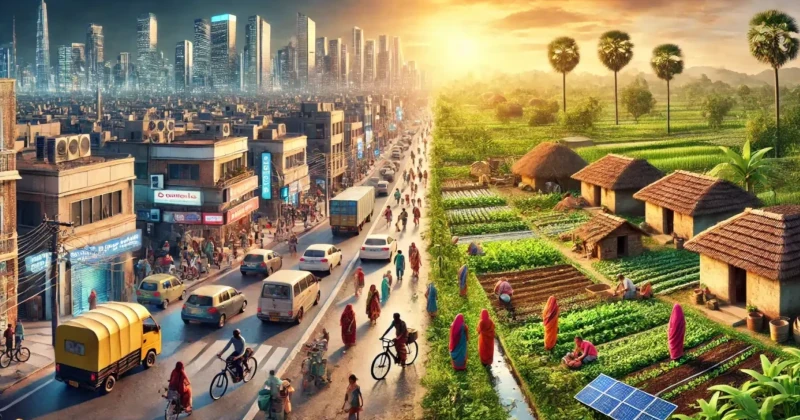
A well-known venture capitalist and one of India’s leading tech-entrepreneurs had a mild face-off on ‘X’ recently. The controversy centred on the way forward for cities with congested infrastructure, such as Bengaluru. In response to the latter’s suggestion that the way forward was development focused on rural India, the former claimed that no developed economy is predominantly rural and that we need to “wean our people off the land and into cities”. Any other plan can only be part of a “Gandhian fantasy”.  These views are similar to those of the Hon’ble Judge of the Kerala High Court, who, while dealing with a case regarding the delimitation of local body seats, called for the scrapping of constitutional recognition for Gandhi’s idea of the village due to the supposed complexity in dealing with contemporary issues like waste management.  Whether fantasy or not, the idea that development should not lead to urbanisation was distinctly Gandhian and was defeated by two competing ideas that became the mainstay of post-independent India’s policy-making. One is, of course, the economic development model, which saw factories and dams as the new temples of India. The other is the Ambedkarite criticism of village life, which argues that it lacks the conditions for equality, supported by the sceptical writings of scholars such as M.N. Srinivas and Andre Beteille.

Technocrats will determine whether emulating the economic models of developed countries, which evolved under different circumstances, societies, and historical periods, is suitable for India today. The increased emphasis we see today on skill development and vocational training may be seen as a restoration of respect for Gandhi’s ‘lokavidya’ as opposed to the disproportionate prestige attached to other forms of education. It may help reduce the rural-urban economic divide at least in terms of talented manpower. The NEP, 2020, makes the promotion of ‘Lokvidya’ a specific goal. Beyond such technocratic matters, the significance of the rural-urban divide for democracy itself needs greater study. The quality of our democracy is the bedrock for all development, including economic progress. One can have the best technological equipment from the city to clean the village’s waste, as the Hon’ble Judge from Kerala feels is necessary. However, whether the decision to do so should include the participation of the villagers is a different question altogether.

The same developed countries whose models we have been trying to emulate have seen a surge of populism in recent times. These political developments have been seen as a result of pent-up resentment among communities, which went undetected or ignored in the practice of representative democracy and became easy fodder for divisive politics. As political philosopher Charles Taylor writes, regions like “the rust belts of the United State and France…have been devastated by decades of deindustrialization, neoliberal fiscal policies and political neglect that the (local communities) find themselves lacking the resources to effectively respond to their present and future challenges.” Taylor points out that no amount of transfer of material resources to these regions will help because industries and technology of a particular kind have shaped not just incomes and skills but also “the prevailing images of what it means to be a worker or what is means to care for your family”.  So communities that are not close to such industrial and technological developments lose “their self-esteem or their sense of self-worth, on both the individual and collective level.” They become “passive victims in an anonymous machine.” The way forward, according to Taylor, is rebuilding communities from the bottom up, as seen in the efforts of some citizens’ councils in Austrian villages and citizen assemblies in Ireland. In India, too, initiatives of individual Sarpanches and local leaders have transformed villages, stemming population flight and increasing participatory democracy. These examples are few and far between because the consensus is in favour of urbanisation.

The question of participation and deliberation in democracy is related to the urban-rural divide in a significant way. Ashis Nandy best captures the psychology of the Indian villager’s aspiration for a city life in his book on Indian cinema-“the anonymity and atomization in a city are doubly seductive in a society scarred by socio-economic schisms and cultural hierarchies…to lose oneself in the city is to widen one’s freedom.” Conversely, “all initiatives in the village, including remedies for social discrimination and institutionalized violence must originated in the city…(and) executed in the village.” This psychological result of the modern-colonial enterprise has rendered the city incapable of sustaining participatory or deliberative democracy, as the allure of “anonymity and atomization” disincentivises cooperation. Urban civil society has proved incapable of providing meaningful direction to governance. One only needs to look at polling percentages in urban local body polls, especially among the relatively affluent, to gauge the levels of public apathy.

On the other hand, there have been numerous studies on how Gram Sabhas foster democratic values. When practised over long periods with the right kind of state intervention, they can reduce inequality and make a more lasting difference to social schisms than mere escape to the “anonymity” of urban life. In one such study, Paromita Sanyal and Vijayendra Rao say, though state-level policy makes a lot of difference, Gram Sabhas can “become a…space where people make demands, transgress boundaries, defend positions, campaign, instruct, inform, entertain and where mutual respect becomes an institutionalised practice.” This will sound too messy for the urban Indian. More importantly, the panchayat systems, even in states that showed great potential, are under increasing stress partly because, as an expert points out, “The consistent trend of urbanisation has meant that the policy focus of development has shifted to India’s cities and towns.”

As a lawyer, I have always wondered why, in a country with just one lawyer for every 1800 people, as opposed to one for every 200 in a country like the US, we need a bar council entrance exam to filter the number of enrolling lawyers. The answer is simply that most fresh law graduates want to work in big cities. This is completely understandable considering the priority of career opportunities. Doctors, who provide essential services, are often required to work in rural areas. The deeper question is how this skewed model of development has affected citizens’ self-perception.

Acharya Vinobha Bhave may be accused of exaggeration when he says, “when village disputes are referred to a city court and settled by city people, the proper name for it is slavery of servitude or dependence.” However, any city lawyer who interacts with a village client who is forced to come to them at great cost for a better opportunity at justice will vouch for the sense of alienation and helplessness the client feels.


Topics: Kerala High CourtNEP 2020Gandhian fantasyUrbanisationGram Sabha
Share
Tweet
SendShareSend
✮ Subscribe Organiser YouTube Channel. ✮
✮ Join Organiser's WhatsApp channel for Nationalist views beyond the news. ✮
Previous News

Balrampur: Jamaluddin who ran multi-crore religious conversion racket referred to Hindu women as ‘Projects’

Next News

Savarkar Defamation Case: Rahul Gandhi pleads ‘Not guilty’ in London speech row, to face criminal trial now

Related News

Skill India 2.0: From Training Millions to Linking Skills With Jobs and Wages (This image is generated from AI)

Skill India Decade: 7.67 crore trained, Rs 34,000 crore push for the next phase

Sabarimala Deity Remarks: Kerala HC Orders Meta to Block Disputed Video

Scandalous & Indecent: Kerala HC orders Meta to block Sabarimala video over remarks on Lord Ayyappa, Malikappurathamma

PFI’s ‘Reporter Wing’, Arms Training and Targeting of Hindu Leaders: Kerala HC Denies Bail to Three in Sreenivasan Murder Case

Sreenivasan Murder Case: Kerala HC denies bail to 3 PFI accused over ‘Reporter Wing’, arms training

Representative Image

Marriage under Muslim Personal Law no shield against POCSO: Kerala HC refuses to quash case Involving 17-year-old wife

Allahabad HC Rejects Hijab Plea, Says Uniform Rules Cannot Be Changed for Individual Demands

‘Uniform Means Uniform’: Allahabad High Court dismisses Muslim girl’s plea to wear Hijab with school uniform

Kerala High Court suspends life sentence of Padmarajan Master in Palathayii rape case

Kerala High Court suspends life sentence of Padmarajan Master in Palathayii rape case

Load More

Latest News

New Delhi, Sep 12 (ANI): Prime Minister Narendra Modi holds a bilateral meeting with Chinese President Xi Jinping on the sidelines of the BRICS Summit 2026, in New Delhi on Saturday. External Affairs Minister S. Jaishankar, NSA Ajit Doval and Principal Secretaries to the PM, Pramod Kumar Mishra and Shaktikanta Das also present. (@MEAIndia X/ANI Photo)

BRICS 2026: Why Putin, Xi and Pezeshkian meetings stand out in PM Modi’s diplomacy

Odisha Chief Minister Mohan Charan Majhi addresses the media at Bhubaneswar airport after returning from his UAE visit on September 13, 2026.

Odisha secures Rs 2.43 lakh crore investment proposals during CM Majhi’s five-day UAE outreach programme

Bhagwan Ganesh

Ganesh Chaturthi: Rationale behind worshipping Bhagwan Ganesh

RSS Akhil Bharatiya Sah-Bauddhik Shikshan Pramukh Deepak Vispute addressing the gathering

‘Nation First’ should be the guiding principle for every individual, regardless of their Field: Deepak Vispute

‘India was not poor; it was made poor’: The truth re-emerges through Jema Ferrer’s perspective

Six years after talent manager Disha Salian was found dead, her father Satish Salian on September 11 recorded a detailed statement with the Central Bureau of Investigation (CBI), naming Shiv Sena (UBT) leader Aaditya Thackeray, actors Dino Morea and Sooraj Pancholi, and others.

Disha Salian Murder Case: Father names Aaditya Thackeray in CBI statement; Lawyer claims gang rape, murder cover-up

Release of a book at Vishwa Bandhutva Diwas programme that was organised in Ujjain

Bharat’s youth rooted in sacrifice, service & discipline can give new direction to World: Parag Abhyankar

AI Generated Representative Image

“Let Go” — But only when it suits you? Exposing the double standards of Kashmir’s political leadership

Bharatiya Kisan Sangh distributed free school uniforms, notebooks, pen bundles, bags to 7,000 students in flood-affected areas of Assam

Assam: Bharatiya Kisan Sangh distributes free school uniforms, notebooks & bags to 7,000 flood-affected students

Chinmoy Prabhu

When a Bengali Hindu suffers in Bangladesh, where does ‘Bangali-Prem’ go?

Load More
  • Privacy
  • Terms
  • Cookie Policy
  • Refund and Cancellation
  • Delivery and Shipping

© Bharat Prakashan (Delhi) Limited.
Tech-enabled by Ananthapuri Technologies

  • Home
  • Search Organiser
  • Bharat
    • Assam
    • Bihar
    • Chhattisgarh
    • Jharkhand
    • Maharashtra
    • View All States
  • World
    • Asia
    • Africa
    • North America
    • South America
    • Europe
    • Australia
  • Editorial
  • Operation Sindoor
  • Opinion
  • Analysis
  • Defence
  • Culture
  • Sports
  • Business
  • RSS @ 100
  • Entertainment
  • More ..
    • Sci & Tech
    • Vocal4Local
    • Special Report
    • Education
    • Employment
    • Books
    • Interviews
    • Travel
    • Health
    • Politics
    • Law
    • Economy
    • Obituary
  • Subscribe Magazine
  • Read Ecopy
  • Advertise
  • Circulation
  • Careers
  • About Us
  • Contact Us
  • Policies & Terms
    • Privacy Policy
    • Cookie Policy
    • Refund and Cancellation
    • Terms of Use

© Bharat Prakashan (Delhi) Limited.
Tech-enabled by Ananthapuri Technologies