





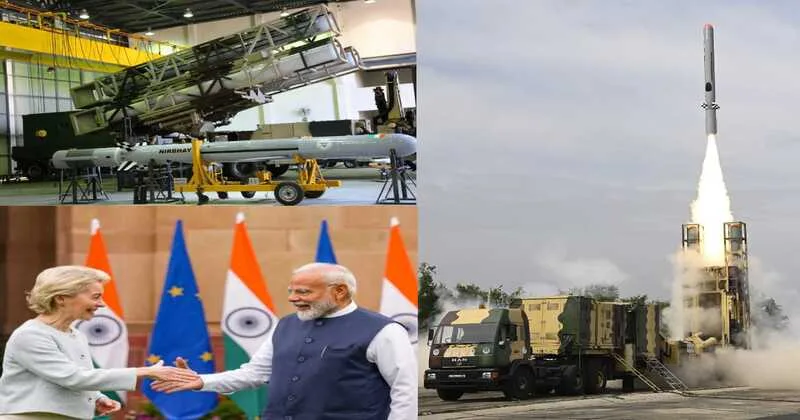
India’s Long-Range Land Attack Cruise Missile (LR-LACM), developed by the Defence Research and Development Organisation (DRDO), has sparked significant interest among several European NATO member states following its unveiling at the Defence Exhibition Athens (DEFEA) 2025 in May. The subsonic missile, boasting a range of 1,000 km, is emerging as a viable, cost-effective, and NATO-compatible alternative to the U.S.-made Tomahawk cruise missile. The LR-LACM’s appeal lies in its unrestricted range offering and seamless integration into NATO systems, making it attractive to countries seeking to reduce reliance on American defence platforms often restricted by export limitations.
Greece has surfaced as a notable potential partner, with early-stage talks reportedly in progress. India’s focus remains on scaling up production and completing its own domestic deployment to meet both internal and external demands. The missile’s NATO-standard architecture is positioning it as a transformative player in Europe’s evolving defence landscape, strengthening India’s role as a credible arms exporter.
Precision Firepower with NATO Compatibility
Built under the Nirbhay missile program, the LR-LACM is designed for precision strikes on high-value military and strategic targets such as command centres, airbases, and critical infrastructure. It features a 450 kg warhead capable of delivering both conventional and nuclear payloads. With a subsonic range of 1,000 km and a circular error probable (CEP) under 10 metres, the missile uses advanced navigation systems combining inertial guidance, GPS, and terrain contour matching (TERCOM) for high accuracy.
Its versatility is further enhanced by multiple warhead configurations, including blast fragmentation and deep-penetration options. Unlike the U.S. Tomahawk, which is often sold to allies like the UK with reduced ranges (1,250 km compared to 2,500 km available to the U.S. military), the LR-LACM’s full range is available to all member states of the Missile Technology Control Regime (MTCR), which includes all European NATO nations.
India’s confidence in the system is underscored by its compatibility with NATO’s standardised platforms. The LR-LACM is fully integrable with NATO command and control systems, including compatibility with the MIL-STD-1760 interface, enabling deployment on widely used platforms such as the F-16, Eurofighter Typhoon, and Rafale.
Its anti-jamming capabilities and low radar signature offer enhanced survivability against advanced air defence networks like Russia’s S-400 system, making it a suitable option for NATO’s eastern flank nations facing evolving regional threats.
Strategic Diversification in Post-Ukraine Conflict Europe
The missile’s debut at DEFEA 2025, held in Athens from May 6 to 8, underlined India’s growing credibility as a global defence supplier. The event attracted the attention of multiple European NATO members seeking to diversify their procurement strategies amid increasing delays and export restrictions from the U.S. defence industry. The Russia-Ukraine war has further intensified the push to reduce dependence on American strategic systems, with the high cost of Tomahawks, around $2 million each, prompting several NATO states to reassess their options.
Greece, a key NATO ally in the Mediterranean, is emerging as a frontrunner in the potential acquisition of LR-LACM. Senior Hellenic Air Force officials reportedly held discussions with DRDO representatives during the exhibition. The missile’s 1,000-km range offers Greece strategic depth to project power across the Aegean and Eastern Mediterranean, bolstering deterrence against rising regional threats, including Turkey’s development of its Gezgin cruise missile. A Greek defence source remarked, “The LR-LACM’s cost-effectiveness and NATO compatibility make it an attractive option for modernising our strike capabilities.”
Other nations such as Poland and Romania are also evaluating the missile in light of their ongoing military modernisation efforts. Poland’s upgrading of its F-16 and F-35 fleets, along with Romania’s efforts to strengthen Black Sea defence, align closely with the missile’s capabilities.
As a member of the MTCR since 2016, India is leveraging the platform to offer LR-LACM to all 35 MTCR nations, including 25 European NATO countries. This aligns with India’s goal to expand its defence exports from $2.5 billion to $5 billion by 2025, as articulated by the Ministry of Defence.
India Emerges as a Balancing Power in European Security
India’s strategic positioning as a defence exporter is not limited to economic ambition. With LR-LACM’s NATO-compatible design, full-range availability, and potential for integration with existing European systems, India is increasingly seen as a technological counterweight to both the U.S. and China in global arms trade.
India’s willingness to engage in technology transfer and co-production also aligns well with Europe’s pursuit of industrial sovereignty under the European Defence Industrial Strategy (EDIS). This collaboration potential has boosted India’s profile as a credible partner in regional security.
The LR-LACM marks not only a technological leap but also a geopolitical shift, with India emerging as a key player capable of reshaping the defence dynamics in Europe. In offering a strategic alternative to U.S. systems, India is not merely entering new markets, it is carving a role as a balancing force in European geopolitics.















Comments