A leader’s greatness is not solely judged by economic growth, military achievements, or popular approval. While these are visible indicators, a deeper and often overlooked measure is the ability to lead through Dharmic Leadership, one rooted in timeless wisdom, moral clarity, and historical understanding. Dharmic Leadership means recognising that history is not just a record of events, but a guidebook of patterns, principles, and consequences. A visionary leader studies history not with nostalgia but with a strategic lens, identifying what worked, what failed, and why.
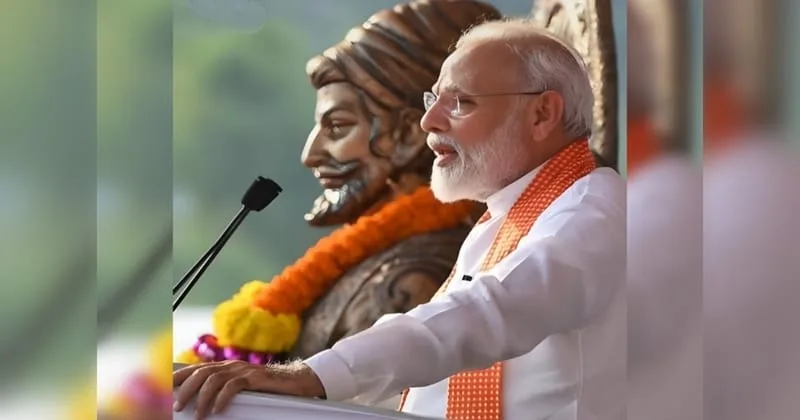
Such a leader does not chase short-term wins but aims for long-term harmony and resilience. This approach aligns deeply with the Indian civilisational ethos, where rulers like Chhatrapati Shivaji Maharaj embodied these ideals. His actions were not just tactical but rooted in Dharma, justice, balance, and the protection of his people and culture. In contemporary times, Prime Minister Narendra Modi has displayed similar traits, particularly in cultural renaissance, and policy rooted in civilisational vision. His leadership, like Shivaji Maharaj’s, reflects not only strategic acumen but also a conscious alignment with India’s historical and Dharmic imperatives.
Let’s explore this through just one lens: the control of the seas.
The Maritime Truth: Who Rules the Sea, Rules the World
Sanjeev Sanyal, in The Forgotten History of India’s Maritime Past, makes a compelling case: control over the seas has historically determined the rise and fall of empires.
The Achaemenids, the Romans, and the Chinese used fleets to protect their supply lines and trade.
The Cholas expanded their influence across Southeast Asia via a powerful navy.
The Portuguese, Dutch, and British didn’t conquer India solely by land, they came and stayed through maritime dominance.
The Battle of Diu in 1509 was decisive; the Portuguese sank the combined fleets of Gujarat, Egypt, and the Zamorin of Calicut, effectively eliminating Indian presence from the Arabian Sea.
By the 17th century, European powers were fighting each other off Indian coasts, while Indians had receded into maritime irrelevance.
This decline wasn’t inevitable. It was the outcome of strategic neglect. While ancient and early medieval India had thriving maritime connections, later powers, especially the Mughals, ignored the seas. Sanyal observes that the Mughals were focused on agrarian revenue and territorial conquests; the ocean simply did not fit into their strategic imagination. This allowed others to dominate India from the coastlines inward.
Shivaji Maharaj: Reclaiming maritime sovereignty and delaying colonisation
Then came Shivaji Maharaj, who broke this pattern. He understood what the Mughals missed: that maritime power was not just about trade, it was about security, sovereignty, and survival. Unlike other rulers of his time, he built a navy from scratch, constructed coastal forts like Sindhudurg and Vijaydurg, and developed shipyards.
As noted in Shivaji, the Founder of Maratha Swaraj, Shivaji was the first Indian ruler in centuries to systematically organise a disciplined naval force. He protected the Konkan coast, challenged European powers, and restored Indian visibility on the waters.
This was not just a military revival, it was a civilisational reawakening. Crucially, his naval assertiveness delayed European colonisation, especially by the British and Portuguese, by at least a century. Because of Shivaji’s maritime resistance, the British could not establish a foothold on the western coast and were forced to enter from the east via Bengal.
Had the British succeeded earlier, they might have accomplished what the Mughals never could, the complete eradication of Sanatana Dharma. British colonisation, as Sanjeev Sanyal also hints, was culturally far more devastating than Mughal rule. The systematic dismantling of Indian education, philosophy, language, and temples was far more intense. We are still surviving as a civilisation because of Shivaji Maharaj. If the British had come earlier, our spiritual and cultural core might not have survived.
Prime Minister Narendra Modi’s Maritime Strategy: Strategic continuity with civilisational depth
Prime Minister Narendra Modi’s maritime doctrine represents a deliberate, multi-dimensional strategy rooted in civilisational memory and forward-looking national interest. It spans port infrastructure, naval strength, maritime diplomacy, and cultural revival.
Port Modernisation and Coastal Integration
Sagarmala Project (launched in 2015): Aims to modernise over 400 ports and coastal assets, reduce logistics costs, and connect industrial zones with sea routes.
Agreements signed in 2024 include Rs 18,000 crore in maritime infrastructure investments across states like Odisha and Tamil Nadu.
Naval Capability and War Readiness
On January 17, 2025, Modi commissioned three indigenous naval assets: INS Surat (destroyer), INS Nilgiri (stealth frigate), and INS Vagsheer (Scorpene-class submarine).
Operation Sindoor (June 2025): Demonstrated rapid deployment of Indian Navy forces, compelling adversary disengagement. Navy Chief Admiral Dinesh Tripathi hailed it as “timely deterrence.”
Strategic Partnerships and Maritime Security
Operation Sankalp (since June 2019): Ongoing Indian Navy mission securing merchant vessels in high-threat zones like the Red Sea and Arabian Sea.
Bilateral maritime security agreements signed recently with Indonesia, Cyprus, and Saudi Arabia cover joint patrols, search and rescue, and anti-piracy operations.
Indo-Pacific Engagement and Naval Diplomacy
Quad-at-Sea (June 2025): Joint maritime mission with Japan, Australia, and the United States, boosting domain awareness and interoperability.
Largest-ever African naval exercise co-hosted with Tanzania in May 2025; Indian Navy deployed INS Chennai and INS Sunayna.
Control of Strategic Chokepoints
Intensified naval presence near the Strait of Malacca, a critical sea lane through which ~60 per cent of Indian trade and 30 per cent of global crude oil passes.
The Andaman and Nicobar Command plays a key role in surveillance and rapid response in this zone.
Maritime Cultural Revival
Development of Lothal Maritime Heritage Complex in Gujarat—reviving India’s ancient port legacy from the Harappan era.
Shipbuilding projects revived at traditional dockyards; Cochin Shipyard Ltd. and Mazagon Dock Shipbuilders lead defence production under the ‘Make in India’ initiative.
Cultural initiatives tie modern maritime policy to India’s civilisational maritime history, re-establishing the nation as a seafaring power of global relevance.
Strategic Vision and Doctrine
SAGAR (2015) – “Security and Growth for All in the Region” – Modi’s guiding principle for regional maritime policy.
Evolved into MAHASAGAR (2024) under Navy doctrine: “Mutual and Holistic Advancement for Security and Growth Among Regions”.
Modi’s maritime policy is not episodic; it is structured, layered, and historically informed. It repositions India as a maritime power, not only through defence or trade, but by invoking cultural memory, regional responsibility, and strategic assertiveness.
History as Compass: A mark of true leadership
What connects Shivaji Maharaj and Narendra Modi is not mere national pride, it is strategic continuity. Both saw the importance of the seas. Both acted when others ignored. Both used history as a guide, not a burden.
This is the mark of a leader who thinks in centuries, not just election cycles.
Learning history in the right context is not a luxury for leaders, it is a necessity. When leaders understand history deeply, they can see long-term patterns. They can rebuild where others forgot. They can avoid past errors and amplify past successes.
The Sea as a Mirror of Leadership
The ocean does not lie. Those who rule it write history. Those who ignore it become history. From the forgotten maritime strategies of ancient India, to the revival under Shivaji Maharaj, to the reassertion under Prime Minister Modi, there is a clear message: greatness lies in recognising patterns, reclaiming legacies, and restoring what was lost. That is why Shivaji Maharaj remains a timeless leader. And that is why Narendra Modi, in learning from that legacy, demonstrates the true essence of visionary leadership.