Swami Vivekananda’s Immortality: End of an era, rise of an idea
July 13, 2026
  • Read Ecopy
  • Circulation
  • Advertise
  • Careers
  • About Us
  • Contact Us
Android AppiPhone AppArattai
Organiser
  • ‌
  • Bharat
    • Assam
    • Bihar
    • Chhattisgarh
    • Jharkhand
    • Maharashtra
    • View All States
  • World
    • Asia
    • Europe
    • North America
    • South America
    • Africa
    • Australia
  • Editorial
  • International
  • Opinion
  • RSS @ 100
  • More
    • Op Sindoor
    • Analysis
    • Sports
    • Defence
    • Politics
    • Business
    • Economy
    • Culture
    • Special Report
    • Sci & Tech
    • Entertainment
    • G20
    • Azadi Ka Amrit Mahotsav
    • Vocal4Local
    • Web Stories
    • Education
    • Employment
    • Books
    • Interviews
    • Travel
    • Law
    • Health
    • Obituary
  • Subscribe
    • Subscribe Print Edition
    • Subscribe Ecopy
    • Read Ecopy
  • ‌
  • Bharat
    • Assam
    • Bihar
    • Chhattisgarh
    • Jharkhand
    • Maharashtra
    • View All States
  • World
    • Asia
    • Europe
    • North America
    • South America
    • Africa
    • Australia
  • Editorial
  • International
  • Opinion
  • RSS @ 100
  • More
    • Op Sindoor
    • Analysis
    • Sports
    • Defence
    • Politics
    • Business
    • Economy
    • Culture
    • Special Report
    • Sci & Tech
    • Entertainment
    • G20
    • Azadi Ka Amrit Mahotsav
    • Vocal4Local
    • Web Stories
    • Education
    • Employment
    • Books
    • Interviews
    • Travel
    • Law
    • Health
    • Obituary
  • Subscribe
    • Subscribe Print Edition
    • Subscribe Ecopy
    • Read Ecopy
Organiser
  • Home
  • Bharat
  • World
  • Operation Sindoor
  • Editorial
  • Analysis
  • Opinion
  • Culture
  • Defence
  • International Edition
  • RSS @ 100
  • Magazine
  • Read Ecopy
Home Bharat

Immortal Swami Vivekananda: The end of an era, the rise of an idea

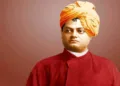
Today, July 4th, marks a poignant anniversary: the passing of Swami Vivekananda in 1902 at the remarkably young age of 39. Yet, to speak of his "death" feels inadequate, for his immense legacy transcends mere mortality

Bhupendra Kumar SullereBhupendra Kumar Sullere
Jul 4, 2025, 08:30 am IST
in Bharat
Follow on Google News
Swami Vivekananda

Swami Vivekananda

FacebookTwitterWhatsAppTelegramEmail

In Indian philosophy, death is not merely a physical event—it is seen as a stage in the higher evolution of the soul. When Swami Vivekananda left his mortal body in a meditative state at Belur Math on July 4, 1902, it was not merely the passing of a great monk. It marked the expansion of a consciousness that came to symbolize India’s renaissance, self-confidence, and national awakening.
This article offers a comprehensive exploration of the circumstances of Swamiji’s death, its interpretation through the lens of Yogic philosophy, its socio-political impact, and its continuity in Indian consciousness.

1. The Final Moments: The Convergence of Yoga and Death
Swami Vivekananda was the hero of the 1893 Parliament of Religions in Chicago, but his extensive travels across America and Europe took a heavy toll on his health. After 1900, he suffered from diabetes, asthma, insomnia, and chronic headaches. Despite this, he never allowed these ailments to hinder his mission. He maintained a disciplined routine of morning meditation, teaching Vedanta to students, evening walks, and deep introspection.

He had already hinted to his close disciples that he would not live beyond the age of 40. On the afternoon of July 4, 1902, he engaged in scriptural discussions with the scholars at the Math, spent a few hours teaching, and later entered deep meditation. In that meditative state, he consciously withdrew his soul from the body through the Brahmarandhra—an act described in the scriptures as Mahasamadhi.

“I am a yogi from a tradition that can choose when to die.” — Swami Vivekananda

2. Not Death, But the Expansion of Life
In the Indian worldview, death is not an end, but a transition. Swami Vivekananda was a living embodiment of this belief. He popularized the Vedantic idea:

“Na jāyate mriyate vā kadācin, nāyaṁ bhūtvā bhavitā vā na bhūyaḥ”
(Bhagavad Gita 2.20)
“He is never born, nor does he die; having once existed, he never ceases to be.”

For Swamiji, death was not a matter of sorrow. He once said:

“I do not fear death, for I know I am not the body, I am the soul.”

He had already instructed his fellow monks that his death should not be a cause of mourning, but a source of renewed energy for service and spiritual pursuit.

3. The Role of Death in National Renaissance
Though his demise brought a wave of sorrow across the country, it was soon followed by a surge of action inspired by his ideas. Numerous institutions, movements, and organizations were born in the wake of his teachings:

(a) Reorganisation of the Ramakrishna Mission
After his passing, the Ramakrishna Mission evolved into a powerful service organization. The seeds he planted grew into a vast tree spreading across the nation, contributing to education, healthcare, rural development, women’s empowerment, and religious harmony.

(b) Awakening Among Revolutionaries
Freedom fighters like Sri Aurobindo, Bhagat Singh, and Netaji Subhas Chandra Bose drew immense inspiration from him. Netaji famously said:

“Vivekananda was the first to make me realize I was an Indian.”

(c) Contribution to Educational Movements
Institutions such as Visva-Bharati, Bharatiya Vidya Bhavan, Sharada Peeth, and Banaras Hindu University reflect the deep imprint of Swamiji’s educational vision.

4. Interpretation of Death in Yogic Philosophy
In Raja Yoga, Swami Vivekananda explained that a yogi can choose the moment of their physical departure. For him, death was not a random event but a conscious journey of the soul’s complete expansion. He frequently quoted from Patanjali’s Yoga Sutras:

“Kāyendriya-siddhir-aśuddhi-kṣayāt tapaḥ॥”
“Through austerity, the body and senses attain perfection.”

Swamiji had awakened his Kundalini Shakti and ultimately merged into the Sahasrara chakra—the thousand-petaled lotus at the crown. This was not a normal death, but a yogic state of becoming one with the Absolute—Brahma-lina.

5. Global Perspective: Worldwide Reaction
Swamiji’s passing drew significant attention abroad. Newspapers like the New York Times, London Times, and Paris Gazette described him as “The Philosopher Representative of Asia” and “The Young Sage of India.”

Lady Sarah Chapman, who presided over his lectures in London, wrote:

“He was a representative of God, who came to teach us that love and service are the essence of religion.”

6. Impact on Modern India
After his death, while the Ramakrishna Mission carried forward his legacy of practical religion, his thoughts began to influence India’s Constitution, educational reforms, cultural revival, and even foreign policy.

Dr. Sarvepalli Radhakrishnan observed:

“Vivekananda’s death gave us a work ethic—Karma Yoga, Rashtra Yoga, and Jnana Yoga.”

In 2013, the Government of India declared Swami Vivekananda’s birthday (January 12) as National Youth Day—a testimony to the immortality of his contribution.

An Immortal Idea Beyond Death
Swami Vivekananda’s death was not an event of mourning, but the dawn of a new spiritual and national consciousness. He transformed death into a celebration of life. His words continue to guide us:

“Arise, awake, and stop not till the goal is reached.”

He may have departed in body, but his spirit, ideas, and dedication to service live on in the minds of India’s youth and across the world. His death, in essence, was a proclamation of the immortality of his vision.
Topics: Bharatiya Vidya BhavanRamakrishna MissionSwami Vivekanada Death Anniversary4 JulyTo the Fourth of July
ShareTweetSendShareSend
✮ Subscribe Organiser YouTube Channel. ✮
✮ Join Organiser's WhatsApp channel for Nationalist views beyond the news. ✮
Previous News

MY Bharat 2.0: Transforming youth engagement with AI-based career services and real-time mentorship

Next News

PM Modi calls Kamla Persad Bissessar “daughter of Bihar”, asks her to offer Mahakumbh & Saryu water in ‘Ganga Dhara’

Related News

Swami Vivekananda

What Swami Vivekananda has given us!

The Russian translation of ancient Indian Sanskrit classic, Yoga-Vasishtha was presented to Cheremin Sergey

Sanskrit classic Yoga-Vasishtha presented to Minister Sergey Cheremin; Marks new chapter in Indo-Russian cultural ties

Swami Vivekananda at Chicago in the World’s Parliament of Religions, 1893

‘To the Fourth of July’: A poem written by Swami Vivekananda 4 years before his Mahasamadhi

Ram Krishna Mission School vandalised in Christian dominated village

Meghalaya: Christian dominated village attacks Ramakrishna Mission school; People condemn the attack

Hindu organisations under attack in West Bengal: Sanyasis peacefully walked the streets against sacrilegious remarks

Book Review: Strategic Culture in Ramayana

Load More

Latest News

A delegation of Hindu Aikyavedi met Chief Minister VD Satheeshan

Keralam: Hindu Aikyavedi delegation meets CM, submits resolutions adopted at Hindu leadership conclave

IED blast targets Assam Rifles Convoy in Nagaland; One martyred

IED attack on Assam Rifles convoy in Nagaland; One soldier martyred, four injured; CM Rio terms it cowardly act

Representative Image

PoJK protests hit White House as Kashmiri diaspora shouts anti-Pakistan slogans; Muzaffarabad rises against abuse

Home Minister Amit Shah laying foundation stone for 125-foot Dr Syama Prasad Mookerjee statue in Kolkata

Dr Syama Prasad Mookerjee: Not just a statue but the foundation of Sonar Bangla

Indian mathematician T A Sarasvati Amma

The Woman Who Rewrote Mathematical History: The extraordinary journey of T A Sarasvati Amma

The people in Pakistan-occupied Jammu Kashmir (PoJK) are rising against Pakistan's brutality

POJK Unrest: Azad or gulam

Prime Minister Narendra Modi (Left) and Indonesian President Prabowo Subianto (Right)

PM Modi’s Indonesia Visit: Threads from the past, transformation for future

PoJK: Uprising against continued colonisation

Delhi Riots 2020

Delhi Riots 2020: Former AAP Councillor Tahir Hussain & four others convicted for murdering IB Officer Ankit Sharma

500-year-old murti recovered from Bay Of Bengal after fishermen find it in fishing net

500-year-old murti recovered from Bay of Bengal by fishermen; Authorities probe origin & possible smuggling link

Load More
  • Privacy
  • Terms
  • Cookie Policy
  • Refund and Cancellation
  • Delivery and Shipping

© Bharat Prakashan (Delhi) Limited.
Tech-enabled by Ananthapuri Technologies

  • Home
  • Search Organiser
  • Bharat
    • Assam
    • Bihar
    • Chhattisgarh
    • Jharkhand
    • Maharashtra
    • View All States
  • World
    • Asia
    • Africa
    • North America
    • South America
    • Europe
    • Australia
  • Editorial
  • Operation Sindoor
  • Opinion
  • Analysis
  • Defence
  • Culture
  • Sports
  • Business
  • RSS @ 100
  • Entertainment
  • More ..
    • Sci & Tech
    • Vocal4Local
    • Special Report
    • Education
    • Employment
    • Books
    • Interviews
    • Travel
    • Health
    • Politics
    • Law
    • Economy
    • Obituary
  • Subscribe Magazine
  • Read Ecopy
  • Advertise
  • Circulation
  • Careers
  • About Us
  • Contact Us
  • Policies & Terms
    • Privacy Policy
    • Cookie Policy
    • Refund and Cancellation
    • Terms of Use

© Bharat Prakashan (Delhi) Limited.
Tech-enabled by Ananthapuri Technologies