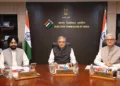
MADURAI: In a significant relief for thousands of devotees planning to attend the Bhagwan Murugan conference in Madurai, a division bench of the Madras High Court, Madurai bench, on June 20, 2025, unequivocally struck down a contentious condition that mandated participants to obtain prior passes from district police authorities for their vehicles. This landmark ruling by Justices G.R. Swaminathan and Rajasekhar champions fundamental rights, emphasizing freedom of movement and assembly, and underscores the judiciary’s role in curbing arbitrary administrative directives.
The legal battle began when Hindu Munnani functionary Arasupandi challenged six of the 52 conditions imposed by the Assistant Commissioner of Police, Anna Nagar Range, Madurai Greater City (North), who had initially granted permission for the conference on June 12, 2025. Among the most restrictive conditions was the requirement for all vehicles carrying conference participants to secure passes from their respective sub-division Deputy Superintendents of Police (DSPs). This condition, according to the petitioner, placed an undue burden on common devotees, especially those traveling from distant areas, and was not typically imposed on other large public gatherings, including political ones.
Earlier, a single judge, Justice B. Pugalendi, had partially upheld the necessity of vehicle passes, citing traffic management concerns. While acknowledging the need for efficiency, he had directed that passes should be issued within 24 hours of application and that any refusal must be justified with valid reasons. Following this, a fresh plea was made to implement an online e-pass system, similar to those used for tourist vehicles entering popular destinations like Ooty and Kodaikanal. However, this request was declined by the court, though an extension for applying for physical passes was granted until 10 a.m. on June 21. The matter briefly escalated to the Supreme Court, which, however, declined to intervene, advising the petitioners to pursue their remedies at the High Court.
The appeal against the single judge’s order landed before the division bench of Justices G.R. Swaminathan and Rajasekhar on June 20. The counsel for Hindu Munnani presented a compelling argument, asserting that the Assistant Commissioner of Police in Anna Nagar had overstepped her territorial and jurisdictional bounds by issuing a blanket order restricting vehicle entry into the entire Madurai city without proper passes. They meticulously pointed out that such a far-reaching restriction was not within the purview of an officer whose authority is confined to a specific geographical area.
A key contention raised by Senior Counsel for the petitioner revolved around Condition No. 7, which mandated vehicle passes. The counsel highlighted the practical difficulties for “common devotees” who might decide to attend the event at the last minute and would find it arduous to navigate the bureaucratic process of approaching a Deputy Superintendent of Police, submitting an RC book, driving license, and Aadhaar card, merely to obtain a pass. This, they argued, effectively curtailed the fundamental right to assemble and participate in a democratic gathering.
The division bench, in its keenly observed judgment, meticulously analyzed Condition No. 7, which stated: “no vehicle carrying the conference participants without a vehicle pass will be allowed to enter Madurai City limits. It also states that such a vehicle pass has to be obtained from the respective offices of Deputy Superintendent of Police. The applicants have to submit RC book, driving license and Aadhar card.”
Click here to download the Madras High Court Judgement
The Judges expressed their astonishment at such a directive, stating, “We fail to understand as to how such a condition could have been imposed by the Assistant Commissioner of Police, Anna Nagar Circle, Madurai in the first place. An Assistant Commissioner can have jurisdiction and sway only over her territorial limits. She could not have issued an order preventing entry of vehicles into Madurai city.” This highlighted the fundamental issue of ultra vires – an action taken without legal authority.
More critically, the bench delved into the constitutional implications of such a restriction. Citing Article 19(1)(d) of the Constitution of India, which guarantees all citizens the “right to move freely throughout the territory of India,” the Judges emphatically declared that “It is open to any citizen to enter Madurai city in his/her vehicle and such a right cannot be interfered with by an Assistant Commissioner of Police….” They underscored that fundamental rights cannot be curtailed without strong, demonstrable reasons that are both reasonable and proportionate.
The Court found a conspicuous “lack of justification” for the impugned condition. “The authorities have not specified the problems anticipated by them and not demonstrated as to how insistence on vehicle passes would quell the problem,” the bench observed, pointing out the absence of a clear rationale for such a draconian measure.
Further, the Judges invoked Article 19(1)(b) of the Constitution, which guarantees the right “to assemble peaceably and without arms.” They reasoned that if a person from Ramanathapuram decided to attend the conference at the last moment and was prevented by the vehicle pass rule, their fundamental right to attend the gathering would be unjustly infringed. “Thus the fundamental right guaranteed under this Article is also involved,” the bench stated, reiterating the importance of facilitating democratic participation.
The Court also provided a broader commentary on the nature of a democratic society. “We are a republican democracy. Just as ease of doing business is important, the ease of participation in democratic gatherings is equally vital,” the judges remarked. They critically examined the practicality of the required physical pass: “Calling upon the citizen to go the office of the DSP and take a pass may not look objectionable on the face of it. But in reality, things work out otherwise.”
Offering a more technologically advanced and less intrusive solution, the bench suggested, “If the object of the Police authority is to gather the details and particulars about the vehicles entering the area where the event is to be held, it can be very easily achieved by employing a very simple technology such as scanning the license plates of vehicles.” This observation not only provided a practical alternative but also highlighted the police’s failure to adopt modern, less burdensome methods.
The ruling was based primarily on two decisive factors: “a) lack of jurisdiction on the part of the Police officer who stipulated the impugned condition and b) the lack of justification.” The Judges firmly stated that since the condition was not a statutory provision, there was no compulsion to “read it down and sustain the same.” Finding that the Assistant Commissioner lacked the authority to issue such a “blanket prohibitory order restraining the entry of vehicles into Madurai city without a vehicle pass for the conference participants,” the bench concluded that they had to “necessarily strike it down.”
In their concluding remarks, Justices Swaminathan and Rajasekhar reiterated that “the fundamental rights of the citizens cannot be interfered with without strong reasons which are totally absent in this case.” They clarified that the scope of their writ petition was limited to examining the jurisdictional power of the Assistant Commissioner of Police in issuing such an order, not any other aspect of the conference or its conditions.
In a poignant acknowledgment of recent crowd tragedies, particularly the stampede during the RCB celebration in Bengaluru (referring to the event in the other prompt), the judges added, “The organisers assure us that pucca arrangements have been made so that there is no stampede which was witnessed in Bangalore, Delhi and other places recently.” This remark implicitly highlights the judiciary’s awareness of public safety concerns while simultaneously asserting that such concerns must be addressed through reasonable and legally sound means, not through arbitrary restrictions on fundamental rights.
The division bench thus modified the order of the learned single Judge and unequivocally set aside the impugned Condition No. 7, ensuring that devotees can attend the Bhagwan Murugan conference in Madurai without the hurdle of obtaining mandatory vehicle passes, marking a significant victory for constitutional liberties in the state.