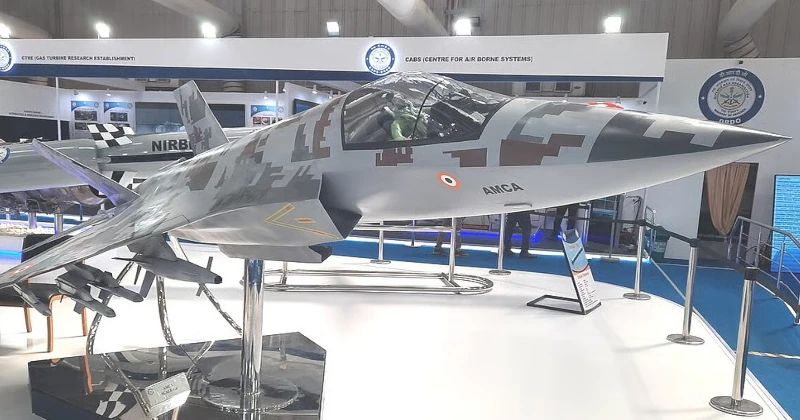
In a transformative step towards self-reliance in defence, India has greenlit the development and manufacturing of the Advanced Medium Combat Aircraft (AMCA) under a Public-Private Partnership (PPP) model, with its design officially approved. This move to create India’s first fifth-generation stealth fighter jet underscores the nation’s commitment to modernising its air force and reducing reliance on foreign technology amid growing regional security challenges.
Strategic imperative amid regional tensions and delivery delays
The AMCA program’s approval comes at a critical juncture, as India faces escalating tensions with Pakistan, exemplified by operations like Operation Sindoor, which highlighted the evolving nature of aerial warfare with extensive drone usage. While not the primary driver, such conflicts emphasise the need for advanced indigenous capabilities. Pakistan’s acquisition of China’s J-10 jets has intensified the regional arms race, pushing India to prioritise technological parity.
Compounding this urgency are delays in the delivery of the Tejas Mk1A, as highlighted by the Indian Air Force (IAF) chief, Air Chief Marshal AP Singh. These delays, attributed to supply chain bottlenecks and production challenges at Hindustan Aeronautics Limited (HAL), have left the IAF operating below its sanctioned strength of 42 squadrons, relying heavily on ageing Soviet-era aircraft. The IAF chief emphasised the need for faster indigenous production, justifying the PPP model for AMCA to leverage private sector efficiency and innovation to meet timelines.
AMCA: A fifth-generation powerhouse
Designed by the Aeronautical Development Agency (ADA), the AMCA is a twin-engine, multirole stealth fighter equipped with cutting-edge features like supercruise, advanced stealth, and provisions for directed energy weapons. It is poised to execute diverse missions, including air supremacy, ground strikes, suppression of enemy air defences (SEAD), and electronic warfare (EW), eventually replacing the IAF’s Sukhoi Su-30MKI fleet.
With prototypes in development and mass production targeted for 2035, the IAF plans to induct seven squadrons, totalling 126 AMCA units, significantly boosting its combat capabilities.
PPP Model: Catalysing indigenous innovation
The PPP model, approved by Defence Minister Rajnath Singh, fosters collaboration between the ADA and private industry, aligning with the Atmanirbhar Bharat initiative. This approach aims to harness private sector expertise to expedite development, reduce costs, and build a robust domestic aerospace ecosystem. Hyderabad’s emergence as an aerospace hub is evident, with VEM Technologies Private Ltd delivering the first centre fuselage for the Tejas Mk1A, showcasing the private sector’s growing role in defence manufacturing.
The PPP model addresses lessons learned from Tejas delays, ensuring AMCA benefits from streamlined production and diversified supply chains, enhancing efficiency and scalability.
Indigenous technological advancements
The AMCA will integrate cutting-edge indigenous systems, including the Uttam Active Electronically Scanned Array (AESA) radar, developed by the Electronics and Radar Development Establishment (LRDE). This radar offers multi-target tracking and high-resolution imaging, bolstering the AMCA’s combat prowess.
On the propulsion front, the Gas Turbine Research Establishment (GTRE) is refining the Kaveri engine, addressing past performance shortfalls with upgrades like a new afterburner to meet the AMCA’s thrust requirements. A successful indigenous engine will mark a major milestone in India’s defence self-reliance.
India-made weapons shine in Operation Sindoor
Operation Sindoor, launched on May 7, 2025, demonstrated the prowess of India’s indigenous defense systems, validating the push for self-reliance. Key highlights include:
BrahMos Supersonic Cruise Missile: Jointly developed by India’s DRDO and Russia’s NPO Mashinostroyeniya, the BrahMos was a cornerstone of India’s precision strikes. On May 10, the IAF used air-launched BrahMos missiles to target Pakistani airbases, including Noor Khan and Rahim Yar Khan, causing significant damage to radar installations, command centers, and ammunition depots. The missile’s sub-meter precision and versatility across land, air, and naval platforms obliterated terrorist infrastructure, such as the Jaish-e-Mohammed headquarters in Bahawalpur, forcing Pakistan to seek a ceasefire.
Akash Surface-to-Air Missile (SAM) System: The DRDO-developed Akash SAM system was pivotal in India’s air defense, neutralising Pakistani drones and missiles during retaliatory attacks on May 7-9. Deployed along the Line of Control and western border, Akash’s 45-70 km range and multi-target engagement capability thwarted threats targeting 15 Indian military installations, including Jammu, Srinagar, and Pathankot. Its “stellar performance,” as noted by the Press Information Bureau, has drawn interest from countries like Armenia, boosting India’s defense export prospects.
D4 Anti-Drone System: Developed by DRDO and Bharat Electronics Limited (BEL), the D4 Drone Detect, Deter, Destroy system countered Pakistan’s swarm of Turkish and Chinese drones. Capable of real-time detection, tracking, and neutralisation through GPS spoofing, radio frequency jamming, and laser-directed energy weapons, the D4 ensured minimal penetration of Indian airspace. Its success against Pakistani UAVs, including Yiha (YEEHAW) drones, underscored India’s advancements in counter-drone technology.
SkyStriker Loitering Munitions: A collaboration between Bengaluru-based Alpha Design and Israel’s Elbit Systems, the SkyStriker “suicide drones” made their operational debut in Operation Sindoor. These kamikaze drones, capable of carrying a 5kg warhead over 100 km, executed precision strikes on terrorist camps in Pakistan-occupied Kashmir, enhancing India’s ability to target high-value assets with minimal collateral damage.
Nagastra-1 Loitering Munition: Inducted by the Indian Army in June 2024, the Nagastra-1, India’s first indigenous suicide drone, played a critical role in targeting terrorist infrastructure. Its ability to loiter and strike with precision complemented the BrahMos and SkyStriker, showcasing India’s growing expertise in unmanned systems.
Akashteer Air Defense Management System: This indigenous system, integrated with the IAF’s Integrated Air Command and Control System (IACCS), provided real-time situational awareness, coordinating multi-layered defenses. It enabled seamless integration of Akash SAMs, legacy systems like Pechora and OSA-AK, and counter-UAS grids, neutralising Pakistan’s Chinese PL-15 missiles and Turkish drones in just 23 minutes on May 8.
These systems, battle-tested against Pakistan’s Chinese and Turkish arsenals, demonstrated superior reliability and precision, with no loss of Indian assets. The operation’s success, as noted by Prime Minister Narendra Modi on May 12, 2025, affirmed that “the time for Made-in-India defence equipment in 21st-century warfare has arrived,” boosting global interest in India’s defence exports, projected to reach Rs 50,000 crore by 2029.
The approval of the AMCA’s design and its development under the PPP model is a bold step towards modernising the IAF and achieving defence self-reliance. By addressing delays seen in programs like Tejas and leveraging private sector expertise, India is poised to deliver a world-class fifth-generation fighter.