





The journey of the Rashtriya Swayamsevak Sangh, which started in the year 1925, will attain the milestone of its centenary on Vijayadashami this year. Today, the Sangh has become the most unique, widespread and nationwide organisation. After the Pratinidhi Sabha (Representative Council), the resolution and call of the Sangh came out, in which there was a call for evaluation of this journey, introspection and resolve of rededication to the fundamental thought of the Sangh. What is the functioning of the Sangh, and what are the dimensions? Who were those people who provided depth to this resolution? What were the turning points, what were the incidents, after going through which the Sangh has stood before us in this form today? What do the opponents of the Sangh think, and what does the Sangh think about its opponents? What is the Sangh today, and what will the Sangh be tomorrow? To explore all these questions and more—including its path ahead, Organiser Editor Prafulla Ketkar, Panchjanya Sampadak Hitesh Shankar, Editor of Marathi Weekly Vivek Ms Ashwini Mayekar and Associate Editor of Malayalam daily Janmabhumi M Balakrishnan had a detailed conversation with RSS Sarsanghchalak Dr Mohan Bhagwat. Excerpts:
(This conversation was in the backdrop of the Akhil Bharatiya Pratinidhi Sabha of RSS on March 21-23, 2025 and was recorded before the Operation Sindoor, at the Organiser-Panchjanya office)
As a Swayamsevak and the Sarsanghchalak, how do you view this 100-year journey of the Sangh?
Dr Hedgewar initiated this mission with a thoughtful deliberation. The challenges before the nation were analysed, and through experience and experimentation necessary treatment was decided, which proved to be apt. By 1950, confidence was instilled about the Sangh way of functioning, and the Sangh work could march forward, overcoming all the obstacles. In the next phase, the nationwide expansion of Sangh and the convergence of Swayamsevaks in society started. In four decades, Sangh Swayamsevaks, by navigating in different walks of national life, through their character, actions and a spirit of belonging, earned the trust of society. After the 1990s, it was proved that the nation can be governed on the basis of this thought and qualities. Now, the next stage is to ensure that, following the same thought process and qualities, the entire society works with sincerity and selflessness, leaving aside all differences, starts working for the nation to take it to the pinnacle of glory.
What were the major milestones in this 100-year journey?
Initially, the Sangh had nothing. There was no recognition of its ideology or availability of means of propagation. There was nothing except neglect and opposition in the society, not even Karyakartas. Had one fed this data into a computer, it would have predicted a premature death for this entity. But the Sangh survived and successfully emerged as a resilient force after facing the challenges of saving Hindus during the Partition of the country and the ban on RSS. By 1950, it was ascertained that the Sangh’s work will continue and grow, and the Hindu society can be organised with this method. Later, the Sangh’s work was expanded even more than before. The society realised the significance of Sangh’s strength during the Emergency of 1975 due to the constructive role of Sangh in restoring democracy. Later, through the participatory movements like Ekatmata Rath Yatra, Kashmir-related awakening, Shri Ram Janmabhoomi Mukti Andolan and Vivekananda Sardhashati (150th Anniversary) and the massive expansion of Sewa works (service activities), the sense of credibility exponentially extended towards the Sangh ideology and the Sangh across the society.
What were the learnings from the crises of 1948 and 1975?
Both the 1948 and 1975 bans on the RSS were politically motivated. Even those who imposed them knew very well that the Sangh was not harmful — on the contrary, it was beneficial. However, due to the natural ideological competition in such a large society, to maintain their political dominance, the people in the Government chose to suppress the Sangh.
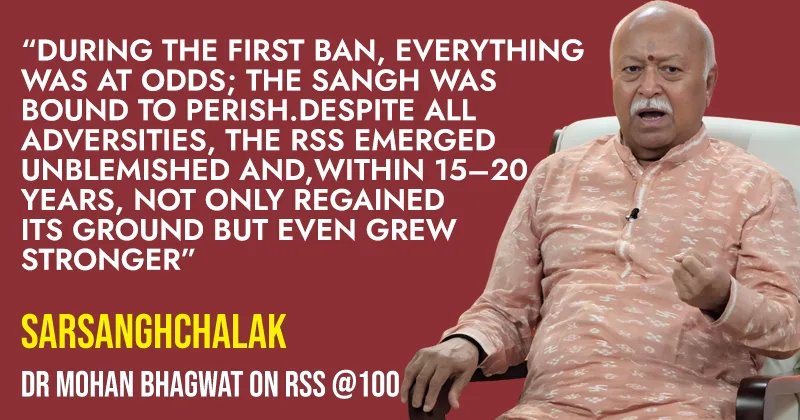
During the first ban, everything was at odds; the Sangh was bound to perish. Despite all adversities, the RSS emerged unblemished and, within 15–20 years, not only regained its ground but grew even stronger.
Swayamsevaks, who only use to run shakhas and did not have any major societal role, started participating in various social activities, ensuring their decisive roles.
In a way, the ban of 1948 helped the Sangh in realising its own potential, and Swayamsevaks started planning for a leading role in social and systemic transformation. From the inception, it was clear that the Sangh work is not limited to a one-hour shakha but the Sangh Sanskars, the values imbibed in the Shakha, should be reflected in the remaining 23 hours— in personal, family, social and professional life. Later, during the 1975 Emergency, society could experience the inherent but extended strength of the Sangh. When many of the stalwarts were paralysed in fear and despair, an ordinary Swayamsevak would confidently remained assured about the passage of difficult times and emerge unscathed from the crisis.
During the 1975 Emergency, the RSS prioritised restoring democracy over fighting against ban on itself. We also stood by those who generally used pessimistic language against the Sangh. In this period, the Sangh emerged as an intellectual, trustworthy pole of the society, especially among the thought leaders. Post-Emergency, the Sangh came out with a multifold strength.
Despite numerical and geographical expansion, how did the Sangh manage to maintain the qualitative dimensions of work and training of Swayamsevaks?
The qualitative and quantitative dimensions are not exclusive to each other; if you neglect one, the other will diminish over a period of time. That’s why the Sangh from day one has decided to organise the entire society – that is, quantitative expansion encompassing all. But this ‘organising’ has a specific meaning and content.
We have devised certain standards for developing a person as per his temperament and how such individuals should work collectively with the sense of ‘we’ to function as an organisation. We have to grow without breaking the standards or compromising with them but that does not mean excluding people from the organisation.
There is an incident from the early days of a big organisation. A new karyakarta with a socialist background joined the organisation. He was a chain-smoker. First time, he attended the organisational abhyas varg (training camp), where not even betel nut was allowed. He was uncomfortable the whole day. At night, the Organising Secretary took him for a walk and suggested him to visit a cigarette shop around the corner and have a smoke and also instructed him not to take any inside the camp. He eventually became a dedicated Karyakarta and quit smoking. He contributed to the organisation in attaining great heights in that region.
Accept people as they are—we have this flexibility. At the same time, we also have the art of affection to transform him as per the need. We have such courage and strength. This is the reason we’ve grown while sustaining quality. We want quality in the organisation, but we also keep in mind that we have to qualitatively transform the entire society.
The Sangh has been functioning as per the foundational thoughts of Dr Hedgewar and Shri Guruji. If change is required, how is it approached?
The original thoughts of Dr Hedgewar, Sri Guruji, or Balasaheb are not distinct from the eternal (Sanatan) tradition and culture. The Sangh method of functioning has been firm and working after the deep contemplation and the experiences based on the actual experimentations of the Karyakartas. From the beginning, there is no scope for scriptural, personality-driven driven or blind imitation. We are principle-centred. We may take inspiration and follow the direction given by great personalities, but in every Desh-Kaal-Paristhiti (time and situation), we must carve our own path. This calls for constant discernment between what is eternal (nitya) and what is situational (anitya).
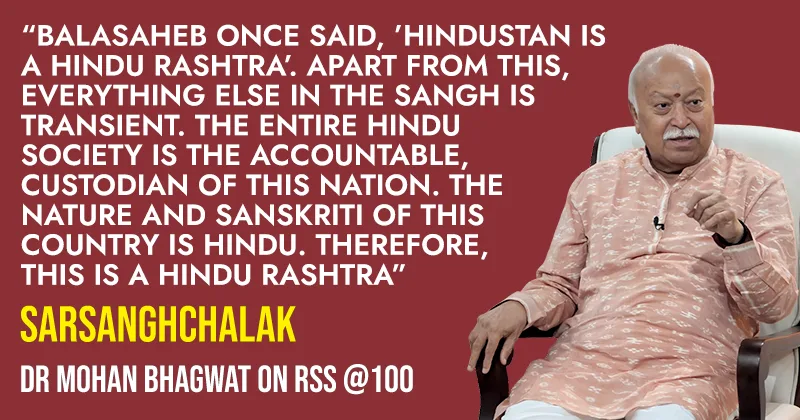
What is nitya in the Sangh? Balasaheb once said, “Hindustan is a Hindu Rashtra’. Apart from this, everything else in the Sangh is transient. The entire Hindu society is the accountable custodian of this nation. The nature and sanskriti of this country is Hindu. Therefore, this is a Hindu Rashtra.”
Everything is to be done while maintaining this core. Hence, the Sangh Swayamsevak, while taking the oath, explicitly states: “The all-round development of the Hindu Rashtra while protecting the sacred Hindu Dharma, Hindu Sanskriti and Hindu society”. The definition of “Hindu” is also comprehensive — there is enough scope in it to maintain the fundamental framework and direction and still make necessary changes as per the need of time and situation. The Sangh pledge also says: “I am an organic element of the Sangh”, organic element means one who shapes the Sangh and inalienable part of the Sangh.
Therefore, there is complete freedom to express diverse and conflicting opinions during the discussion. Once a decision is reached by building consensus, everyone keeps aside their individual opinions by merging them into the collective decision. The decisions taken are accepted as theirs by everyone. Hence, everyone has the freedom to do work and still maintain direction with all others. The eternal is preserved; the transient evolves with time, space, and context.
Outsiders, who perceive Sangh without direct experience, often see it structurally but how does the internal process of introspection and discussion work?
There’s a well-established system where the objective and essence are constant. While the delivery may change. Structures may change, but the core essence of that structure remains the same. Along with the situation, the mindset is equally important.
Therefore, our training programmes take into account the national situation and challenges, etc. Accordingly, how should swayamsevaks prepare themselves, which qualities constitute the organisation and what should be done to inculcate those qualities to address those challenges is also thought about.
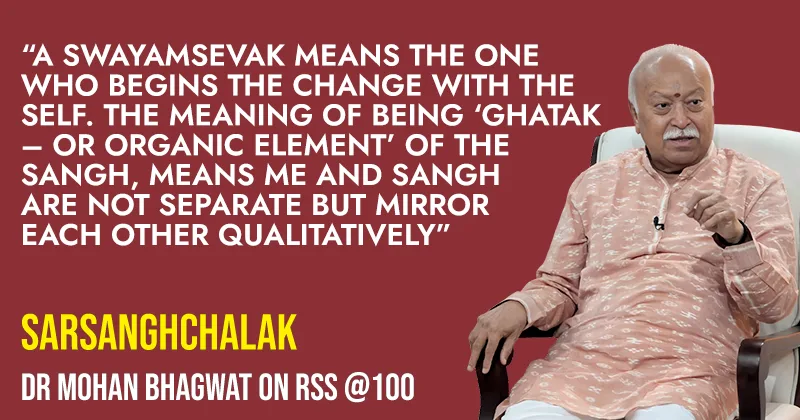
We daily remind ourselves about the collective resolve in the form of Prarthana, the prayer, and individual resolve, in the form of Pratigya, the pledge. A swayamsevak means the one who begins the change with the self. The meaning of being ‘Ghatak – or organic element’ of the Sangh, means me and Sangh are not separate but mirror each other qualitatively, as with the relationship between the drops and the ocean, just as each drop constitutes the entire ocean and the ocean consists of each drop. This symbiotic relationship between the individual and the collective whole has been intact in the Sangh since its inception.
Introspection is a continuous process for a Swayamsevak. When success comes, it is the collective effort of the Sangh; in case of failure, personal shortcomings are evaluated. This spirit is central to the training of swayamsevaks.
Today, society and lifestyle have drastically changed. Is the model of daily shakha still relevant, or are there any alternatives?
While the programmes in a shakha may have alternatives, the essence of a shakha is—coming together, cultivating collective virtues, and reigniting the resolve on a daily basis that we are working for the param vaibhav (ultimate glory) of Bharat Mata (our motherland) —this is the root — meeting, and cooperating with each other is fundamental. This is the basis, it is irreplaceable.
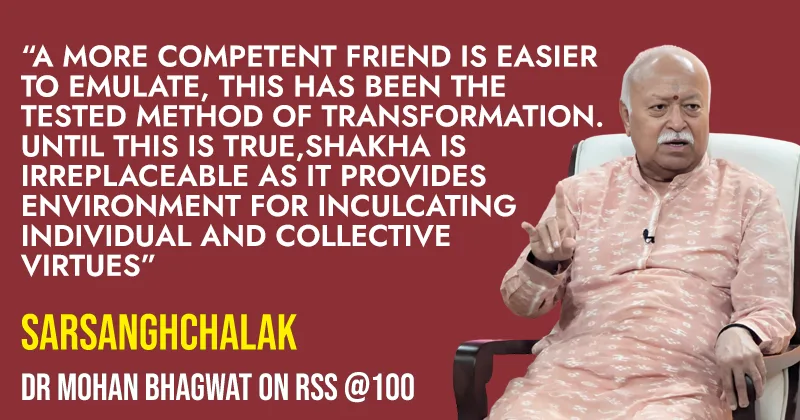
A common person remains common until he is connected with the collective whole. Then even an ordinary person also do extraordinary work and unimaginable sacrifices. For achieving this, what needs is a conducive environment and conditions to be part of that environment. Ideals and affinity are the only facilitators of change, nothing else. All over the world, there exists a model for transformation, somebody becomes agent of self-transformation, which inspires others to emulate. Such a model or ideal cannot be distant; it has to be close by and with a sense of belongingness. There are many great personalities, we know them and have respect and reverence for them, but individually, we generally follow the people around us. We generally do as per the environment provided by our peer group. A more competent friend is easier to emulate; this has been the tested method of transformation. Until this is true, Shakha is irreplaceable as it provides environment for inculcating individual and collective virtues. While the time and attire of shakha may change (and that’s already allowed), there is no alternative to Shakha. Shakha is never irrelevant. Today, people from advanced countries are coming and studying our shakha model, asking about it. Every ten years, we contemplate whether there is any other alternative. I have been present in such contemplations for six-seven times, but till date, no viable alternative has yet emerged.
How has Sangh’s work been growing in the Vanavasi (Scheduled Tribe) areas?
The primary work in the forest areas is to empower the tribal people and serve them. Later, the efforts for safeguarding their interests were also included. We aspire that the leadership should emerge among the Janjatiya from within—leaders who care for their own people and see themselves as an integral part of the nation.
The number of Swayamsevaks working in these areas is steadily increasing. The efforts to build leadership and Karyakartas at the grassroots level, who would echo the national sentiments and contribute accordingly, are going on. To achieve the same, reawakening about the Scheduled Tribe traditions, their roots, local icons and their contribution in the freedom struggle is necessary. Shakhas are expanding across the tribal regions of Bharat, including the North-eastern parts.
Hindus have been facing exploitation in the neighbouring countries, violence has been inflicted on them. Do human rights defenders at the global level care about the same? Sangh in the recently held Pratinidhi Sabha discussed about this issue. What is your take?
Someone will worry about Hindus only when Hindus are strong enough. As Hindu society and Bharat are intertwined, the glorious nature of Hindu society will bring glory to Bharat. Such a strong Hindu society can only present a model for taking along the people of Bharat who do not consider themselves Hindus, as at one point they were also Hindus. If the Hindu society of Bharat becomes strong, then automatically, Hindus will gain strength globally. This work is going on, but it is not yet complete. Slowly but surely, that situation is evolving.
This time, the way anguish against the atrocities on Hindus in Bangladesh has been expressed is unprecedented. Even Local Hindus now say, “We won’t flee. We’ll stay and fight for our rights.”
Now, the internal strength of the Hindu society is increasing. As the organisation grows, its impact will translate naturally. Until then, we must keep fighting.
Wherever Hindus are in the world, we will do everything possible for them, following the international norms. Sangh exists for the same. Swayamsevaks take oath ‘to work for all-over development of the Hindu Rashtra by protecting Dharma, Sanskriti, and society’.
What is the Sangh’s vision regarding national security, military strength, and economic power?
We must strive for strength. As we pray through the daily Prarthana: “Ajayyam cha viśvasya dehīśa śaktim” — “Grant us such a strength that globally we are invincible”.
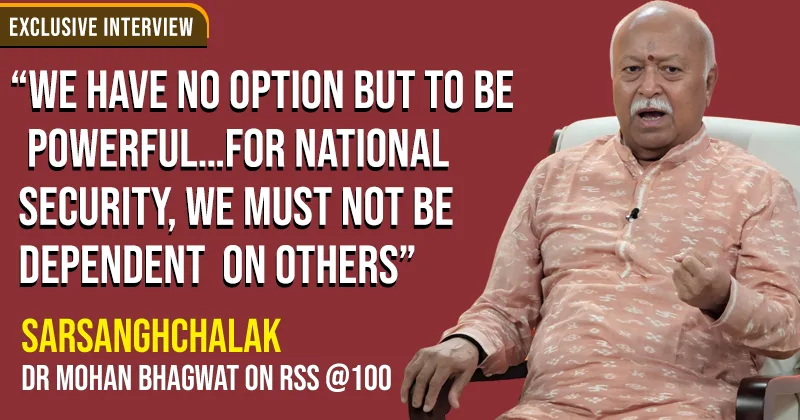
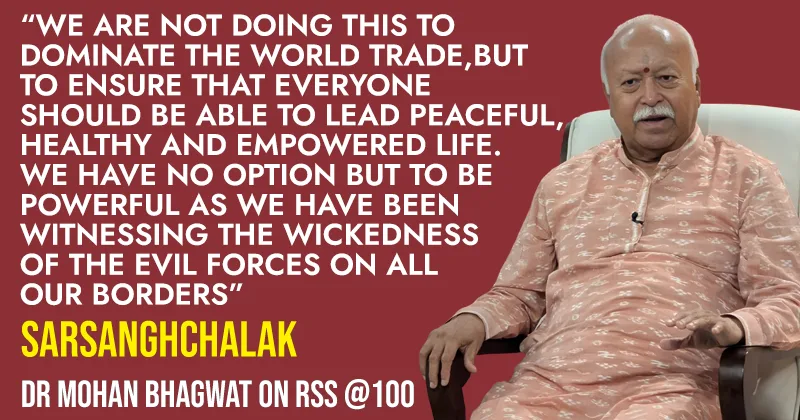
True strength is internal. For national security, we must not be dependent on others. We should be able to defend ourselves. No one should be able to conquer us, not even if multiple powers come together. There are evil forces in the world that are aggressive by nature. A virtuous person is not safe just because of his virtues; hence, virtues should be combined with strength. Mere brute power can be directionless, leading to blatant violence; hence, power should be combined with righteousness. So we must worship both virtues and strength. For the protection of the good, for the destruction of the wicked, should be the nature of our power. When no option is available, then wickedness has to be eradicated forcefully. We are not doing this to dominate the world trade, but to ensure that everyone should be able to lead peaceful, healthy and empowered life. We have no option but to be powerful, as we have been witnessing the wickedness of the evil forces on all our borders.
Given Bharat’s linguistic, religious, and cultural diversity, how does Sangh promote inclusivity?
Come and see for yourself, people from all languages, sects, and backgrounds work together in the Sangh, with great joy. The Sangh songs are there not just in Hindi but in multiple languages. Each language has poets, singers and composers who compose patriotic and inspirational songs of Sangh, and yet the three songs in different languages assigned during the Sangh Shiksha Varg are sung across Bharat. While retaining the unique identity, everyone is working by upholding the sense of one nationhood and unity and integrity of the nation. This is Sangh, which provides a thread to put all diversities in one garland of unity.
The Sangh talks and works for Samarasta (समरसता), but some people speak for equality. How do you differentiate the two?
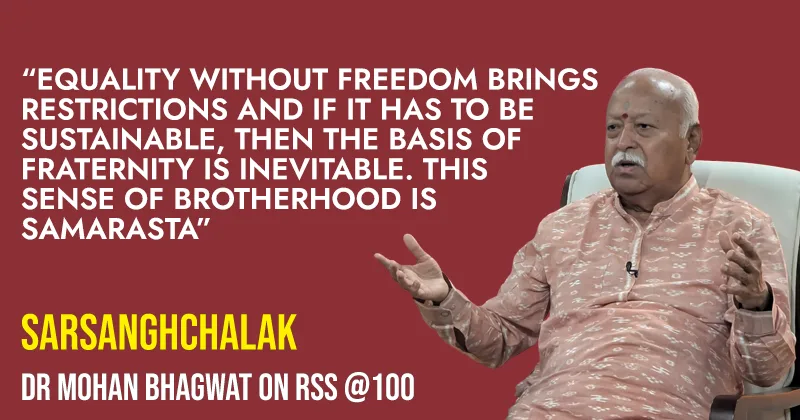
Equality is economic and political, and we are striving for social equality, without which the first two will be meaningless. Fraternity is Samarasta (Social harmony); the edifice of freedom and equality rests on fraternity. Equality without freedom brings restrictions and if it has to be sustainable, then the basis of fraternity is inevitable. This sense of brotherhood is Samarasta. Even after legislating laws against casteism and untouchability, inequalities do not go away as it reside in the mind. It has to be mentally eradicated. We are equal because all are ours has to be the conviction. Even if we do not look alike, we belong to each other, we are bound by affinity, and this is called Samarasta. It is nothing but a sense of affinity and fraternity.
The Sangh often faces questions about women’s participation. What is your response?
In the early days of the Sangh, around 1933, it was decided that the work of personality development and social organisation among women would be done by the Rashtra Sevika Samiti. It continues to function effectively. Whenever Samiti expects Sangh to work among women (for the Shakha work), then only we will think about it.
Another aspect is, the RSS shakha format is designed for men, but women observe and attend freely. Also, the Sangh doesn’t function only on the basis of male karyakartas—mothers and sisters support the work fully, and then only Sangh functions. Every woman in a Swayamsevak’s family is part and parcel of the Sangh.
Women also work together with Swayamsevaks in various organisations. They also have representation and active participation in the meeting of the Akhil Bharatiya Pratinidhi Sabha (national council – the highest decision-making body) of the Sangh. Some of these women have led major survey on status of women which the Government has also accepted. Last year, massive women’s conferences were held with lakhs in attendance.
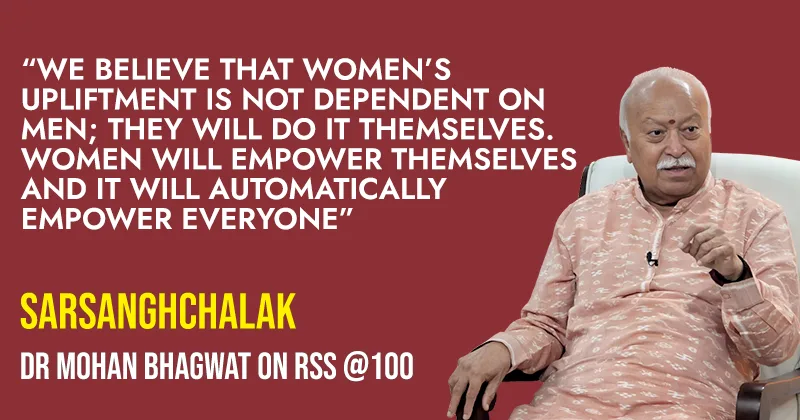
The Rashtriya Swayamsevak Sangh supported and cooperated in all these works. We believe that women’s upliftment is not dependent on men; they will do it themselves. Women will empower themselves and it will automatically empower everyone. Hence, we give emphasis on supporting them for what they think is necessary for their transformation.
In the centenary year, the Sangh has resolved for ‘Panch Parivartan’ (Five Transformations). What is the plan for this?
For the behavioural transformation, mindset is the key. Whatever action transforms the minds and habits, that work needs to be given. Hence, Panch Parivartan:
Samajik Samarasta is the first task. There should be affinity in society. There is a diversity of stages, geographical conditions, problems in our vast society. If we have to find a way out of this situation, then there have to be provisions based on informed consensus, then only everyone will accept it, without diluting the sense of affinity. Samajik Samarasta must be practised, not just spoken of or advertised. We consider all as one, I must have friends of all castes and class, my family must have too. Temples, cremation grounds, and water bodies must be inclusive where Sangh has influence. This is already going on, we must expand it.
The same thing applied to Kutumb Prabodhan. Things that provide relief to the world, that come from essential traditional values, are in our family tradition and the customs of the country. Sitting together, discussing, agreeing on them and bringing them into the family’s conduct, this is family enlightenment. The value of family as a global model must be reintroduced, rooted in samskaras (values).
For Paryavaran (Environmental Awareness), there are many things going on, including various movements. But people do not worry about the water being wasted in their homes; pay attention to that first. Plant trees, remove single-use plastic, and save water. Doing this develops the understanding, one starts thinking about the environment.
The same can be done about Swa (Selfhood). Our conduct should be based on national selfhood. In our families, we must follow our own traditions when it comes to food, dressing, language, home, worship and travel. We need to adjust when outside, but nurture the family values based on selfhood at home. Until we are fully self-reliant, we must fulfil our needs with Swadeshi products. We have to make this a habit. This does not mean that we should stop international trade; we must balance global engagement with national interest. If there’s no Bharatiya substitute or alternative, things may be brought from outside, but then it must happen on our own terms, and not under any foreign pressure. All this will constitute the conduct based on selfhood.
The last one is Civic Duties which is following the law, the Constitution, and social decency.
Swayamsevaks will inculcate these five resolves and after the centenary year, through Shakha,s this will be carried forward through Shakhas in society. If this is brought in behaviour, it will transform the environment and, which will lead to sustainable transformation. Many things will evolve out of this; let us see how fast the change takes place.
What is the resolve for the next 25 years?
To unite the entire Hindu society, and take Bharat to the pinnacle of glory — and eventually, to extend this transformation to the whole world. Dr Hedgewar envisioned this in 1920 itself—he urged the Congress to declare that total independence (purna swarajya) must be our goal and an independent Bharat must liberate other nations from capitalist bondage.
The Sangh turns 100, and Bharat will complete 100 years of Independence in 2047. How will Bharat become a Vishwaguru (global guide)? Many people are trying to create divisions in society. How do you see this?
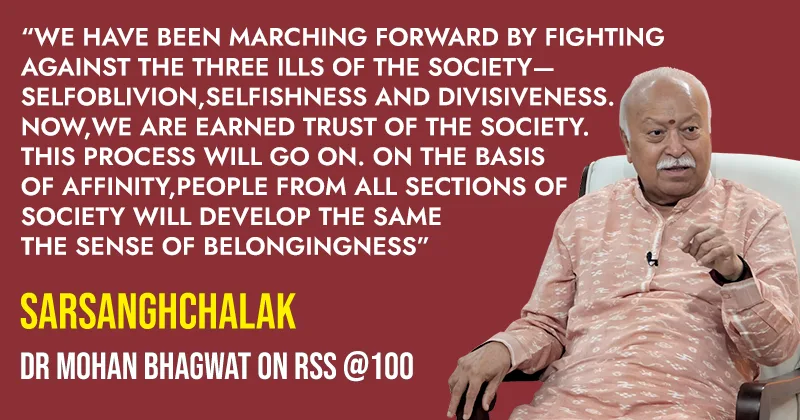
Our process takes care of all these things. We have been marching forward by fighting against the three ills of the society —self-oblivion, selfishness and divisiveness. Now, we have earned the trust of society. This process will go on. On the basis of affinity, people from all sections of society will develop the same sense of belongingness. If we stay organised and dedicated, what is usually “1 + 1 = 2” will become “1 + 1 = 11”. The work of organised and powerful Bharat will encompass all walks of life and will continue. The entire world will emulate the example of harmonious and powerful Bharat, that would constructively contribute to global life.
A senior karyakarta in 1992 had said, people across the globe will form their own “Rashtriya Swayamsevak Sangh”. This process of global transformation will start post-2047, and it won’t take 100 years—20-30 years would suffice.
What is your final message to well-wishers, thinkers, and Hindu society in this centenary year?
The Hindu society must awaken now. Forgetting internal divisions and selfishness, we need to shape our personal, family, social, and professional life based on Dharmik values rooted in Hindutva (Hinduness). That will pave the way for a powerful, righteous and self-reliant Bharat. The world is waiting for a new path and Bharat, means Hindu society, has to provide it as a divine duty. Agricultural, industrial and scientific revolutions are over. Now the world needs a Dharmik revolution—I am not talking about religion, but based on human life has to be reorganised based on truth, purity, compassion, and austerity. The world needs this, and Bharat has to inevitably show that path.
We must understand the importance of our Sangh work. There is a need to rise beyond ‘Me and My Family’ mindset, build such active lives of moving forward together, so that we become living examples for the world.












Comments