





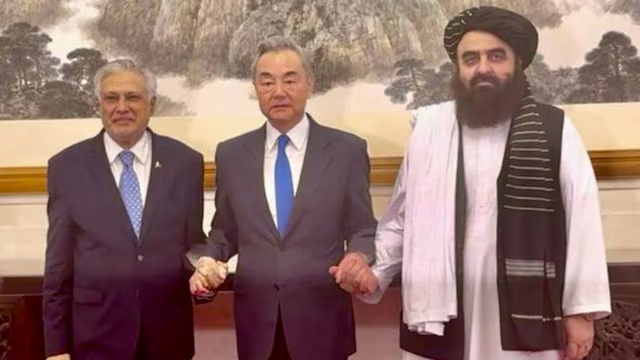
The China-Pakistan Economic Corridor (CPEC), a divisive and controversial element of China’s Belt and Road Initiative (BRI), has extended its predatory reach into Afghanistan, intensifying India’s geopolitical tensions. This provocative trilateral pact, exploiting infrastructure development and resource extraction, brazenly disregards India’s territorial sovereignty over Pakistan-occupied Jammu-Kashmir (PoJK) and threatens to undermine New Delhi’s regional influence, exposing China’s hegemonic ambitions in South and Central Asia.
Origins and Controversial Framework of CPEC
The China-Pakistan Economic Corridor, launched in 2013, is a sprawling multi-billion-dollar scheme designed to aggressively advance China’s geopolitical dominance by connecting its western regions to Pakistan’s Gwadar Port on the Arabian Sea.
Initially valued at dollar 46 billion and later inflated to dollar 62 billion, equivalent to roughly 20 per cent of Pakistan’s GDP, CPEC was formalised during Chinese Premier Li Keqiang’s visit to Pakistan in May 2013 and cemented in April 2015 through 51 agreements signed by Chinese President Xi Jinping and Pakistani Prime Minister Nawaz Sharif. The project’s coercive financial structure, heavily reliant on Chinese loans and equity holdings, has been widely criticised for entrenching Pakistan’s economic dependency while serving China’s exploitative trade agenda, masquerading as a mutual development initiative.
The recent decision to extend CPEC into Afghanistan, announced during a secretive trilateral meeting in Beijing involving Chinese Foreign Minister Wang Yi, Pakistani Foreign Minister Ishaq Dar, and Afghanistan’s Acting Foreign Minister Amir Khan Muttaqi, escalates regional tensions.
This move, far from promoting the promised peace and stability, exploits Afghanistan’s resource wealth and callously ignores India’s vehement objections to CPEC’s illicit route through PoJK, an Indian territory. By disregarding India’s sovereignty concerns, China exposes its true intent: to dominate South and Central Asia at the expense of regional stability and India’s strategic interests.
CPEC’s Infrastructure and China’s Strategic Overreach
CPEC encompasses a vast network of highways, railways, energy projects, and special economic zones, with the Gwadar Port serving as a strategic linchpin for China’s maritime ambitions. The Main Line-1 (ML-1) railway, energy pipelines, and industrial zones are designed to bolster China’s global trade dominance while superficially addressing Pakistan’s infrastructure deficits.
However, the Gwadar Port’s development raises alarm bells, as it provides China with a potential naval foothold in the Arabian Sea, threatening regional security dynamics, particularly for India.
The project’s financial model, with China holding 80 per cent of the equity in CPEC-related investments, has been lambasted as predatory, trapping Pakistan in a cycle of unsustainable debt.
CPEC serves China’s strategic interests far more than Pakistan’s, with Beijing leveraging its financial dominance to ensure Islamabad’s subservience. The port’s strategic location and China’s heavy-handed control over project financing reveal a calculated effort to extend Beijing’s influence across critical maritime and trade routes, undermining the sovereignty of regional actors like India.
Pakistan’s Entrapment in China’s Debt Web
Pakistan’s participation in CPEC was driven by its chronic energy and infrastructure crises, which once crippled urban centers with widespread blackouts and paralysed industrial activity. The promise of Chinese investment in coal-fired power plants, highways, and ports initially offered hope for addressing these challenges.
However, China’s duplicitous shift away from coal-based projects in 2021, citing alignment with global climate commitments made at COP26, derailed Pakistan’s plans to expand its power generation capacity by 20 gigawatts, leaving its energy sector in disarray.
CPEC has significantly worsened Pakistan’s economic vulnerabilities. The country’s reliance on Chinese financing has deepened its debt obligations, with massive imports for CPEC projects contributing to a widening current account deficit and necessitating a dollar 6.3 billion bailout from the International Monetary Fund (IMF).
Despite IMF warnings, Pakistan’s unchecked borrowing for CPEC has bled its foreign exchange reserves. China’s refusal to defer or restructure Pakistan’s debt repayments, as noted by the Observer Research Foundation, exposes Beijing’s ruthless strategy to maintain strategic leverage over Islamabad, ensuring Pakistan remains a compliant ally in China’s geopolitical orbit.
This debt entrapment underscores CPEC’s exploitative nature, prioritising China’s interests over Pakistan’s economic stability.
CPEC’s Exploitative Expansion into Afghanistan
The extension of CPEC into Afghanistan is a calculated manoeuvre to plunder the region’s resources while consolidating China’s dominance in Central Asia. Announced during the secretive Beijing meeting, this expansion involves:
• Infrastructure Exploitation: Extending the ML-1 railway to connect with Afghan freight corridors and constructing highways through the Torkham and Spin Boldak border crossings, tightening China’s grip on regional trade routes.
• Resource Plunder: Targeting Afghanistan’s vast lithium and rare earth mineral deposits, critical for advanced technologies, with little regard for local sovereignty or equitable benefit-sharing.
• Energy Manipulation: Developing pipelines through Afghan territory to connect Iran and Central Asia, prioritising China’s energy security over regional stability.
• Military Disguise: Establishing logistics networks that could mask military objectives under the pretext of civilian trade infrastructure, raising concerns about China’s long-term strategic intentions.
This expansion exploits Afghanistan’s economic vulnerabilities under the Taliban-led government, offering infrastructure investment as a lure while entrenching Chinese influence in its resource-rich provinces.
For Pakistan, it reinforces CPEC’s role as a conduit for China’s regional ambitions, while Afghanistan risks becoming a pawn in Beijing’s broader strategy to dominate Central Asia’s resources and trade networks. Far from fostering trilateral cooperation, this move exposes China’s predatory agenda, prioritising its own economic and strategic gains over the sovereignty and stability of its partners.
India’s Opposition to China’s Aggressive Posturing
India’s staunch opposition to CPEC is rooted in China’s blatant violation of its territorial integrity through the corridor’s route via PoK, which India considers illegally occupied by Pakistan.
In 2022, India’s Ministry of External Affairs issued a scathing statement, declaring, “Any such actions by any party directly infringe on India’s sovereignty and territorial integrity. India firmly and consistently opposes projects in the so-called CPEC, which are in Indian territory that has been illegally occupied by Pakistan.”
This territorial dispute lies at the heart of India’s resistance, as China’s actions are seen as a deliberate provocation to undermine New Delhi’s sovereignty.
Beyond the PoJK issue, India perceives CPEC as part of China’s broader strategy to encircle and contain its regional influence. The development of Gwadar Port fuels fears of China establishing a naval presence in the Arabian Sea, posing a direct security threat to India’s maritime interests. China’s robust military support to Pakistan, including the supply of advanced fighter jets, missile systems, and naval assets, strengthens Islamabad’s military capabilities, further complicating India’s security environment.
Beijing’s diplomatic manoeuvres, such as repeatedly blocking India’s efforts to designate Pakistan-based militants as global terrorists at the United Nations and opposing India’s bids for leadership roles in international forums, expose China’s intent to stifle New Delhi’s global aspirations and keep it mired in regional disputes.
Why CPEC’s Afghan Pact Threatens India’s Sovereignty
The inclusion of Afghanistan in CPEC amplifies India’s strategic concerns for several reasons:
• Undermining Regional Influence: China’s move is a direct response to India’s growing diplomatic ties with Central Asian countries, aiming to preempt New Delhi’s influence in the region. By integrating Afghanistan into CPEC, China seeks to marginalise India’s regional outreach.
• Bolstering Adversaries: The pact strengthens the China-Pakistan-Taliban axis, particularly after the Taliban’s rejection of Pakistan’s claims regarding the Pahalgam terror attack and its condemnation of the incident. This alignment signals China’s cynical support for anti-India forces, challenging New Delhi’s regional security framework.
• Strategic Encirclement: The extension of CPEC into Afghanistan enhances China’s logistical and economic presence in India’s neighbourhood, reinforcing perceptions of strategic encirclement. The potential for military logistics disguised as trade infrastructure heightens India’s security concerns.
• Geopolitical Sabotage: The trilateral agreement undermines India’s recent diplomatic gains with Afghanistan, particularly following Kabul’s condemnation of the Pahalgam attack and subsequent political engagement with Indian leaders. China’s actions expose its intent to disrupt India’s efforts to build stronger regional ties.
The China-Pakistan Economic Corridor’s expansion into Afghanistan is a brazen geopolitical manoeuvre that lays bare China’s exploitative and hegemonic designs in South and Central Asia. While Pakistan remains ensnared in China’s debt trap, unable to break free from Beijing’s financial stranglehold, Afghanistan risks becoming a mere cog in China’s resource-grabbing machinery.
For India, CPEC’s route through PoK and its extension into Afghanistan represent a direct assault on its sovereignty and a calculated effort to curb its regional influence. China’s duplicitous claims of fostering peace and stability are undermined by its aggressive encirclement of India and unwavering support for adversarial forces like Pakistan and the Taliban.














Comments