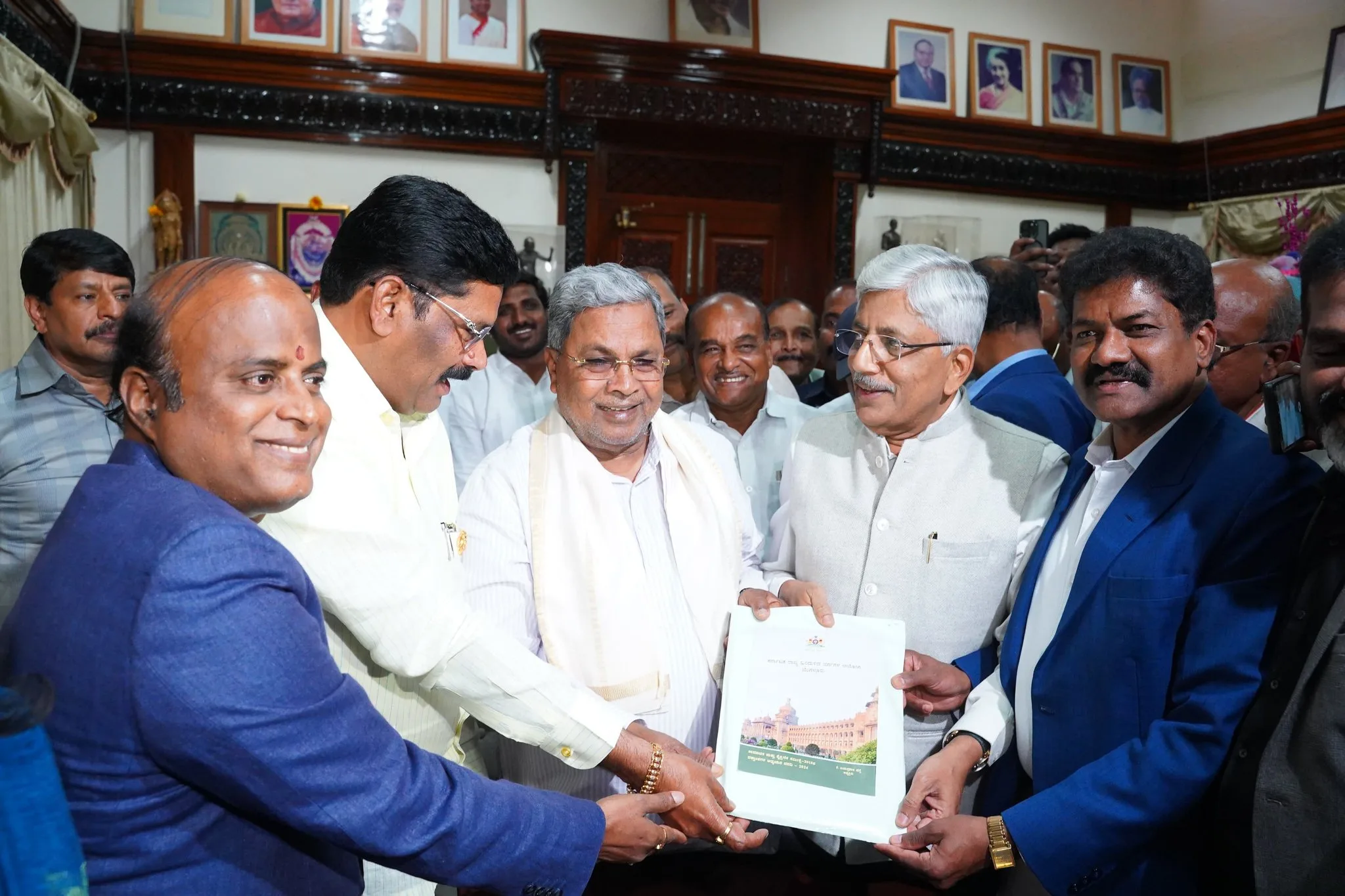
The recent revival of the nearly decade-old caste census in Karnataka has not only triggered a political storm but also revealed the divisive agenda of the Congress-led government. The manner in which the Siddaramaiah government has approached the caste census reflects a deliberate attempt to fracture Hindu society, consolidate minority vote banks, and bypass constitutional norms in the garb of social justice.
1. Selective Categorisation: Division Among Hindus, Unity for Minorities
The most glaring flaw in the caste census report is its treatment of religious communities. While Hindu castes and sub-castes have been broken down into hundreds of segments — often pitting one against another — the Muslim population has been lumped together as a single bloc, estimated at 75.25 lakhs or 12.58% of the state’s population. This monolithic classification masks the diversity and internal caste-like structures within the Muslim community, such as Pinjari, Darji, and Syed, among others.
Interestingly, over 72 sub-castes within the Muslim community are covered under the backward classes list, but the survey avoids disaggregating them. This asymmetric treatment reinforces the perception that the Congress government is actively seeking to divide Hindus while uniting minorities under a single political and policy umbrella.
2. Religious Reservations: An Unconstitutional Overreach
Even more controversial is the government’s move to increase the overall reservation for Other Backward Classes (OBCs) from 32 per cent to 51 per cent, in addition to the existing 24 per cent for SC/STs and 10 per cent for the Economically Weaker Section (EWS) — taking the total to an alarming 85 per cent. This proposed hike is not only a breach of the Supreme Court’s 50 per cent ceiling on reservations (Indra Sawhney case, 1992) but also raises serious constitutional questions if reservations are granted on religious lines.
The intent appears to include Muslim groups more prominently under the ‘most backward’ category — a clear case of religious appeasement. Article 15(1) and Article 16(1) of the Constitution prohibit the State from discriminating on grounds of religion alone. Granting reservation to Muslims as a religious bloc — without adequate socio-educational data for each sub-group — is not only flawed but constitutionally indefensible.
3. Reclassification: Political Engineering in the Name of Social Justice
The reclassification of Hindu caste the community from “more backward” to “most backward” is being seen as a strategic move to secure political dominance under the guise of backwardness. The government seeks to push them into a more backward bracket to ensure continued electoral consolidation.
This shift, however, has raised eyebrows among legal and academic circles, particularly since the survey does not substantiate these reclassifications with detailed socio-economic data or indicators of under-representation in education and employment, as mandated by judicial precedents.
4. Exaggeration and Exclusion: Politically Motivated Data Manipulation
The dominant Hindu communities — Vokkaligas and Veerashaiva-Lingayats — have outrightly rejected the survey data, claiming gross underreporting of their numbers. While past estimates placed the Veerashaiva-Lingayats between 17 per cent and 22 per cent, the survey pegs them at just 11 per cent. Vokkaligas too are shown at only 10.29 per cent, whereas historical estimates suggest 12 per cent–14 per cent. Allegations of selective enumeration, data tampering, and misclassification of sub-castes point to an engineered narrative aimed at weakening these politically significant Hindu groups.
Meanwhile, complaints from Brahmins, Christians, Yadavas/Gollas, and others about underreported population figures add to the growing perception of bias.
5. Electoral Calculations and Power Play
The caste census has become a weapon for political consolidation leading to Internal tussles within the Congress party, especially between CM Siddaramaiah and DyCM D.K. Shivakumar. Party insiders suggest that raising the backwardness rhetoric is Siddaramaiah’s strategy to assert his backward-class leadership and checkmate his Vokkaliga rival.
The report’s selective release — showing only population data and classification recommendations, while withholding socio-economic details — further reinforces the charge that the exercise is more about optics than genuine upliftment.
6. Legal and Social Fallout: A Crisis in the Making
Legal experts warn that implementing the commission’s recommendations could lead to judicial intervention, especially due to the breach of the 50 per cent reservation ceiling and the introduction of religion-based quotas. Socially, this move may deepen caste fissures within Hindu society, erode national unity, and embolden calls for further religious and linguistic appeasement.
The Karnataka caste survey saga is a cautionary tale of how data, if manipulated or selectively interpreted, can be used to serve partisan political ends. By treating Hindus as fragmented vote banks and presenting minorities as cohesive entities deserving special treatment, the current dispensation risks not just constitutional violations but also long-term social disintegration.
A nationalist and constitutionalist approach demands that any policy of affirmative action be based on verifiable backwardness, not religious identity or political expediency. The time has come to resist divisive politics masquerading as social justice.