The chilling reality of infiltration and compromise of identity
June 15, 2026
  • Read Ecopy
  • Circulation
  • Advertise
  • Careers
  • About Us
  • Contact Us
Android AppiPhone AppArattai
Organiser
  • ‌
  • Bharat
    • Assam
    • Bihar
    • Chhattisgarh
    • Jharkhand
    • Maharashtra
    • View All States
  • World
    • Asia
    • Europe
    • North America
    • South America
    • Africa
    • Australia
  • Editorial
  • International
  • Opinion
  • RSS @ 100
  • More
    • Op Sindoor
    • Analysis
    • Sports
    • Defence
    • Politics
    • Business
    • Economy
    • Culture
    • Special Report
    • Sci & Tech
    • Entertainment
    • G20
    • Azadi Ka Amrit Mahotsav
    • Vocal4Local
    • Web Stories
    • Education
    • Employment
    • Books
    • Interviews
    • Travel
    • Law
    • Health
    • Obituary
  • Subscribe
    • Subscribe Print Edition
    • Subscribe Ecopy
    • Read Ecopy
  • ‌
  • Bharat
    • Assam
    • Bihar
    • Chhattisgarh
    • Jharkhand
    • Maharashtra
    • View All States
  • World
    • Asia
    • Europe
    • North America
    • South America
    • Africa
    • Australia
  • Editorial
  • International
  • Opinion
  • RSS @ 100
  • More
    • Op Sindoor
    • Analysis
    • Sports
    • Defence
    • Politics
    • Business
    • Economy
    • Culture
    • Special Report
    • Sci & Tech
    • Entertainment
    • G20
    • Azadi Ka Amrit Mahotsav
    • Vocal4Local
    • Web Stories
    • Education
    • Employment
    • Books
    • Interviews
    • Travel
    • Law
    • Health
    • Obituary
  • Subscribe
    • Subscribe Print Edition
    • Subscribe Ecopy
    • Read Ecopy
Organiser
  • Home
  • Bharat
  • World
  • Operation Sindoor
  • Editorial
  • Analysis
  • Opinion
  • Culture
  • Defence
  • International Edition
  • RSS @ 100
  • Magazine
  • Read Ecopy
Home Bharat

Emerging Afzals: The chilling reality of infiltration and compromise of identity in Bharat

The Modi government's crackdown on illegal Pakistani infiltrators exposes a decades-long systemic failure marked by deceit, appeasement, and security lapses. From forged documents to government jobs, this silent invasion threatens Bharat’s sovereignty and demands uncompromising national vigilance.

Siddhartha DaveSiddhartha Dave
May 4, 2025, 04:00 pm IST
in Bharat
Follow on Google News
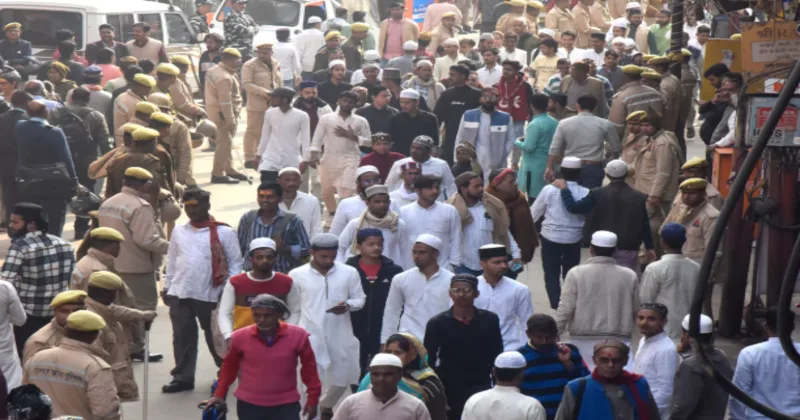
Islamists on the road

Islamists on the road

FacebookTwitterWhatsAppTelegramEmail

In the wake of the recent Pahalgam jihadi attack, the Bharat government has taken bold and decisive steps to root out individuals from Pakistan who have, over decades, stealthily embedded themselves into Indian society. The Modi government’s move to revoke visas and deport Pakistani nationals illegally or dubiously residing in India has unearthed a deep, disturbing web of infiltration, deceit, and systemic failure that has long gone unchecked. This silent incursion was not just a security lapse but a manifestation of years of negligence, political appeasement, and institutional compromise.

What was once dismissed as a provocative slogan—”Har ghar se Afzal niklega” (An Afzal will emerge from every house)—has now materialized into a chilling truth. This was not just a seditious chant at a Left-liberal rally commemorating terrorist Afzal Guru in Delhi’s JNU; it was a veiled prophecy that is now taking form. Today, we see this unsettling statement come to life, not in metaphor, but in flesh and blood. Afzals are indeed emerging from every corner—not just in ideology but in real, physical identities, equipped with documentation, privilege, and access.

Afzal Guru—the mastermind behind the heinous Parliament attack 2001—was no ordinary terrorist. He symbolized an ideological war against Bharat. The fact that segments of India’s so-called intellectual elite organized events to honour him is a travesty beyond comprehension. These were not fringe elements; these were individuals who are now mainstream political players—like Kanhaiya Kumar, who now finds a comfortable place within the Congress party’s fold. Their glorification of such anti-national elements signals an ideological rot festering in the heart of Bharat’s political discourse.

But the threat has evolved. We are no longer dealing with mere slogans or support for convicted terrorists. We are now grappling with an institutional crisis where Pakistani nationals with dubious identities have infiltrated Indian civil society to its core. These individuals possess Indian voter IDs, Aadhaar cards, ration cards, domicile certificates, and, shockingly, even employment in highly sensitive institutions like the Jammu & Kashmir Police.

Take, for instance, Iftekhar Ali—a PoK national who successfully embedded himself in India for 27 years. His employment with the Jammu & Kashmir Police, with his final posting at none other than the Mata Vaishno Devi shrine—a site sacred to millions—should set alarm bells ringing. His case is not an anomaly; it is a symptom of something far more dangerous.

His wife, now lamenting his deportation, may draw sympathy from certain quarters. But the real question is—how did he evade the system for nearly three decades? Who were the enablers? How could such illegal infiltrators acquire legitimate Indian documents and rise to hold a government position without setting off any red flags? And perhaps most alarming—how many more such Iftekhar Alis are currently embedded in our systems, influencing decision-making, and posing as ordinary Indian citizens?

Then there’s the unsettling case of Osama from Rawalpindi. Entering India in 2008, he went on to obtain a domicile certificate from Jammu & Kashmir, vote in local elections, and enjoy public services and welfare schemes reserved for genuine Indian citizens. The contrast is striking: while Osama votes and enjoys rights he never earned, the Kashmiri Pandits—true inheritors of the land—remain refugees in their own nation, still waiting to return home.

Consider Minal Khan, a Pakistani woman who married a CRPF jawan online and began living in India. To the liberal eye, this may appear to be a romantic tale of cross-border unity. But can we afford such sentimentalism when our very sovereignty is at stake? When a Pakistani citizen resides with someone defending our borders, does that not pose a clear and present danger? Where are the background checks, the security clearances, the legal protocols?

And these are not isolated incidents. Parveen Akhtar and many unnamed women from Karachi and other parts of Pakistan have lived in India for over four decades—on extended visas, without applying for Indian citizenship. They marry local men, raise children, and use the Indian public system, all while retaining allegiance to a foreign nation. This duality—of enjoying Indian benefits while remaining Pakistani citizens—is not just opportunistic; it is perilous.

Meanwhile, the bitter irony continues. Genuine citizens—Dalits, tribal populations, Gorkhas, and especially displaced Kashmiri Pandits—face barriers to full voting rights in Jammu & Kashmir. But Pakistani nationals, with forged documents or state-sponsored leniency, vote freely, contest local elections, and shape the political destiny of sensitive regions.

This is not a random administrative lapse. This is the rotten fruit of decades of appeasement politics, open-border romanticism, and vote-bank calculations. For years, the so-called “human rights” lobbies have cried hoarse over issues of statelessness and emotional unity, often ignoring the strategic threats these infiltrators pose. They will now predictably frame the deportation of such individuals as a humanitarian issue—of love separated by borders, of lives disrupted by state action. But let us ask ourselves: can a civilization-state like Bharat afford to risk its internal security for emotional tokenism?

When Pakistani nationals can manipulate their way into our systems—securing jobs, voting rights, and policy influence—we are no longer looking at individual breaches. We are witnessing a systematic, silent invasion aimed at hollowing Bharat from within.

The Modi government’s crackdown is not only justified—it is a historic necessity. National security cannot be held hostage to misguided compassion or ideological softness. Every Pakistani who has infiltrated India under false pretenses must be identified, thoroughly vetted, and deported without hesitation. This is not an act of vengeance; it is a measure of survival.

Citizenship is not a charity doled out for convenience or sentiment. It is a sacred pact—a mutual vow between the nation and the individual. Only those who respect, uphold, and commit themselves fully to this pact should be allowed to stay and integrate.

The chilling reality of “Har ghar se Afzal niklega” is no longer a hypothetical warning. It is our national reality. If we fail to respond with vigilance, decisiveness, and unapologetic nationalism, it won’t just be infiltration—it will be our civilizational unraveling.


Topics: Indian GovernmentRawalpindiPakistani nationalsAfzal GuruPahalgam jihadi attack
Siddhartha Dave
Siddhartha Dave
Siddhartha Dave is an alumnus of the United Nations University in Tokyo and a former Lok Sabha Research Fellow. He writes on foreign affairs and national security. [Read more]
ShareTweetSendShareSend
✮ Subscribe Organiser YouTube Channel. ✮
✮ Join Organiser's WhatsApp channel for Nationalist views beyond the news. ✮
Previous News

Over 56,000 terror incidents in 32 years: 23,000 terrorists killed, 6,413 soldiers lost

Next News

Uttarakhand: Badrinath Dham opens to devotees at sunrise with soulful vedic chants heralding summer pilgrimage

Related News

PoJK: Hostage of Islamabad-Rawalpindi nexus to seek hegemony; Trapped in politics with zero ambitions for progress

Representative Image (This is an AI generated image)

How Congress weaponised state power to surrender sovereignty and demonise Hindu civilisation 

Case registered in Meerut against Pakistani national mother and daughter over forged Indian documents and illegal stay

UP: Masood & Aiman, living in India for 30 years as Pakistani nationals, booked in Meerut for alleged forged documents

Two Pakistani nationals among 3 inmates who escaped a juvenile home in Jammu

J&K: Mohd Suna-ullah and Anwar — Two Pakistani nationals among three escape from observation home, probe underway

Former Prime Minister of Pakistan and his wife imprisoned to 17 years of jail in corruption case

Pakistan: Former Prime Minister Imran Khan, wife Bushra Bibi sentenced to 17 years imprisonment in Toshakhana case

Pakistan PM Shehbaz Sharif had directed Federal Board of Revenue to approach the IMF seeking approval to immediately remove the 18 per cent GST on contraceptives.

Islamabad Ashamed Globally: Saudi deports 56000 Pakistani beggars & IMF blocks govt plea to cut condom tax

Load More

Latest News

Prime Minister Narendra Modi and his Slovakian counterpart Prime Minister Robert Fico

India-Slovakia elevate ties to Comprehensive Partnership; PM Modi hails cultural bond, Upanishads translation to Slovak

Centre seeks explanation from Keralam Waqf Board on Munambam land entry into Umeed Portal

In China's strategic map of threats, geography continues to give India a significance that cannot be overlooked

The Rival China Cannot Ignore: Why India matters more than Beijing admits

Addressing the second day of Vijnana Bharati’s 7th National Convention at BHU, RSS Sah Sarkaryavah Dr Krishna Gopal

Vijnana Bharati’s 7th National Convention | Scientists must work to harmonise spirituality & science: Dr Krishna Gopal

Representative image

West Asia Conflict: Donald Trump announces landmark US-Iran agreement, raises hopes for peace

Keralam: CM VD Satheesan Faces Backlash for Criticising VCs Attending RSS Programme Addressed by Dr Mohan Bhagwat

Prime Minister Narendra Modi: Record maker and breaker

India surpasses South Korea, Enters big 5 manufacturing hub; Seals strategic footprint in the global supply chain

Gujarat: Married Man Karim Rafik Posed as Widower 'Aditya Patel' to Trap Hindu Women; 8,000 Photos and Videos Found on Phone

Gujarat Matrimonial Fraud: Karim posed as widower ‘Aditya Patel’ to target Hindu women; 8,000 photos found on phone

A suicide bomber attacked the Jhangi police checkpost in Taunsa Sharif, Dera Ghazi Khan, Punjab, near the Khyber Pakhtunkhwa border

Khyber Pakhtunkhwa: TTP suicide bomber hits police checkpost, two Pakistani policemen killed

Load More
  • Privacy
  • Terms
  • Cookie Policy
  • Refund and Cancellation
  • Delivery and Shipping

© Bharat Prakashan (Delhi) Limited.
Tech-enabled by Ananthapuri Technologies

  • Home
  • Search Organiser
  • Bharat
    • Assam
    • Bihar
    • Chhattisgarh
    • Jharkhand
    • Maharashtra
    • View All States
  • World
    • Asia
    • Africa
    • North America
    • South America
    • Europe
    • Australia
  • Editorial
  • Operation Sindoor
  • Opinion
  • Analysis
  • Defence
  • Culture
  • Sports
  • Business
  • RSS @ 100
  • Entertainment
  • More ..
    • Sci & Tech
    • Vocal4Local
    • Special Report
    • Education
    • Employment
    • Books
    • Interviews
    • Travel
    • Health
    • Politics
    • Law
    • Economy
    • Obituary
  • Subscribe Magazine
  • Read Ecopy
  • Advertise
  • Circulation
  • Careers
  • About Us
  • Contact Us
  • Policies & Terms
    • Privacy Policy
    • Cookie Policy
    • Refund and Cancellation
    • Terms of Use

© Bharat Prakashan (Delhi) Limited.
Tech-enabled by Ananthapuri Technologies