Syria's future lies in decentralisation
August 7, 2026
  • Read Ecopy
  • Circulation
  • Advertise
  • Careers
  • About Us
  • Contact Us
Android AppiPhone AppArattai
Organiser
  • ‌
  • Bharat
    • Assam
    • Bihar
    • Chhattisgarh
    • Jharkhand
    • Maharashtra
    • View All States
  • World
    • Asia
    • Europe
    • North America
    • South America
    • Africa
    • Australia
  • Editorial
  • International
  • Opinion
  • RSS @ 100
  • More
    • Op Sindoor
    • Analysis
    • Sports
    • Defence
    • Politics
    • Business
    • Economy
    • Culture
    • Special Report
    • Sci & Tech
    • Entertainment
    • G20
    • Azadi Ka Amrit Mahotsav
    • Vocal4Local
    • Web Stories
    • Education
    • Employment
    • Books
    • Interviews
    • Travel
    • Law
    • Health
    • Obituary
  • Subscribe
    • Subscribe Print Edition
    • Subscribe Ecopy
    • Read Ecopy
  • ‌
  • Bharat
    • Assam
    • Bihar
    • Chhattisgarh
    • Jharkhand
    • Maharashtra
    • View All States
  • World
    • Asia
    • Europe
    • North America
    • South America
    • Africa
    • Australia
  • Editorial
  • International
  • Opinion
  • RSS @ 100
  • More
    • Op Sindoor
    • Analysis
    • Sports
    • Defence
    • Politics
    • Business
    • Economy
    • Culture
    • Special Report
    • Sci & Tech
    • Entertainment
    • G20
    • Azadi Ka Amrit Mahotsav
    • Vocal4Local
    • Web Stories
    • Education
    • Employment
    • Books
    • Interviews
    • Travel
    • Law
    • Health
    • Obituary
  • Subscribe
    • Subscribe Print Edition
    • Subscribe Ecopy
    • Read Ecopy
Organiser
  • Home
  • Bharat
  • World
  • Operation Sindoor
  • Editorial
  • Analysis
  • Opinion
  • Culture
  • Defence
  • International Edition
  • RSS @ 100
  • Magazine
  • Read Ecopy
Home World

Syria’s future lies in decentralisation

The recent Kurdish Unity Conference in Qamishli reignited calls for a decentralised Syrian state, clashing with the interim government's push for centralised power amid rising minority unrest. With Syria’s deep ethno-sectarian divides, only a devolved governance model can ensure national unity, stability, and minority inclusion in post-Assad Syria

Manish RaiManish Rai
May 4, 2025, 01:00 pm IST
inWorld, Opinion, International Edition
Follow on Google News
Facebook
Twitter
WhatsAppTelegramEmail

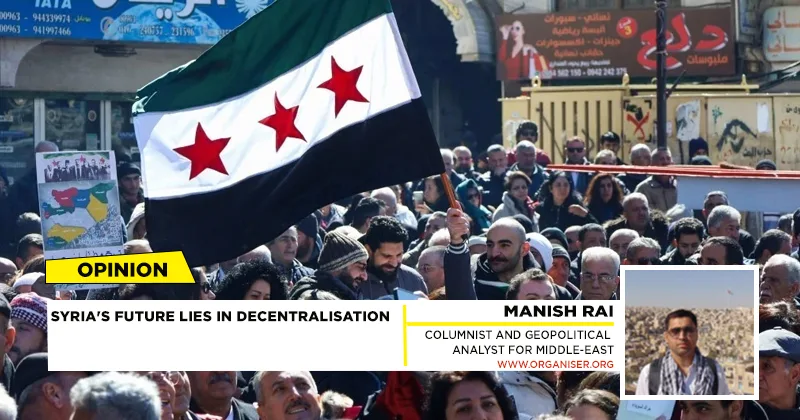
The Conference on Kurdish Unity and Common Stance was recently concluded in Qamishli, North-East Syria. Over 400 delegates from various parts of Syria participated in the conference, which aimed to strengthen Kurdish unity and establish common political positions. A communiqué at the end of the conference, which United States officials also attended, demanded that a future Syrian constitution should enshrine respect for Kurdish national rights in post-Assad Syria. The most important point of the pan-Kurdish statement was advocacy for Syria as a decentralised democratic state. Unfortunately, without giving much thought to this idea, the Syrian Presidency, in a haphazard manner, rejected it. The Syrian presidency’s statement rejected the call for a decentralised state and mentioned that recent statements by Syrian Democratic Forces (SDF) leaders advocating a federal solution are clearly against the agreed-upon deal. The Syrian President was joined by Syria’s Islamist leaders, who opposed Kurdish demands for the country to adopt a decentralised system of government as a new political order, stating that this poses a threat to national unity. Before the Syrian uprising morphed into a full-scale war, Syria was probably the most authoritarian regime in the Arab region, unequalled in the scale of its repressive practices except by the Iraqi regime of Saddam Hussein. The new authorities in Damascus want to rebuild the country on this same line with a highly centralised governance structure.

Today’s Syria, because of thirteen years of conflict, now suffers from deep divisions along both ethno-sectarian and geographic lines. While economic links and interdependency persist between the various parts of the country, and most Syrians remain remarkably attached to the idea of national unity, the country’s social fabric has fragmented. Even after the removal of the regime of Bashar al-Assad, the new interim government did not put any effort into restoring confidence among the minorities of the country. In March this year, Alawites living mostly in coastal areas of Syria were brutally targeted by the militias allied with the current government, and the Jihadists killed more than 1600 civilians. Currently, another minority group. i.e. Druze are being targeted by the forces loyal to Damascus; the clashes between pro-government fighters and local Druze gunmen resulted in the killing of more than a dozen people in a suburb of the Syrian capital. In the aftermath of this violence, the Druze have taken control of Suwayda province and are preventing interim government forces from entering. The same goes for Druze-populated districts in the capital’s suburbs, including Jaramana, Sahnaya, and Jdeidat Artouz. With this kind of deep feeling of insecurity among the minorities, building a Syrian state with concentrated power in Damascus is unrealistic.

Ironically, interim President Ahmad-al-Sharaa wrongly believes that centralisation is essential to preventing further fragmentation and dismantling competing power structures. By consolidating authority under a strong central state, he seeks to monopolise control over security, political, and economic decision-making, ensuring the transitional authorities retain dominance over Syria’s future direction. He is following the same deeply centralised approach he adopted in Idlib. Still, Sharaa needs to understand that this approach can’t be applied to pan-Syria, as ruling a homogenous province that mainly has one ethnicity and governing a very diverse country is different. The Syrian conflict has devastated every component on which a country stands on its own, like its population, civil society, infrastructure, cultural heritage, and economy. Before the conflict, Syria was a middle-income country with an economy based on agriculture, industry, oil, trade, and tourism, with decent health care and education. In a country that has suffered from decades of authoritarian rule, an overly centralised system could replicate the same patterns of exclusion and repression that fuelled the previous conflict, potentially leading to renewed instability, governance paralysis, or even conflict relapse.

One thing is clear: Syria can’t be a monolithic nation-state. However, the Syrians must decide whether it will be a decentralisation, federalism, or a confederation. However, deciding the exact form of a decentralised state structure will be a long negotiation process. In the past, some form of decentralisation was conceptualised. Along the lines of a 2011 decree, the Syrian government of Bashar Al-Assad issued the devolution agreement detailing the role of local authorities. Decree 107, also known as the “Local Administration Law,” was introduced as part of a package of political reforms passed in August 2011 in response to demands by a civil uprising already sweeping the country. The decree was designed to devolve political and administrative responsibilities to institutions at the local level, but it was never fully clear how it would be implemented. However, this proposal of the past regime can be used as a starting point to develop a governance system that is acceptable to everyone.

Syria is a multiethnic society consisting of Sunni Arabs, Kurds, Assyrians, Armenians, Turkomans, Alawites, and Yazidis. To keep the country united and stable, it is need of the hour to delegate powers at the local level. In multiethnic countries like Nigeria and India, this model has arguably helped hold these nations together. The future Syrian state should be a nation that accommodates and grants rights to all ethnic groups, and everyone feels their participation in running the state.

Mr Jwan Shekaki from NPA Syria, based in Qamishli, and Mr Hozan Zubair, a Syrian Journalist from Al-Hasakah, currently based in Erbil, Kurdistan, provided inputs for this article.


Topics: QamishliSyriaSDFKurdish Unity ConferenceSyria decentralisation
Manish Rai
Manish Rai
The writer is a Political Analyst for West Asia and Af-Pak Region. [Read more]
Share
Tweet
SendShareSend
✮ Subscribe Organiser YouTube Channel. ✮
✮ Join Organiser's WhatsApp channel for Nationalist views beyond the news. ✮
Previous News

Viksit Bharat through the lens of the Bhagavad Gita: A spiritual blueprint for India’s development

Next News

A step towards Bharatiyakaran: Reclaiming India’s educational identity

Related News

The return of ISIS widows has triggered one of Australia’s most divisive security debates in recent years

Australia Split on ISIS Widows: The return of Caliphate brides rekindle fear of extremism and terror 

Kurds in Syria struggle to preserve their rights and lives

Kurds: The victims of international betrayal

Syrian Kurds has to be protected from the Jihadist forces

Syrian Kurds must not be abandoned in their struggle against Jihadist forces

Representative Image

Operation Hawkeye Strike: US conducts strikes across Syria on ISIS targets

Representative Image

Saudi Arabia records over 300 executions again as drug cases hit citizens from Pakistan, Egypt, Syria & Nigeria

Operation Hawkeye strike by the US military in Syria

Operation Hawkeye Strike: US military massive strikes in Syria targeting ISIS in a hitherto conflict-ridden West Asia

Load More

Latest News

Tamil Nadu Governor Arlekar

Tamil Nadu: “Education should shape nation-builders with character, not just professionals,” says Governor Arlekar

President Droupadi Murmu honoured 22 artisans with the Sant Kabir and National Handloom Awards

National Handloom Day 2026: President Murmu honours 22 master artisans with Sant Kabir and National Handloom Awards

Representative Image

Agni 4 Successfully Tested: Indigenous nuclear-powered ballistic missile seals strategic deterrence & combat readiness

VHP International President Alok Kumar ji addressing the media

VHP to launch nationwide campaign seeking freedom of Hindu Temples from government control

Tamil Nadu: ED conducts raids at 15 locations linked to 2022 Coimbatore ISIS-inspired car bomb blast case

Union Finance Minister Nirmala Sitharaman refutes claims of upcoming UPI transaction fees.

Fact Check: Nirmala Sitharaman rebuts Jairam Ramesh’s UPI ‘MDR’ claim, says users will not be charged

Teenager opens fire in Thailand school

Thailand School Shooting: Teenager opens fire on teachers, classmates & grandparents; Atleast 2 killed & 15 injured

Air India employee abuses Hinduism on Instagram, mocks Bhagwan Rama as ‘evil Jewish’

Air India employee Veeravel faces outrage over abusive remarks against Bhagwan Sri Ram on Instagram

Prime Minister of Bangladesh Tarique Rahman and Former Prime Minister Sheikh Hasina

Bangladesh: BNP govt sharply reacts to Sheikh Hasina’s live interaction; Seeks mutually benificial ties with India

GBA demolishes 233 illegal shops in Bengaluru’s KR Market area in a major encroachment clearance drive

Karnataka: 233 illegal shops razed in KR Market encroachment drive as GBA reclaims public space

Load More
  • Privacy
  • Terms
  • Cookie Policy
  • Refund and Cancellation
  • Delivery and Shipping

© Bharat Prakashan (Delhi) Limited.
Tech-enabled by Ananthapuri Technologies

  • Home
  • Search Organiser
  • Bharat
    • Assam
    • Bihar
    • Chhattisgarh
    • Jharkhand
    • Maharashtra
    • View All States
  • World
    • Asia
    • Africa
    • North America
    • South America
    • Europe
    • Australia
  • Editorial
  • Operation Sindoor
  • Opinion
  • Analysis
  • Defence
  • Culture
  • Sports
  • Business
  • RSS @ 100
  • Entertainment
  • More ..
    • Sci & Tech
    • Vocal4Local
    • Special Report
    • Education
    • Employment
    • Books
    • Interviews
    • Travel
    • Health
    • Politics
    • Law
    • Economy
    • Obituary
  • Subscribe Magazine
  • Read Ecopy
  • Advertise
  • Circulation
  • Careers
  • About Us
  • Contact Us
  • Policies & Terms
    • Privacy Policy
    • Cookie Policy
    • Refund and Cancellation
    • Terms of Use

© Bharat Prakashan (Delhi) Limited.
Tech-enabled by Ananthapuri Technologies