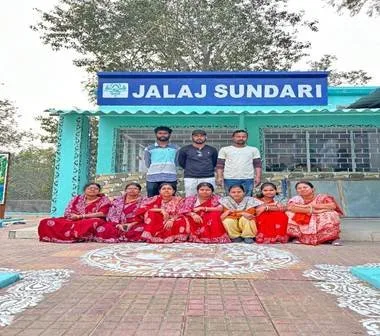
In a pioneering step that interlinks ecology with economy, the Government of India’s Jalaj initiative is reversing the dynamics of river conservation and rural livelihoods in the Ganga River Basin. Led by the Ministry of Jal Shakti in the National Mission for Clean Ganga (NMCG) and implemented by the Wildlife Institute of India (WII), Jalaj has become a potent model for ecological renewal that also strengthens people, particularly women and indigenous river-dependent communities, through sustainable livelihoods.
The scheme has just been visited by Union Jal Shakti Minister, Shri C.R. Patil, who appreciated Jalaj’s success, mentioning its role in transforming the conservation model and creating thousands of livelihoods in nine states of India. With the aim of further expanding and scaling up successful models to other river basins like Godavari and Periyar, Jalaj is being acclaimed as a path-breaking initiative towards bringing the larger Arth Ganga vision into fruition through an economic model which connects people to rivers.
Jalaj: Where Rivers Breathe and Communities Thrive!
In a landmark review led by Union Jal Shakti Minister Shri @CRPaatil, the transformative Jalaj initiative charts a new course for India’s rivers — one where conservation meets community, and ecology powers economy. Anchored in… pic.twitter.com/pXQSBLbq5K
— Namami Gange (@cleanganganmcg) May 1, 2025
From Namami Gange to Jalaj: An Evolution in Conservation
The seeds of Jalaj were sown under Namami Gange, a daring initiative brought about to rejuvenate and sanitise the Ganga, India’s economically most crucial and most sacred river. It realised that conservation of the river cannot be achieved without the local people and commissioned the Wildlife Institute of India with a project called “Biodiversity Conservation and Ganga Rejuvenation.” This led to the development of the “Ganga Prahari” cadre, eco-aware community members who emerged as ecological ambassadors of the river. As the project progressed, the need for a scalable, community-based, and economically sustainable model of conservation was felt. Jalaj was born of this awareness, a scheme that was not only designed to preserve aquatic biodiversity but also to establish a symbiotic relationship between the river and its people.
What is Jalaj? A Holistic Vision for the River and its People
The Jalaj scheme is a composite livelihood and conservation scheme intended to reconcile environmental goals with economic development. As a conceptual framework to execute the Arth Ganga concept, Jalaj synthesises the concepts of biodiversity conservation, sustainable development, skills development, and community empowerment under one framework. The program plans to open 75 Jalaj centers in the Ganga Basin, representing 75 years of India’s independence as part of the Azadi Ka Amrit Mahotsav celebrations. The centers are planned to be hubs for local economic activity, biodiversity education, and cultural preservation. They are being built keeping in mind local talent, availability of raw materials, and local market requirements, so each center is especially site-specific and highly embedded in the local culture.
Key Components of Jalaj Models
Every Jalaj center is an independent, locally managed module that has multiple uses:
• Eco-tourism and Cultural Outreach: Concepts such as Dolphin Safaris, nature treks, home stays, and boat tours generate revenue while introducing visitors to the ecology of rivers.
• Skill and livelihood training: Training is imparted to women and youth in activities such as stitching, organic agriculture, food processing, herbal products, and hand crafts.
• Sale and exhibition points: Centers are also marketplaces at the local level where stationery, decor, wellness products, and edibles produced by the community are sold.
• Knowledge Corners and Awareness Hubs: These serve as areas for environmental education, dissemination of sustainability practices, and awareness generation on endangered aquatic animals such as the Gangetic dolphin, hilsa fish, freshwater turtles, and crocodilians.
Empowerment in Action
Ever since it was launched, the Jalaj initiative has made significant contributions to empowerment of people and integration of livelihoods into river conservation. It has helped over 5,000 members of the traditional boating community to participate in sustainable livelihoods, while also enabling more than 2,400 women through skill development and micro-enterprise promotion. Working in 42 districts spread over 9 states—Uttar Pradesh, Bihar, West Bengal, and Uttarakhand, the project has organised 263 training events and made intensive outreach efforts via online media like YouTube and community radio. Among Jalaj’s strongest points is its contribution to gender mainstreaming. Instead of considering women as passive recipients, the program has helped them to become active change agents. By combining commerce with conservation, Jalaj has enabled the creation of self-respecting livelihoods and instilled a new sense of ownership and accountability among local people.
Innovation and Recognition
The innovativeness built into Jalaj has attracted top-level appreciation. In his Mann Ki Baat address and during the ICCON 2023 held in Mysuru, the Prime Minister of India, Narendra Modi, raised Jalaj as a model for the conservation of freshwater biodiversity and as an example of the people’s participation bringing about systemic change. The Hon’ble President of India also appreciated the initiative during Gaj Utsav 2023.
Union Minister C.R. Patil, in the recent review meeting, underscored Jalaj’s scalability and replicability to other river systems. He also launched a special Jalaj website featuring center models, training calendars, eco-products, and success stories. Moreover, a Jalaj Products Catalogue was published, classifying ecologically produced items into stationery, clothing, body care, and food, all designed by community members trained under the initiative.
Cultural Revival: “SaanskritikLehren”
The project does not limited with economy and ecology; it is also working on India’s intangible heritage. There was a special cultural feature named “SaanskritikLehren” launched to emphasise the religious and traditional significance of the Ganga. This value of Jalaj seeks to restore rituals, folkloric tales, and environmentally sustainable traditions which have co-evolved along with the river since centuries, thus promoting a wholesome value of the river as a natural and cultural asset.
A Circular Economy in Action
It’s what distinguishes Jalaj from most other government schemes: that it is anchored in the practices of the circular economy. Community people are not merely passive receivers of welfare but are trained, mobilised, and empowered with opportunities to generate, sell, and invest back in their surroundings. Each step from skills training to environmental tourism returns to the wider purpose of building up people as well as planet.
This not only renders the Jalaj model resistant to outside shocks such as climate change and market fluctuations, but also deeply local which developed around existing knowledge systems, traditions, and available resources.
Way Forward: Scaling with Sustainability
With over 70 Jalaj centers already in operation or under construction, the Ministry of Jal Shakti is actively pursuing scaling the initiative to other large river basins. Rivers like the Godavari, Barak, Periyar, and Pampa are being considered for possible expansion of the Jalaj model. One of the distinguishing characteristics of this next phase is the proposed integration of Jalaj with other flagship government initiatives, such as Skill India, Swachh Bharat, Digital India, and Start-Up India. This strategic convergence is intended to increase the reach of the initiative, optimise resource utilisation, and promote overall development through inter-departmental synergy. In the long run, Jalaj has the potential to contribute immensely towards India’s journey towards various Sustainable Development Goals (SDGs), including SDG 1 (No Poverty), SDG 5 (Gender Equality), SDG 6 (Clean Water and Sanitation), SDG 13 (Climate Action), and SDGs 14 and 15 (Life Below Water and Life on Land). With this holistic and sustainable practice, Jalaj continues to lead the way to resilient ecosystems and empowered people.
A Living Model for Arth Ganga
Fundamentally, Jalaj is not merely a project; it is a paradigm shift. It conceives river conservation not as a technocratic or bureaucratic exercise, but as a people’s movement—based on local knowledge, driven by economic engagement, and guided by ecological ethics. As the world and India struggle with the twin threats of livelihood insecurity and climate change, Jalaj is a living testament to how we can construct a greener, more equitable, and resilient future, one river, one village, one community at a time.