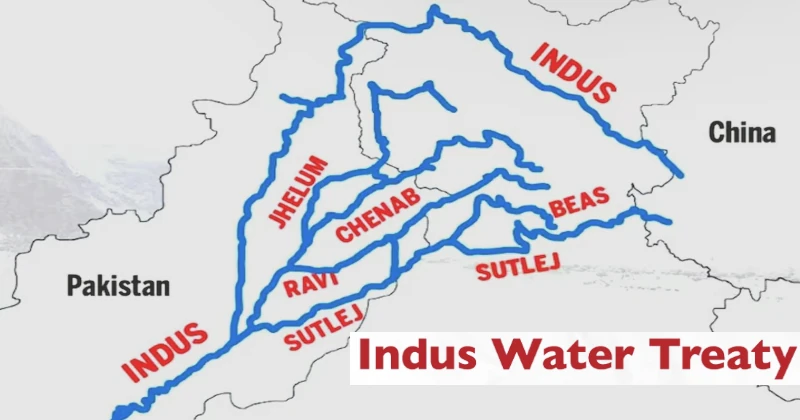
For over six decades, the Indus Waters Treaty (IWT) has dictated the flow of the most vital natural resource between Bharat and Pakistan water. Signed in 1960 under World Bank supervision, the Treaty divides the waters of six rivers in the Indus basin. While Bharat retained control over the eastern rivers Ravi, Beas, and Sutlej Pakistan was given rights over the western rivers Indus, Jhelum, and Chenab.
What went unnoticed by many is that Bharat, despite being the upper riparian state, allows a massive 135–145 Million Acre Feet (MAF) of water to flow into Pakistan annually from the western rivers. That generosity call it a legacy of Nehruvian idealism is now being re-evaluated in the corridors of New Delhi. The urgency of this reassessment lies in numbers that should shake the conscience of every Bharat’s policymaker.
Let’s decode the situation in terms the public understands land, power, and politics.
One MAF is the volume of water required to submerge one million acres of land under one foot of water. That equals approximately 1.23 billion cubic meters. To put it in relatable terms, 1 MAF is enough to flood Delhi nearly three times over.
Every year, around 90 MAF from the Indus, 25 MAF from Jhelum, and 25 MAF from Chenab enter Pakistan. That’s enough water to fill the Bhakra-Nangal reservoir a key dam on the Sutlej 24 times over. Now imagine losing that water while our own states Punjab, Haryana, Rajasthan, Delhi, Uttar Pradesh, and Gujarat struggle to feed their populations and recharge their depleting groundwater.
Bharat’s existing hydroelectric projects on Jhelum, Chenab, and Indus like Kishanganga and Baglihar are classified as “run-of-the-river” schemes. These are non-storage projects, designed to generate electricity by harnessing flow velocity but incapable of withholding water during lean seasons. In technological terms, they act like RAM in a computer—fast but temporary.
Currently, Bharat’s total water storage capacity on these rivers is estimated to be a paltry 1.2 to 3.6 MAF. That’s barely 2.5 per cent of what Pakistan receives each year. If Bharat truly wants to exert pressure or reclaim its fair share, it needs a radical approach. And now, the vision is finally emerging.
Canal Revolution: A six-channel strategy to transform Bharat
Inspired by China’s South-North Water Transfer Project (SNWTP which moves 36 MAF of water across 2,900 kilometres to nourish the dry north—Bharat could emulate a similar design.
A six-canal network, each 40 metres wide (roughly 13–15 DTC buses in width), is proposed to carry 28–36 MAF from the surplus western rivers across the plains of Bharat. These canals would span up to 3,000 km, flowing from the Jammu region through Punjab, Haryana, Rajasthan, Delhi, Uttar Pradesh, and even into Gujarat. This would be more than just a water supply project—it would be Bharat’s largest strategic infrastructure mission since Independence.
Where it helps: From borderland to breadbasket
Bharat’s northwestern states are reeling from groundwater depletion and increasing urban demand:
- Punjab: Over 76 per cent of blocks are classified as overexploited.
- Haryana: 61 per cent of districts report critical water levels.
- Delhi: Already importing water, faces a 1 MAF shortfall yearly.
- Uttar Pradesh and Rajasthan: Together face over 25 MAF in unmet agricultural water demand.
This canal network could solve 75 per cent of the water deficiency in the five key states. Farmers who currently depend on borewells could shift to canal irrigation, reducing electricity use and groundwater pressure. It could also resolve the decades-long Sutlej-Yamuna Link (SYL) canal dispute, removing a significant political deadlock in Punjab-Haryana relations.
And if leveraged wisely, this ‘Water Revolution’ could spark a second Green Revolution—pushing the region’s agri-GDP beyond $1 trillion.
Economic and strategic costs and benefits
The project would require a capital investment exceeding Rs 5 lakh crore, spread over a decade. That’s less than Bharat’s annual infrastructure budget—and could be mobilised through public-private partnerships, multilateral loans, and sovereign infrastructure bonds.
Critics may point to land acquisition hurdles. However, in this case, the very farmers who stand to lose land will be the primary beneficiaries. With the water crisis worsening by the year, support for this plan in Punjab, Haryana, and Western UP is politically feasible.
Further, the Dedicated Freight Corridor (DFC) and Bharatmala Expressways already crisscross much of this area. Adding water canals alongside existing logistics routes will optimise construction and create rural job opportunities through the Mahatma Gandhi National Rural Employment Guarantee Act (MGNREGA) and beyond.
What happens to Pakistan? Strategic implications
This isn’t just about Bharat’s water security. The ripple effects on Pakistan could be profound.
- Mangla Dam Crisis: Built on the Jhelum River, Pakistan’s second-largest reservoir would see severe inflow cuts. This would damage both agricultural irrigation and hydropower generation in Pakistan’s Punjab, a politically volatile region.
- Power Shortages: A 25 per cent reduction in water inflow means lesser energy generation. Pakistan already suffers from load-shedding; this could further erode its industrial stability.
- Agricultural Stress: Water scarcity could force Pakistan to import more food—putting pressure on an already debt-ridden economy. Its GDP growth could drop due to energy and farm output shocks.
- Geopolitical Leverage: Once Bharat starts consuming its own rightful water share under IWT, future Bharatiya governments will hold a permanent negotiating upper hand. Any political party promising to reverse the project will be viewed as anti-national by the electorate in water-scarce states, which together send 160 Lok Sabha MPs.
The current proposal excludes Indus River water usage, for good reason. Much of Indus flows through Ladakh and Kashmir, then into Pakistan. It would be logistically and politically costlier to divert water from here. Moreover, China’s proximity and upstream control could make such plans vulnerable.
Instead, the focus is wisely placed on Jhelum and Chenab—rivers entirely under Bharatiya control before they cross into Pakistan. This isn’t just about Pakistan, nor only about agriculture. This is about nation-building through hydro-diplomacy.
NCR is aiming for a $1 trillion economy by 2040.
Water availability will directly impact urban expansion, tourism, manufacturing, and quality of life.
Small cities can build riverfronts and canalside infrastructure, encouraging eco-tourism and industrial hubs.
And more than anything else, the water wars are coming—not metaphorically, but literally. Climate change is shrinking glaciers. Rainfall patterns are shifting. Aquifers are drying. If Bharat doesn’t act now, it will soon be staring at a crisis far more urgent than even electricity or oil.
(This story is based on the thread on X by Tushar Gupta)