





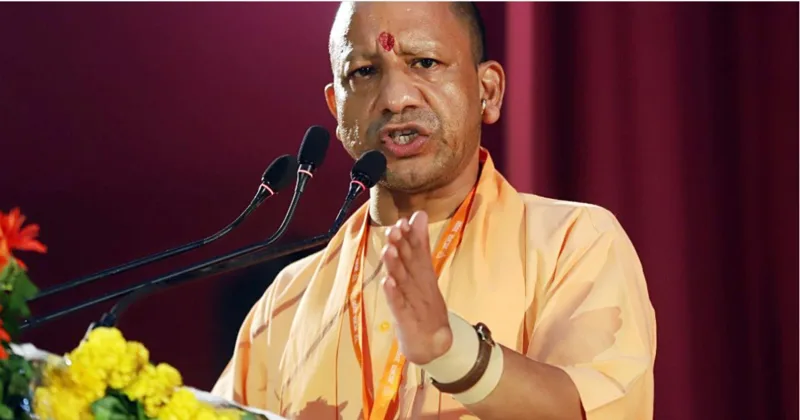
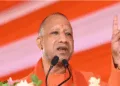
Uttar Pradesh Chief Minister Yogi Adityanath came down heavily at the opposition leaders without mentioning names directly. He asserted that individuals driven by dictatorial instincts and are unable to witness or accept development. These people, he said, are focused solely on their own and their family’s growth, making them inherently opposed to the inclusive vision of Sabka Saath, Sabka Vikas (Together with all, development for all).
Speaking at the inaugural session of a leading media house’s program titled Utsav Abhivyakti Ka at a hotel auditorium near Ramgarh Tal, Gorakhpur, CM Yogi said, “Those who once imposed Emergency in 1975, censored the media, and still frequently threaten the media are the ones who can’t tolerate the rise of India or Uttar Pradesh. They were happy as long as only their family benefited. But now, they are uncomfortable with the inclusive development model brought in under the leadership of Prime Minister Narendra Modi.”
CM Yogi highlighted how previous state governments limited themselves to the progress of a few families, ignoring the needs of the masses. “Due to their narrow, self-serving approach, Uttar Pradesh faced a crisis of identity. Farmers were committing suicides, the poor were dying of hunger, and women and traders lived in fear,” he said.
He contrasted the current scenario with the past, saying that today’s UP has become the growth engine of India’s economy, thanks to the double-engineered government (referring to the same party at both state and central levels). “Before 2017, UP was seen as a ‘sick state’ and a hurdle in development. Today, it stands as a model of both heritage and progress,” the CM added.
Elaborating on the economic strides, Yogi stated that in 2017, UP’s economy was worth Rs 12.75 lakh crore. In a span of just eight years, the state’s economy has expanded to Rs 30 lakh crore, with per capita income rising from Rs 46,000 to Rs 1.10 lakh. These milestones reflect the continuous journey of protecting heritage, welfare for all, and comprehensive development.
CM Yogi took a dig at previous governments, accusing them of creating “One District One Mafia.” In contrast, his administration introduced the One District One Product (ODOP) initiative and established medical colleges across districts, restoring UP’s reputation and empowering local economies.
Tracing the economic decline post-independence, he said that in 1947, UP had a higher per capita income than the national average. But due to indifferent governance, by 2017 it fell to a third of the national average. Since then, focused efforts have reversed the trend. “From having just one expressway in 2017, UP now has six operational expressways and work is ongoing on seven more. Metro services have expanded from one to six cities. The state now boasts the largest highway network and is home to India’s first rapid rail and inland waterway,” he informed.
UP’s Identity Was Once So Weak, Ministers Were Embarrassed Abroad
CM Yogi narrated a shocking anecdote from 2013 when a UP minister was strip-searched at an international airport because the name ‘Uttar Pradesh’ did not evoke trust or recognition abroad. “Such was the state’s identity crisis. But today, UP is known for discipline, development, and dynamism,” he said.
He described Sabka Saath, Sabka Vikas not as a mere slogan, but as a mantra that empowers and ensures inclusive growth. “To achieve collective development, unity and coordinated action are essential,” CM Yogi emphasized.
Highlighting Prime Minister Modi’s vision, CM Yogi said, “When PM Modi took charge, India was the 11th largest economy. Now it is the 5th. Within two years, India will be the third-largest economy. His goal for 2047 – India@100 – is a developed and self-reliant nation, and we must unite to meet the challenges ahead.”
He reflected on the transformation of Gorakhpur, which before 2017 was infamous for gangsterism, poor health infrastructure, and frequent migration due to lack of opportunities. “Now, no one associates Gorakhpur with mafia or disease. The city is known for education, healthcare, commerce, and employment,” he said proudly.
The Chief Minister remarked that the world now discusses Prayagraj not because of mafia activity, but because of the grandeur of events like Mahakumbh 2025. “Over 66 crore devotees visited during the 45-day mega event, and there wasn’t a single case of theft, harassment, or mismanagement. This shows what is possible when everyone works together with discipline and dedication,” he added.
Recalling the grim state of affairs before 2014, he mentioned how news of farmer suicides and hunger deaths used to dominate headlines. He cited his visit to Kushinagar in 2003–04 after reports of starvation deaths among the Musahar community, even though it wasn’t his parliamentary constituency. “When we formed the government, we ensured land rights, ration cards, Ayushman cards, and pensions to marginalised communities like Musahars, Van Tangiyas, Tharus, Sahariyas, and Buksas. Today, 80 crore Indians and 15 crore UP citizens receive free rations. 10 crore have Ayushman health coverage. 4 crore Indians and 60 lakh UP residents got homes under PM Awas Yojana,” CM Yogi highlighted.
The Chief Minister lauded the media for playing a self-motivated and vital role as the fourth pillar of democracy. “Though the Constitution only mentions the legislature, executive, and judiciary, the media has voluntarily assumed the responsibility of strengthening democracy. During the Emergency, they printed blank pages to show resistance,” he recalled.
He noted the shift from print to visual, and now digital and social media, cautioning against deepfakes and fake news that can cause havoc. “Social media is like an unbridled horse – powerful but potentially dangerous if not handled responsibly,” he said.
CM Yogi concluded with a quote from former Prime Minister Atal Bihari Vajpayee: “Individuals or institutions without principles are problems themselves.” He emphasized the need for ideological clarity and national commitment. The event was attended by public representatives, intellectuals, and distinguished citizens from various sectors.











Comments