India aims for $145 billion auto component production by 2030
September 21, 2026
  • Read Ecopy
  • Circulation
  • Advertise
  • Careers
  • About Us
  • Contact Us
Android AppiPhone AppArattai
Organiser
  • ‌
  • Bharat
    • Assam
    • Bihar
    • Chhattisgarh
    • Jharkhand
    • Maharashtra
    • View All States
  • World
    • Asia
    • Europe
    • North America
    • South America
    • Africa
    • Australia
  • Editorial
  • International
  • Opinion
  • RSS @ 100
  • More
    • World Hindu Congress 2026
    • Op Sindoor
    • Analysis
    • Sports
    • Defence
    • Politics
    • Business
    • Economy
    • Culture
    • Special Report
    • Sci & Tech
    • Entertainment
    • G20
    • Azadi Ka Amrit Mahotsav
    • Vocal4Local
    • Web Stories
    • Education
    • Employment
    • Books
    • Interviews
    • Travel
    • Law
    • Health
    • Obituary
  • Subscribe
    • Subscribe Print Edition
    • Subscribe Ecopy
    • Read Ecopy
  • ‌
  • Bharat
    • Assam
    • Bihar
    • Chhattisgarh
    • Jharkhand
    • Maharashtra
    • View All States
  • World
    • Asia
    • Europe
    • North America
    • South America
    • Africa
    • Australia
  • Editorial
  • International
  • Opinion
  • RSS @ 100
  • More
    • World Hindu Congress 2026
    • Op Sindoor
    • Analysis
    • Sports
    • Defence
    • Politics
    • Business
    • Economy
    • Culture
    • Special Report
    • Sci & Tech
    • Entertainment
    • G20
    • Azadi Ka Amrit Mahotsav
    • Vocal4Local
    • Web Stories
    • Education
    • Employment
    • Books
    • Interviews
    • Travel
    • Law
    • Health
    • Obituary
  • Subscribe
    • Subscribe Print Edition
    • Subscribe Ecopy
    • Read Ecopy
Organiser
  • Home
  • Bharat
  • World
  • Operation Sindoor
  • Editorial
  • Analysis
  • Opinion
  • Culture
  • Defence
  • International Edition
  • RSS @ 100
  • Magazine
  • Read Ecopy
Home Bharat

India aims for 145 billion dollars auto component production by 2030: NITI Aayog Report

India’s automotive sector is set to shift gears with NITI Aayog’s latest report, “Automotive Industry: Powering India’s Participation in Global Value Chains”, envisioning a 145 billion USD component production by 2030. The report outlines a comprehensive roadmap to triple exports, boost India’s GVC share from 3 per cent to 8 per cent, and generate up to 2.5 million new jobs

Shashank Kumar DwivediShashank Kumar Dwivedi
Apr 12, 2025, 08:30 pm IST
inBharat
Follow on Google News
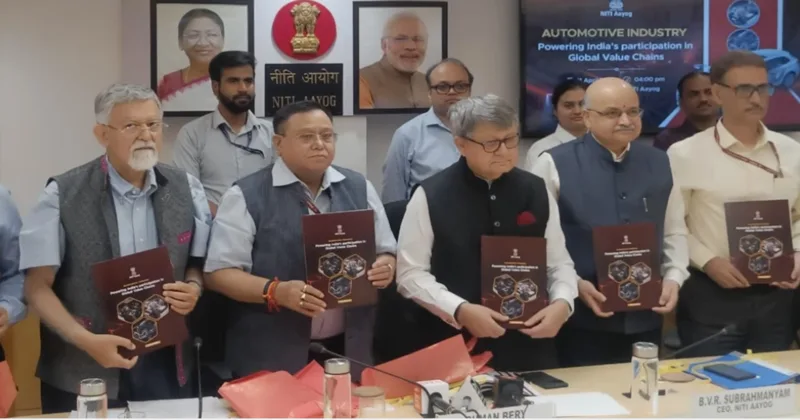
Battery manufacturing hubs are emerging in regions like Europe and the U.S., creating a competitive environment for India to participate in this fast-evolving sector. Image Credit: Twitter(@airnewsalerts)

Battery manufacturing hubs are emerging in regions like Europe and the U.S., creating a competitive environment for India to participate in this fast-evolving sector. Image Credit: Twitter(@airnewsalerts)

Facebook
Twitter
WhatsAppTelegramEmail

In a move to reposition India’s automotive sector on the global stage, NITI Aayog launched a comprehensive report titled “Automotive Industry: Powering India’s Participation in Global Value Chains” on April 11. The report was unveiled by NITI Aayog Vice Chairman Suman Bery in the presence of Members Dr. V.K. Saraswat and Dr. Arvind Virmani, along with CEO Shri B.V.R. Subrahmanyam.

The report presents a roadmap to accelerate India’s transition from being a domestic manufacturing hub to a major global automotive powerhouse, with an ambitious goal of raising India’s share in the global value chain (GVC) from 3 per cent to 8 per cent by 2030.

India’s Automotive Aspiration

With a clear vision for the future, the report sets forth a target of increasing auto component production to USD 145 billion by 2030. Currently valued at around USD 20 billion, India’s automotive exports are expected to triple to USD 60 billion, contributing to a projected trade surplus of USD 25 billion.

Furthermore, this growth is anticipated to generate 2 to 2.5 million new employment opportunities, bringing the sector’s total direct employment to an estimated 3 to 4 million workers by 2030.

From Factory Floors to Global Headlines

In 2023, global automobile production touched approximately 94 million units. The global automotive component market was valued at USD 2 trillion, with around USD 700 billion in exports. India, now the fourth-largest vehicle producer globally—after China, the US, and Japan—manufactures nearly 6 million vehicles annually. Notably, India has carved out a niche in small car and utility vehicle segments, supported by the cost competitiveness of its workforce and initiatives such as ‘Make in India’.

Key Challenges

Despite its manufacturing strength, India’s participation in high-precision automotive component segments—such as engine parts, transmissions, and steering systems—remains low at 2–4 per cent. Challenges such as high operational costs, infrastructural deficits, insufficient R&D expenditure, and moderate GVC integration continue to hinder India’s competitiveness.

Emerging Global Trends Shaping the Sector

The automotive sector globally is undergoing rapid transformation driven by:

• Electric Vehicles (EVs): Soaring demand, regulatory push for decarbonisation, and advances in battery technology are redefining vehicle manufacturing.

• Battery Ecosystem: The rise of battery manufacturing hubs in Europe and the U.S. is reshaping the supply chain for key minerals like lithium and cobalt.

• Industry 4.0: Technologies like AI, IoT, robotics, and ML are enabling smarter factories and data-driven production, enhancing efficiency and enabling new business models.

Strategic Interventions Proposed by NITI Aayog

To strengthen India’s position in the GVC, the report lays out a series of strategic interventions, classified under four component categories based on complexity and maturity:

Fiscal Measures

• Opex Support & Capex Boost: Support for manufacturing capabilities and essential infrastructure including tooling and dies.

• Skill Development: Creating a talent pipeline aligned with future needs.

• R&D and Branding: Incentives for innovation, branding, and government-facilitated IP transfer, especially for MSMEs.

• Cluster Development: Shared R&D and testing centers to promote collaboration.

Non-Fiscal Measures

• Industry 4.0 Adoption: Emphasis on automation, digitisation, and flexible manufacturing.

• International Partnerships: Promoting foreign collaborations, JVs, and FTAs.

• Ease of Doing Business: Streamlining regulatory processes, enhancing supplier discovery, and encouraging labor flexibility.

Vision 2030: A Roadmap to Leadership

By 2030, India aims to become a globally competitive automotive manufacturing hub, with increased integration into global value chains, technological advancement, and job creation. The proposed strategy aims to not only boost output but also elevate the country’s profile as a preferred destination for high-tech and sustainable automotive solutions.

With the automotive sector being a critical pillar of India’s economic development, NITI Aayog’s report emphasises that realising this vision requires concerted efforts from both government and industry. The roadmap offers a comprehensive plan to address existing bottlenecks, enhance global competitiveness, and usher in a new era where Indian vehicles and components play a central role on the global automotive stage.


Topics: NITI AayogAuto component productionManufacturing hubNITI Aayog Vice Chairman Suman Bery
Share
Tweet
SendShareSend
✮ Subscribe Organiser YouTube Channel. ✮
✮ Join Organiser's WhatsApp channel for Nationalist views beyond the news. ✮
Previous News

Kerala’s leftist government attacks Sanatan Dharma on frivolous grounds taking name of RSS

Next News

Odisha: “ASI to complete Puri Srimandir Ratna Bhandar repair work ahead of Ratha Yatra 2025,” says SJTA Chief

Related News

NITI Aayog Focuses over the Strategies for Empowering Caregivers in the path of Viksit Bharat@2047

Reimagining Caregiving: Bharat’s action for empowering the hands that hold us

NITI Aayog data puts India’s unemployment debate in context, highlighting rising employment and labour-force participation

How did the opposition turn unemployment into a political weapon? NITI Aayog data puts the debate in the right context

Ayurveda is rapidly emerging as one of India's strongest tools of global health diplomacy and soft power

From Jamnagar to the World: How Ayurveda is transforming India’s global health diplomacy and soft power

Odisha CM Mohan Charan Majhi

NITI Aayog’s IFI 2026: Odisha emerges as a leading investment destination, ranks among India’s top five states

India's BioE3 Policy aims to build a $2.6 trillion bioeconomy by 2047 through biotechnology-driven innovation, jobs and growth

India’s Bioeconomy Revolution: How NITI Aayog’s roadmap seeks to make the country a global biotechnology leader by 2047

India's Ayush exports doubled to USD 2.16 billion in a decade, with NITI Aayog charting Ayurveda's global expansion

Ayurveda Export Decade: How India doubled Ayush exports to USD 2.16 billion and reached 150 countries

Load More

Latest News

Rashtriya Swayamsevak Sangh (RSS) Sarkaryawah Dattatreya Hosabale in Bhopal (Left)

Not caste, but harmony; not division, but fraternity — Hosabale’s message as an opportunity for introspection to Hindus

Self-reliance in shipping technology: A roadmap to strategic technological independence

Asaduddin Owaisi; Revanth Reddy; Raja Singh (Left to Right) - Inset-Proposed Osmania Hospital

Goshamahal under siege: Is Osmania Hospital project a ‘Trojan horse’ for Congress-MIM to reshape Hyderabad politics?

Suhail, T.N. Reena, Vivek Vijayan and Subramanian (Left to Right)

Keralam: Police arrested four persons, including guest lecturer of a Muslim Educational Society college in Malappuram

Deen Dayal Upadhyaya Grameen Kaushalya Yojana 2026

Deen Dayal Upadhyaya Grameen Kaushalya Yojana to train 34,920 rural youth from October

BJP Leaders Slam PM Modi Mimicry at Rahul Gandhi’s Indore Event

‘Congress is a party of jokers’: BJP slams PM Modi mimicry at Rahul Gandhi’s ‘Chhatron Ki Goonj’ event

RSS voluneterss distributing food during Assam flood

RSS: When SEWA is dharma

An India-born female cheetah with her four cubs at Kuno National Park in Madhya Pradesh

India-born Cheetah gives birth to four cubs at Kuno national park

AI Generated Representative Image

Resolve to Return to Their Roots: Majhis, Gaitas and Patels take historic decision in Koylibeda, Kanker

Gorakhpur is emerging as manufacturing hub

From a shut fertiliser plant to 500 industries: How Gorakhpur is emerging as Purvanchal’s manufacturing hub

Load More
  • Privacy
  • Terms
  • Cookie Policy
  • Refund and Cancellation
  • Delivery and Shipping

© Bharat Prakashan (Delhi) Limited.
Tech-enabled by Ananthapuri Technologies

  • Home
  • Search Organiser
  • Bharat
    • Assam
    • Bihar
    • Chhattisgarh
    • Jharkhand
    • Maharashtra
    • View All States
  • World
    • Asia
    • Africa
    • North America
    • South America
    • Europe
    • Australia
  • Editorial
  • Operation Sindoor
  • Opinion
  • Analysis
  • Defence
  • Culture
  • Sports
  • Business
  • RSS @ 100
  • Entertainment
  • More ..
    • Sci & Tech
    • Vocal4Local
    • Special Report
    • Education
    • Employment
    • Books
    • Interviews
    • Travel
    • Health
    • Politics
    • Law
    • Economy
    • Obituary
  • Subscribe Magazine
  • Read Ecopy
  • Advertise
  • Circulation
  • Careers
  • About Us
  • Contact Us
  • Policies & Terms
    • Privacy Policy
    • Cookie Policy
    • Refund and Cancellation
    • Terms of Use

© Bharat Prakashan (Delhi) Limited.
Tech-enabled by Ananthapuri Technologies