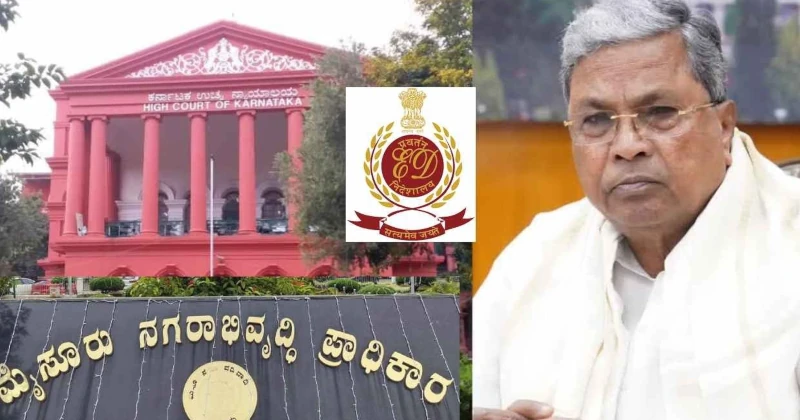
The Karnataka High Court has granted the Enforcement Directorate (ED) permission to further investigate the MUDA scam case, raising the likelihood of complications for Chief Minister Siddaramaiah. This new development comes after the ED sought to investigate other accused parties based on statements made by former MUDA Commissioner D.B. Natesh.
Earlier, a single-judge bench of the High Court had dismissed ED’s summons to Natesh and the search and seizure orders related to his residence. This ruling temporarily relieved CM Siddaramaiah and his wife, Parvathi, as individual inquiries against them were halted. However, the ED petitioned against this ruling in the High Court’s divisional bench, indicating a desire to pursue further investigations.
The divisional bench clarified that while it did not impose a stay on the single-judge bench’s order, it affirmed that the ED could conduct investigations into other accused individuals based on Natesh’s statements and supporting documentation obtained during the probe.
The situation is growing increasingly tense for Siddaramaiah. The ongoing scrutiny stems from allegations surrounding the allotment of land in the MUDA scandal, which some observers suggest could unravel his administration’s integrity. With the ED’s renewed mandate, the potential for new evidence and testimonies could further complicate matters for the Chief Minister.
In another twist, the ED also submitted a petition to dismiss the Lokayukta’s submitted report, seemingly exonerating Siddaramaiah and his associates. The ramifications of this petition could spell further legal challenges for the CM as he navigates mounting political pressure.
Recent reports have indicated that the investigation into the MUDA scam included simultaneous raids by the ED across multiple locations, including Bengaluru and Mysuru. The ED seized several documents from the residences of Rakesh Pappanna and his father, Pappanna, as part of their efforts to gather evidence against those implicated.
In the backdrop of legal skirmishes, the opposition parties, notably the BJP and JD(S), are poised to leverage the situation against the Siddaramaiah government, which they previously criticised for allegedly sidestepping accountability. With public sentiment and opposition scrutiny intensifying, the stakes are high for Siddaramaiah.
Previously dismissed motions to transfer the MUDA investigation to the CBI have only ignited further discussion about accountability and transparency in governance. The Supreme Court’s decision to reject the summons to CM Siddaramaiah’s wife, Parvathi, had initially provided a sense of security for them; however, the latest ruling by the High Court has thrust the couple back into a precarious spotlight.
As the enforcement agency prepares to resume its investigation into the MUDA scam, political analysts and opposition leaders are watching closely to see how the ED’s activities may shape the political landscape leading into upcoming elections. The developments in this case will have repercussions for the Congress party in Karnataka, and CM Siddaramaiah must navigate these turbulent waters carefully to maintain his position and credibility.
On April 1, the Enforcement Directorate (ED) formally challenged the B report submitted by the Lokayukta police regarding alleged irregularities tied to land allotments by the Mysuru Urban Development Authority (MUDA). The case implicates Karnataka Chief Minister Siddaramaiah, his wife Parvathi M, and others, with the ED asserting its status as an aggrieved party regarding the proceedings.
In its petition, the ED highlighted the broader implications of money laundering, stating, “It is being realised worldwide that money laundering poses a serious threat not only to the financial systems of countries but also to their integrity and sovereignty.” This assertion underscores the importance of the Prevention of Money Laundering Act (PMLA), 2002, which the agency referenced in its argument.
The ED contended that the state itself can be considered a “victim” of money laundering, further establishing that it should be regarded as an aggrieved party in this context. As designated prosecutors under PMLA, the ED stated that it possesses the right to intervene or voice its concerns regarding Lokayukta’s closure report.
The core of this ongoing legal saga revolves around the alleged improper allotment of 14 plots of land to Siddaramaiah’s wife, Parvathi, in a prime area of Mysuru. This allotment was purportedly made as compensation for 3.16 acres of land that MUDA supposedly acquired.
Controversially, it is alleged that Parvathi lacked legal ownership of the 3.16 acres, which was claimed to be a gift from her brother, Mallikarjuna Swamy, who allegedly purchased it from a man named Devaraju. Both Swamy and Devaraju have also been implicated in the case.
Despite the Lokayukta police concluding their investigation and stating that no evidence of wrongdoing could be linked to Siddaramaiah or Parvathi, the findings noted violations by MUDA officials during land denotification and conversion processes. This report seemingly absolved the veteran Congress leader of any direct wrongdoing, yet it has not quelled the controversy surrounding the allocations.
The Lokayukta police indicated intentions to continue investigating compensatory allotments from 2016 to 2024, promising to present an additional report to the high court. They have also mentioned that they may utilise recorded statements throughout the ongoing investigations as the law permits.
The Lokayukta findings have received criticism, particularly from opposition parties like the BJP and JD(S), who are poised to leverage this case against Siddaramaiah’s government. They have already characterised the Lokayukta’s report as biased in favour of the Chief Minister. Meanwhile, Congress has denied these allegations, asserting that the ED is merely acting on instructions from the central government regarding what they describe as a coordinated attack against Siddaramaiah.
Adding to the ongoing legal drama, the Karnataka High Court recently declined to put a stay on a prior ruling that had dismissed ED’s summons issued to Natasha DB, former commissioner of MUDA, involved in the land allotment scandal. A division bench, comprising Chief Justice NV Anjaria and Justice KV Aravind, clarified that the previous ruling does not obstruct any ongoing investigations against other accused parties in the matter.