





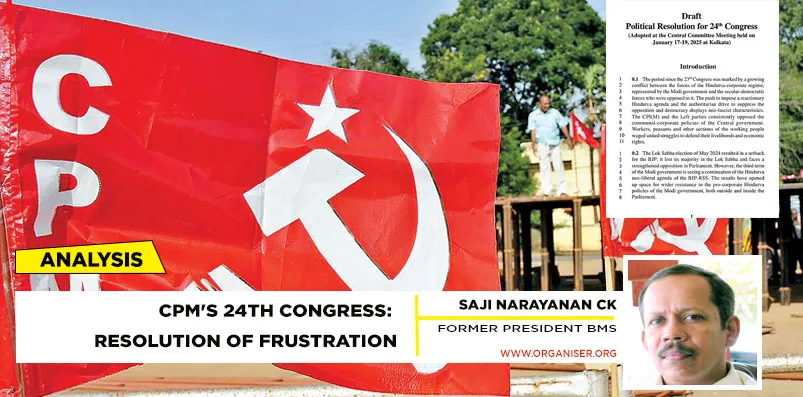
CPM is still groping in the dark as to why it has perilously come close to losing its national party status quite a few times, whereas, CPI did lose its status in 2023. As the Indian Communist movement approaches its 100th year, the fate of Leftist politics is shadowed in an utterly pessimistic note as highlighted in the draft political resolution for the CPM’s 24th Congress. The future of the party is shrouded in gloom and uncertainty. This draft was adopted during the Central Committee meeting held from January 17 to 19, 2025, in Kolkata. It notes, in India, “Party’s mass base and influence have not grown.” Specifically, it points out: “Kerala is the biggest unit of the party……there Lok Sabha election results have shown weaknesses in our political and ideological work…. The state is facing a financial crisis.” This happened despite the CPM coalition ruling Kerala for the past nine years. This situation mirrors the fall of the CPM-led Government in West Bengal, which held power for approximately 30 years.
Both class and mass have distanced themselves away from CPM. At the global level too, the picture is disheartening for them: “The global trend is of a rightward political shift.” The only remaining socialist countries in the world are China, Vietnam, Cuba, the DPRK (North Korea) and Laos while the “Left progressive forces are winning elections in Colombia, Mexico, Brazil, Sri Lanka and Uruguay.” Additionally, there are concerns regarding President Trump’s designation of Cuba as a state sponsor of terrorism.
Embracing Capitalism in Bengal
Communism as an ideology was declared dead when both Buddhadeb Bhattacharjee and Jyoti Basu openly embraced capitalism in Bengal in 2008. On January 3, 2008, Buddhadeb Bhattacharjee strongly advocated “capitalism and not socialism as the only way to industrialise the State.” The following day, Jyoti Basu supported this stance, asserting that socialism was unattainable and that private capitalism was the only remedy; “Socialism is not achievable at this point of time. We have been working within the capitalist system and as such private capital has to be used.”
Eulogising China’s Expansionist Role
While battling for Chinese hegemony, the draft praises China as “emerging as one of the trusted economic powerhouses.” It expresses concern over the escalating conflict between the US and China, noting the emergence of an anti-China alliance in the Asia-Pacific region. The draft recalls a warning from its previous 23rd Congress: “US-China conflict will have an impact on the central contradiction between imperialism and socialism.” The US-led G-7 and NATO have publicly declared China as a major threat. Even during the Biden administration, the US has intensified its efforts to contain and isolate China, but without much success. It also says that the US moves in the Asia-Pacific region are creating tensions due to the increased presence of its navy and military exercises as part of its efforts to contain and isolate China.
The draft highlights that conflict between the US and China is intensifying and the US-led G-7 and NATO have openly declared China as a major threat. The new Trump administration is expected to increase tariffs on countries like China and reignite trade wars. The US, Japan and South Korea have bolstered trilateral military cooperation and are conducting extensive joint military exercises, targeting China, North Korea and Russia, which are officially designated as a ‘Revisionist Power’ (China), a ‘Malign State’ (Russia) and a ‘Rogue State’ (DPRK). The draft is also unhappy about the US forming a ‘Chip Four-Party Alliance’ with South Korea, Japan and Taiwan in an attempt to exclude China from the global semiconductor supply chain. Conversely, it observes that the strong partnership between Russia and China and the rallying of many developing countries behind them have further exposed the vulnerabilities in the US armour. It acknowledges China’s significant achievement as over 150 countries and more than 30 international organisations have joined the Belt and Road Initiative (BRI) of China. The BRI is viewed as an important platform for international cooperation, indirectly hinting that the Indian Government’s failure to participate in the initiative is a missed opportunity.
CPM showers praise for the autocratic regime in North Korea, a self-proclaimed communist state, stating: “North Korea (DPRK) has changed its policy on relations with South Korea and declared that North and South Korea are no longer people of the same nation but are enemies and warring parties.”
CPM feels obligated to support Russia in its declaration of war against Ukraine noting with satisfaction that “Russia has increased its territorial grip in the Donbas and is advancing steadily into the eastern regions of Ukraine…… Russia was able to escape from the net of sanctions because of its close relations and trade with many developing countries, particularly China and India.”
The draft raises concerns about the “targeting of NewsClick by the police and central agencies”. Cases were filed against NewsClick for serious charges of receiving Chinese funding for writing against national interests, money laundering, violation of foreign funding laws and the like. These allegations stem from a New York Times investigation. The CPM appears more concerned with protecting individuals accused of being Chinese agents in India than with national interests. The CPM is not worried about the national interests, but is anxious to save the China agents working in India.
Unreasonable Objections
In its critique of the Modi Government’s economic policies, the CPM accuses the Modi Government as a Hindutva-corporate regime. Party objects to people being provided benefits of health care schemes, terming PMJAY scheme as “Publicly paid private care.” The criticism targets the specialised care offered to the common man for the first time in history through empanelled private hospitals in the country, given the inadequacies of the Government hospital system. CPM’s national leadership, which complains about the Modi Government’s land acquisition for development projects, must, instead, advise Kerala’s CPM Government for its massive land acquisition programmes for a K-rail project which had to be stalled for the time being due to vehement public protest.
Similar to its previous opposition to tractors in agricultural fields, the draft does not mince words in blindly opposing Artificial Intelligence, accusing it of being a threat to jobs, a tool for warfare, collecting personal data, a violator of right to privacy and the like. While these concerns warrant discussion, the nation cannot shut its eyes to the advancements in new technologies being developed worldwide.
The CPM expresses outrage to find, “for the first time in our political history, two Chief Ministers of Jharkhand and Delhi were arrested.” It is pleading immunity for Chief Ministers facing corruption charges, probably to defend Pinarayi Vijayan, the CPM Chief Minister embroiled in corruption charges related to his daughter. The party also expresses its displeasure with the imposition of the Unlawful Activities (Prevention) Act (UAPA) and the stringent Prevention of Money Laundering Act (PMLA) on offenders and anti-social elements.
Party is irritated by the peaceful transition occurring in Jammu & Kashmir, demanding the reinstatement of statehood at the earliest, and vowing to continue the struggle for special status. CPM is not happy with the idea of ‘One Nation, One Election’. Party claims that it asserts its resistance against the West Bengal, Andhra Pradesh, Jharkhand, and Tamil Nadu governments, which also oppose Modi. The draft articulates the party’s position that Congress has not changed from the same neoliberal policies and class interests shared with the Bharatiya Janata Party (BJP). However, as the main secular opposition party, Congress has a crucial role to play. The CPM is willing to cooperate with I.N.D.I. Alliance parties in Parliament and on agreed issues outside Parliament.
On foreign policy, the draft states that India is isolated in the neighbourhood, at the same breath acknowledging that the Indian Government has slowly established relations with neighbouring countries, even with the Taliban. On the National Education Policy, the party’s objection against the National Education Policy (NEP) is reduced to a passing reference since its opposition did not find support in the education field. It’s only objection to NEP is around the perceived “extreme centralisation” of the sector’s management, particularly with the Governor’s authority as chancellor to select Vice Vhancellors etc. Additionally, it expresss apprehension about the Government’s effort to rewrite Indian history, arguing that this effort aims to present mythology as real history, whereas they should not forget the distortions done by Leftist historians in historical studies.
It’s concern about Hindutva forces’ efforts to infiltrate and control the film industry, television channels, and OTT platforms is natural as these domains were traditionally viewed as the pasture land of communists, which are now losing their influence.
In their view, Rashtriya Swayamsevak Sangh (RSS) poses the greatest threat, prompting the party to devise a strategic plan to counter both the RSS and the Modi Government, which they accuse of promoting a pan-Hindu identity, bluntly alleging that it retains caste hierarchies. Party prepares a plan of action to counter RSS outfits and the Modi Government. Their action plan includes:
- Intervening in festivals and social gatherings
- Mobilising intellectual resources
- Conducting anti-Hindutva, anti-communal campaigns in working class residential areas
- Countering efforts to rewrite history *Involving in social service, science movements, and cultural activities
- Campaigning ‘Socialism is the Alternative’, tailored to Indian conditions, and setting out socialist ideals to the youth
- Advocating that the only real alternative is Left and Democratic Alternative
- Positioning Communist Parties, socialism and Marxism-Leninism as alternatives to imperialism
- Conducting class and mass struggles *Utilising appropriate electoral tactics *Uniting the peasant movement and organising worker-peasant conventions.
Anti Hindu and Pro Muslim Agenda
The party’s objection to the Pran Pratishtha of the Ram Mandir in Ayodhya in January 2024, highlights that it has not yet politically grasped the significance of Shri Ram as an icon in the hearts of every Bharatiya. It criticises Government initiatives like Uniform Civil Code (UCC), Waqf amendment and laws against Love Jihad, labelling them as aggressive extensions of the “Hindutva” agenda.
Furthermore, it opposes the emerging pan-Hindu identity, dismissing nationalism and patriotism as a “false sense of pride.” It aligned with Tamil Nadu Chief Minister Stalin in opposing Sanatan Dharma, alleging RSS-BJP-Hindutva forces of “promoting Manuvadi ideologies in the garb of Sanatan Dharma.” They also warned that “pro-Hindutva, RSS elements are actively supporting these pro-monarchy forces in Nepal.”
To placate the minority community, it opposes what they term “India’s shameful support for Israel”, indirectly endorsing Hamas and other Islamist terrorist outfits while expressing solidarity with the State of Palestine with pre-1967 borders and East Jerusalem as its capital.
However, the draft resolution admits about Bangladesh: “Amidst the turmoil and chaos, Islamist fundamentalist forces targeted and attacked minorities to create a communal divide. The secular opposition is also facing targeted attacks. Religious fundamentalist and extremist elements who had been arrested and put in jail were released by the interim government.”
Turning a Blind Eye to Progress
When the party raises concern about alleged “violence” against Muslims, they overlook the transformation that has taken place in a State like Uttar Pradesh, having a population of more than 24 crores, which has shifted from being a crime-ridden State to a crime-controlled State. In contrast, Kerala, under CPM rule, is rapidly becoming a hub for narcotics, crime, and violence. CPM Chief Minister Pinarayi Vijayan should benefit from learning how to control crimes from the UP Chief Minister Yogi Adityanath.
Thus, a cursory review of the draft document reveals the reason for the party’s isolation from the Bharatiya populace and highlights how their leadership shapes defective policies in a country like Bharat, disconnected from the ground realities.





![A Representative image [ANI Photo]](https://organiser.org/wp-content/uploads/2025/12/representative-image-e1765612818961-120x70.webp)
Comments