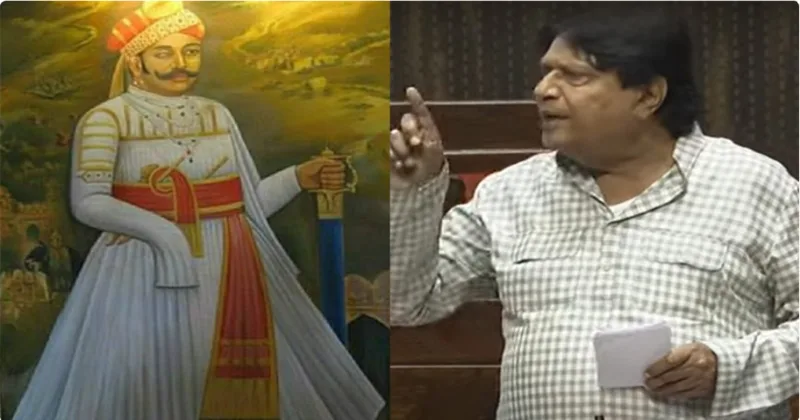
A recent statement by Samajwadi Party Rajya Sabha MP Ramji Lal Suman has sparked controversy wherein he called Maharana Sangram Singh, better known as Rana Sanga, a “traitor.” Speaking in the Rajya Sabha on March 22, the MP alleged that Rana Sanga invited Babur to India to defeat Ibrahim Lodi and, in doing so, labelled Hindus as descendants of a “traitor.” But does history support this claim? A closer examination of Rana Sanga’s life and achievements tells a very different story.
Rana Sanga: The unyielding defender of India
One of the most persistent misconceptions is that Rana Sanga invited Babur to India to overthrow the Lodi dynasty. However, historical evidence tells us otherwise. By the time Babur invaded India, Rana Sanga had already established himself as a dominant force, winning battles against Ibrahim Lodi and other rulers. He had no reason to seek external help, especially from Mughals who had half the courage as Sanga himself, he was already one of the most powerful kings of his time.
Ascending the throne of Mewar in 1508, Rana Sanga was a warrior of unparalleled courage. He fought over 100 battles, sustaining grievous injuries, including the loss of an eye, a hand, and more than 80 wounds on his body, yet he remained undefeated except in the Battle of Khanwa. His bravery earned him the title of ‘Hindupat.’ Under his leadership, Mewar’s influence stretched from Agra in the east to the borders of Gujarat in the south.
Colonel James Todd, a noted historian of Rajputana, documented that Maharana Sanga commanded a vast army of 80,000 cavalry, 500 war elephants, and nearly 200,000 infantry troops. His authority was respected across northern and western India, and his allies included the rulers of Gwalior, Ajmer, Sikri, Raisen, Kalpi, Chanderi, Bundi, Gagraun, Rampura, and Abu.
Warrior who reshaped Indian history
Rana Sanga was more than a warrior; he was a strategic leader who repelled multiple invasions and expanded Rajput dominance. His victories over the Sultans of Malwa and Gujarat restored Rajput power in Malwa for the first time since the fall of the Parmar dynasty in 1305 AD.
In the Battle of Khatoli (1517), he inflicted a crushing defeat on Ibrahim Lodi, forcing the Sultan of Delhi to retreat. He followed this with victories at Dholpur (1518-19) and Ranthambore, further weakening Lodi’s grip over northern India. Similarly, he defeated Mahmud Khilji II of Malwa at Idar and Gagron in 1517 and 1519. Despite capturing Khilji, he released him following the principles of Sanatan war ethics, after securing territorial concessions.
By 1520, Rana Sanga had defeated Nizam Khan of Idar and marched into Ahmedabad, annexing North Gujarat and establishing his vassals. His campaigns brought territories such as Gagron, Bhilsa, Raisen, Sarangpur, Chanderi, and Ranthambore under his dominion. One of his significant reforms was abolishing the Jaziya tax imposed on non-Muslims and removing structures symbolizing Islamic rule.
Rana Sanga’s fierce resistance against Babur
The claim that Rana Sanga invited Babur crumbles when one looks at the actual course of events. When Babur defeated Ibrahim Lodi at Panipat in 1526 and seized Delhi, he faced stiff opposition from the Rajputs in the west and Afghan forces in the east.
After taking Delhi, Babur sought to consolidate power in Agra, but Rajput forces controlled the surrounding areas. His attempt to take Bayana failed on February 21, 1527, when Rana Sanga’s army inflicted a humiliating defeat on the Mughals, forcing Babur to retreat.
Scottish historian William Erskine noted that Babur was taken aback by Rana Sanga’s military prowess. Even Babur himself admitted in his autobiography Baburnama: “The infidels fought such a fierce battle that the morale of the Mughal army was broken. They were terrified.” Historian V.K. Krishnarao affirmed that Rana Sanga viewed Babur as a foreign invader and was determined to expel him from India.
The Battle of Khanwa
Realising the strength of Rana Sanga, Babur changed tactics. He played on religious sentiments, portraying the Rajputs as infidels to rally his troops. On March 16, 1527, the two armies met at Khanwa, near Agra.
Although Rana Sanga’s force was estimated at around 100,000 troops compared to Babur’s 80,000, the Mughals had one significant advantage, gunpowder and cannons. Many historians argue that Babur would not have won without firearms.
One such historian, Pradeep Barua noted that had Babur not adopted the same tactics he used at Panipat, the Rajputs might have changed the course of Indian history by reclaiming Delhi. The loss at Khanwa weakened the Rajput alliance, clearing the way for Mughal dominance for the next two centuries.
Who Really Invited Babur?
The claim that Rana Sanga invited Babur is baseless. The true culprits were powerful figures of the Delhi Sultanate, Punjab Governor Daulat Khan, Sultan Sikandar Lodi’s brother Alam Khan Lodi, and Ibrahim Lodi’s uncle Alauddin Lodi. These men, desperate to overthrow Ibrahim Lodi, invited Babur to India in 1523.
Alam Khan Lodi even travelled to Babur’s court, informing him about the instability in Delhi. Babur had been attempting invasions of India since 1503 but had failed multiple times. Finally, in 1526, with Ibrahim Lodi weakened by repeated defeats at the hands of Rana Sanga, Babur seized his opportunity.
Dr. Mohanlal Gupta, in Influence of Mewar in National Politics, completely dismisses the idea that Rana Sanga sought Babur’s assistance. At the time, Rana Sanga was the most powerful ruler in India, leading a Rajput confederacy and defeating multiple Muslim rulers. It is illogical to suggest that he would rely on a foreign invader when he was already at the height of his power.
Even Babur himself, in Baburnama, acknowledged Rana Sanga as one of the greatest Hindu rulers of his time, along with Krishnadevaraya of Vijayanagar. The historical evidence overwhelmingly debunks the myth that Rana Sanga was a “traitor.”
The legacy of Maharana Sangram Singh is one of resilience, honour, and an unwavering commitment to his land and people. Far from being a “traitor,” he was a warrior who stood against foreign domination and defended Indian sovereignty. His military genius and strategic vision made him a formidable adversary against the Lodis, the Malwa and Gujarat Sultans, and the Mughal invaders.
Attempts to distort history do a great disservice to his contributions and misrepresent the broader struggle for Indian independence during his time. The truth is undeniable that, Rana Sanga was one of India’s greatest warriors, a beacon of resistance, and a leader who fought till his last breath for his people and his homeland.