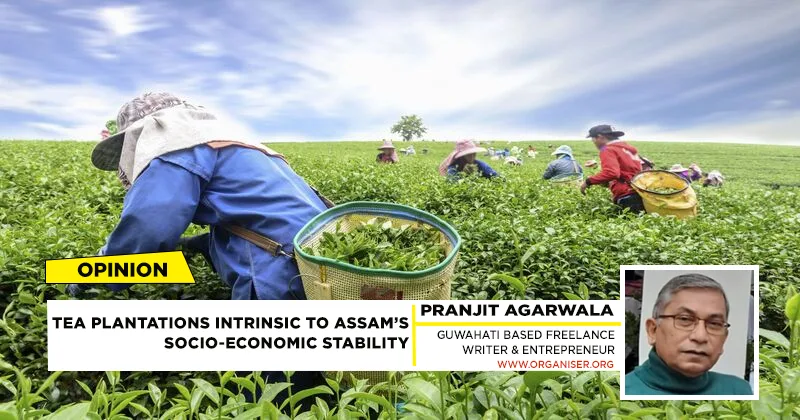
In 2023, Assam Tea completed 200 years. Although the Singpho tribe of Arunachal Pradesh have been drinking the brew made from the Camellia Sinensis plant since ancient times, the tea plant as we know it today was discovered in Assam in 1823 by Robert Bruce. The first tea garden in Assam was started in 1833. Since then, tea gardens have grown rapidly in Assam, necessitating infrastructure development that has helped open up this remote region to the world. In two centuries, Assam Tea, with its strong body and colour, has become globally famous. Assam Tea accounts for 23 per cent of the world’s total tea output and 60 per cent of India’s tea production. Besides contributing to State revenues, the export of Assam Tea is a major foreign exchange earner for the country. Even though today the focus is on sunrise industries like semiconductors, renewable energy, Artificial Intelligence, etc, tea remains the backbone of Assam’s predominantly agricultural economy.
There are more than 850 tea gardens in Assam. Initially, most of the tea gardens were owned by British/European companies, with a few belonging to native persons. The early planters were hardy pioneers with a futuristic vision. They transformed a primitive agricultural economy into a plantation-based economy capable of competing in the global tea trade. Till about 1900, 96 per cent of tea consumed in the UK was from China and only 4 per cent from India. By 1920, 60 per cent of the tea imported by the UK was from India, and the lion’s share was from Assam. This was possible because the tea sector underwent many progressive changes during this period.
The first significant change came around 1896 with the invention of tea rolling and drying machines. This introduced mechanisation in black tea manufacturing, reducing the cost of production, increasing output and improving quality. In 1911, the Tocklai Tea Research Institute was established to conduct research and develop all aspects of tea cultivation and processing. In 1930, the innovation of the CTC machine in Assam brought a paradigm shift in tea processing and consumer tastes from orthodox to CTC varieties. By the 1950s, Assam CTC tea, with its dark colour and strong flavour, dominated the markets. As the tea gardens expanded/prospered, Assam’s GDP and per capita income grew. By 1951, Assam had the second-highest per capita income in the country.
However, post-independence, a change in the ownership pattern of tea gardens from British/European companies to Indian businessmen altered management and tea culture practices. The entrepreneurial, progressive approach was replaced by more commercial considerations. The new approach focused more on short-term gains rather than sustainability and development. Tea gardens suffered. Tea is an agro-based industry, which requires timely inputs and investments for the rejuvenation/replacement of ageing tea bushes and maintenance/upgrading of plants and machinery.
Today, structural weaknesses are inherent in the Assam gardens. More than 30 per cent of the acreage under tea is above the economic threshold age limit. Poor management, compromise in standard tea culture practices, outdated factory set-up, diversion of funds with negligible fresh investment by inexperienced owners, over-dependence on bank loans, etc, have resulted in the neglect of tea gardens, impacting financial sustainability and development. Competition from other tea-producing nations in the domestic and international markets for cheaper teas has deepened the crisis. The deteriorating conditions of the tea gardens have strained management/worker relations, causing labour unrest.
Tea plantations are labour-intensive and dependent on cheap labour to be cost-effective. In the colonial era, cheap indentured labour was brought from Central India and parts of Bengal and Bihar. This was primarily responsible for the exploitative work practices in the tea gardens. Even today, plantation workers endure a rigorous work schedule and live in poor, unhygienic conditions with limited access to basic amenities, education and healthcare. However, with the unionisation of plantation workers, such practices/conditions have been increasingly challenged. The political mobilisation of the tea garden community has added another dimension to plantation economics. Government’s policy of unilaterally hiking wages to win votes has upset the already precarious cost-revenue equation of tea estates.
The present crisis in the tea industry is due to shortsighted policies that prioritised short-term gains instead of long-term sustainability and development. To combat climate change, regenerative agriculture that revitalises the soil, improves the health of tea bushes, reduces chemical inputs and enhances bio-diversity is needed in tea gardens. The annual recommended rate of uprooting and replanting of old bushes with infilling of vacancies is essential to maintain the economic age limit threshold for better yield and quality. Standard tea-culture practices must not be compromised; factories must be properly maintained with timely upgrading of machinery, and owners must be willing to invest in new agri-technology to achieve sustainable development.
Labour wages, a critical factor, account for 60 per cent of production expenses. Another 10 per cent is added to the expenses for providing facilities like subsidised grains, housing, firewood, medical supplies, and education. This is higher than in other labour-intensive sectors, where wages account for 50 per cent of production costs. For the financial sustainability of tea gardens, a system of productivity-linked wages must be explored. It is also necessary to skill workers in regenerative agriculture practices, modern tea cultivation techniques, quality control, water management, soil and environmental conservation methods, entrepreneurship etc. At the same time, the government should bring the non-cash benefits given to the workers under its various welfare schemes to improve their living conditions and ease the burden on owners.
The tea gardens in Assam employ 15 lakh people, which is 17 per cent of the State’s workforce. The multi-ethnic and multi-cultural tea community, which has worked in the tea gardens for generations, is today an integral part of Assam’s socio-cultural fabric. Their lives and livelihoods are tied to the future of tea plantations. Another 20 per cent of Assam’s population is dependent directly or indirectly on the tea sector. Moreover, there are an estimated 1.5 lakh Small Tea Growers (STGs), mainly rural unemployed youth engaged in tea cultivation. Diverting tea garden land for different mega-projects may make corporate sense, but any disruption of tea plantations or the STG sector will have serious socio-economic consequences for Assam.