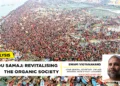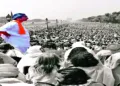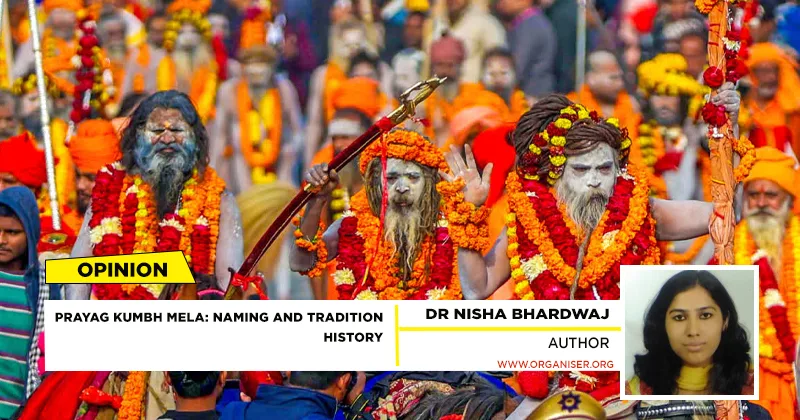
Pragwal Brahmins named the Kumbh festival in Prayag in 1870. Before that, the fair that started on the day of Makar Sakranti in January was called Magh Mela. According to John Irwin, Magh Mela has been held at Sangam place since ancient times. From ancient times until today, people have taken a dip in the water of the Sangam River in Magh Mela to wash off their sins and choose the path of attaining heaven. Every year, when the Sun enters Aries and Jupiter enters Aquarius, Magh Mela is held. Which is recognised today as Kumbh Mela. The description of Prayag and Magh Mela as historical, religious and holy places is mentioned on the Kosam Stambh or Rosetta stone built in the earlier period of King Ashoka and dated in Prayag. Secondly, in the initial documents, Prayag has been called the navel of the earth i.e. the land of dialogue with God. That is, the universe is believed to have originated from water and Prayag is believed to be the first earthen structure to emerge from that water. A mythological story is also associated with Prayag about Lord Varah finding the earth hidden in water by Hiranyaksha ashur and bringing it out by placing it on his nose.
The separation of earth and heaven is also believed to have taken place in Prayag. The means of separating heaven and earth is believed to be the fig tree or pillar. The emptiness between heaven and earth was filled with space by this tree and the sun was freed from water. The sun spread light on earth and gave life to it. The high land symbolizing the cosmic life cycle is identified as Jhusi village. In the Mahabharata era, King Yudhishthira and his brothers spent their exile days in Jhusi village. The well located here is called Samudra Kup, its water was used by the Pragwal community in ritual activities. This well fills with Sangam water through an underground drain. Daraganj and the Vasuki temple there are identified as the second place of origin of the universe, which does not submerge even during floods in rivers, because Vasuki Nag protects Daraganj. For this reason, it is necessary for the devotees of Magh Mela to worship in the Vasuki temple.
Chinese traveller Hieun Tsang writes in his description that Prayag and Sangam Bhumi have been important since ancient times as charity and holy places. Therefore, many kings have been bathing in the water of Sangam after doing charity here. King Harsha also performed Havan-Yagna by donating all his treasures, clothes, grains and metals in Prayag. Harsha started shouting in joy after donating that he has done a pious deed by doing charity. According to Hieun Tsang, after the worship and rituals, pilgrims had to feed Brahmins, which is said to be a tradition as old as the Vedas. In Majhima Nikaya, Mahatma Buddha says that along with bathing in Prayag, a pious person should be pure at heart and impartial in action. In Mahabharata, Prayag Magh Snan Tirtha has been mentioned as a means of atonement for past mistakes and guilt. Secondly, Prayag has been called Mansa Tirtha.
Apart from giving the description of Prayag in Daan Bhumi, Hiuen Tsang has written an interesting description of the pillar cult of Prayag. According to Hiuen Tsang, the ascetics climb this pillar, hold it with one hand and foot, and keep an eye on the movement of the sun by stretching one hand and leg. This is Surya Chakra Puja, that is, this action is a cosmic ritual process of the rotation and movement of the sun. Which was done at the beginning of the year to stimulate the fertility powers of the sun. Hiuen Tsang has also revealed the belief of the people in the confluence water of Prayag as liberation from the cycle of life. Secondly, the pilgrims used to climb the branches of the fig tree and jump into the confluence water and give up their lives, so that they could be freed from the cycle of life and sins and virtues. For this reason, there used to be a pile of human bones under this tree. Alberuni has also mentioned this fig tree. This fig tree is a symbol of eternity, which separates earth and sky (life-death) in a moment.
At present, Kosam Stambh, Akshay Vat and Samudra Koop are included in the Allahabad Fort. Mughal ruler Akbar built the Allahabad Fort in 1575-84. Akbar had visited Magh Mela in 1575 with Raja Birbal, the description of which is engraved on the Kosam-Stambh. Seeing the sanctity, importance and religious significance of Magh Mela, Akbar had chosen Prayag as the headquarters of his Din-i-Ilahi religion and the place of choice for his followers. Akbar did not find the truth in the story of destruction of life for millennia in Islam and under the importance of Hindu religion, he chose Prayag to rebuild his life. Akbar started a new religion, built a fort, and named Prayag as Allahabad (Ilah means God in Arabic and Baad means residence). Akbar had banned death rituals in the Magh Mela in Prayag under the concept of life-cycle ending. Secondly, Samudra Koop reservoir was closed. Perhaps the British did this work, i.e. by destroying the Samudra Kup reservoir in 1798 during the conversion of the Allahabad Fort into an armory.
Even during the time of Akbar, Akshay Vat was recognized as the tree of life and indestructible. William Finch wrote about the fig tree being green and Tiefenthaler wrote about Akshay Vat being dry during his visit in 1766, but a milky white substance coming out when its branches were cut. This white milk was the expression of semen, i.e. life potential. Today, Akshay Vat and Patal Puri Temple inside the fort are famous as Darshan Graha. Due to raising the land during the construction of the fort, Akshay Vat was buried in a pit and Madhav Temple, i.e. Patalpuri Temple was buried underground, which indicates their current state. Devotees worship at Akshay Vat and the temple through an underground passage, which was constructed between 1611 and 1766. According to Chaitanya Charitamrita, in the 16th century Chaitanya ji had visited and bathed in the holy Magh Mela. Tulsidas, the author of Ramcharitmanas, has also mentioned the sanctity of the annual Magh Mela and said that after the Rabi harvest, thousands of Hindu pilgrims flocked to the Magh Mela, and even the forests and fields could not become an obstacle to stop them.
Tabaqat-i-Akbari and Yadgar Bahaduri mention the organisation of the annual Magh fair in the month of Magh in the winters in Allahabad and its sanctity by calling it Tirtharaj. Thus, before 1870, Kumbh Mela was world famous as Magh fair. The Magh fair of Prayag was so sacred that for centuries, the Indian people, from the king to the common person, have been observing it by taking a dip in the confluence water and giving donations. This Mansa Teerth does not need anyone’s belief or conviction because it is a symbol of faith. Thank you