





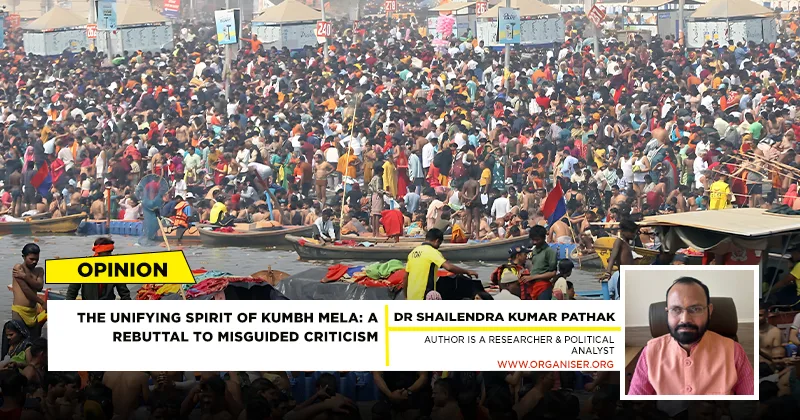
The recent article by Delhi University professor Savita Jha in the Indian Express, titled “Rush at Maha Kumbh shows how Hinduism is losing its pluralistic character,” is a flawed and misleading critique of one of the most significant religious gatherings in Hinduism. The professor’s argument that the Mahakumbh is transforming Hinduism into a more “codified, performative, and mandatory” religion is not only baseless but also dismissive of the historical and spiritual significance of this event.
Hinduism, by its very nature, has always been a performative and diverse tradition, enriched by rituals, festivals, and public expressions of faith. The grand celebration of Kumbh Mela is not an aberration but a testament to the inclusive and participatory nature of Hindu dharma. The professor’s assertion that the increased participation in Mahakumbh is forcing Hinduism towards rigidity is a deliberate misreading of the event’s essence.
The Mahakumbh is not mandatory for Hindus, nor is it a recent phenomenon aimed at enforcing religious conformity. It is a time-honored tradition where Hindus from across sects and regions gather at the confluence of the Ganga, Yamuna, and the mystical Saraswati to cleanse their sins and seek spiritual enlightenment. The presence of millions of devotees, including Vaishnavas, Shaivas, Shaktas, and Naga sadhus, highlights the pluralistic character of Hinduism rather than diminishing it. This plurality is deeply embedded in Hindu scriptures. The Bhagavad Gita (4.11) states: “As people approach me, so do I receive them. All paths, Arjuna, lead to me.” This verse itself confirms Hinduism’s ability to accommodate diverse spiritual approaches while maintaining unity.
Jha’s comparison of Hindu religious expression to Abrahamic traditions is fundamentally flawed. Abrahamic religions have a centralized authority and mandatory rituals, whereas Hinduism thrives on diversity, decentralization, and individual choice. Unlike Islam, which mandates Hajj as a compulsory pillar of faith, Kumbh Mela remains an optional yet deeply revered pilgrimage for Hindus. Hindus do not ostracize those who do not participate, nor is there any compulsion for attendance. The Rig Veda (1.164.46) further emphasizes this inclusivity: “Ekam Sat Vipra Bahudha Vadanti”—Truth is one, but the wise call it by many names.
The article further criticizes the “heightened devotion” among Hindus and the younger generation’s enthusiastic participation in Mahakumbh. This criticism is both elitist and historically inaccurate. Traditionally, pilgrimages and spiritual gatherings in Hinduism have always attracted both the elderly and the youth. The increased presence of young Hindus at Kumbh Mela today is a sign of the religion’s resilience and continued relevance in modern times, not an erosion of its pluralism.
Jha’s lamentation that Hinduism is becoming “unilinear” due to social media and commercialization is another weak argument. The availability of information and improved transportation has merely facilitated greater participation in pilgrimages, making it more accessible to people across economic and regional backgrounds. The claim that mass participation diminishes contemplation is unfounded—devotees engage in deep meditation, fasting, prayers, and spiritual discussions throughout the Kumbh Mela. The Kalpvaasis, for example, undertake strict spiritual disciplines for the entire duration of the festival. The Upanishads, which form the philosophical bedrock of Hinduism, encourage both ascetic withdrawal and devotional engagement, affirming that all forms of spiritual seeking are valid.
The comparison of Kumbh Mela to the Jain practice of Sallekhana is not only inappropriate but also misleading. Sallekhana is a personal vow of renunciation leading to voluntary fasting unto death, whereas Kumbh Mela is a grand celebration of life, devotion, and communal unity. To equate a joyous congregation with an ascetic’s self-imposed end is an attempt to distort Hindu practices to fit an academic narrative detached from reality.
The author also attempts to blame “heightened devotion” for the unfortunate stampede at Mahakumbh. This is a dishonest insinuation. Stampedes occur due to logistical failures, mismanagement, or unforeseen circumstances, not because of religious fervor. The 2015 Mecca stampede, which resulted in thousands of deaths, did not lead to an argument that Islam’s devotion is “dangerous.” Yet, when a tragedy occurs in a Hindu pilgrimage, intellectuals like Jha are quick to blame the faith rather than the administrative shortcomings.
Moreover, Jha’s characterization of the Kanwar Yatra as a “problematic” display of Hindu faith due to music and public processions exposes her inherent bias. Hinduism has always incorporated music and dance into its religious expressions—be it Bhajan-Kirtans, Bharatnatyam, or Raas-Leela. Unlike Islam, where music is often deemed haram, Hinduism celebrates divine expression through sound and movement. It is hypocritical to praise Sufi Qawwalis while criticizing Hindu devotional songs played during pilgrimages. As the Shiva Purana describes, Bhagwan Shiva himself is the source of all sound and music, further reinforcing the integral role of music in Hindu worship.
Savita Jha’s underlying grievance appears to be that urban, left liberal blend education recipient Hindus, who were expected to be deracinated from their faith, are reclaiming their spiritual heritage with pride. The professor’s argument that modern Hinduism is being reshaped into something “it was never meant to be” ignores the fact that Hinduism has always evolved while retaining its foundational principles. The Vedas, Upanishads, Smritis, and Puranas offer multiple paths to spirituality, and Kumbh Mela remains a vibrant space where these paths converge without any singular doctrine imposing itself on others.
Kumbh Mela is a perfect representation of Hindu pluralism. It is a melting pot where ascetics, householders, scholars, and common devotees co-exist, engage in philosophical debates, and perform diverse rituals. Contrary to Jha’s claim that Kumbh imposes a standardized version of Hinduism, it actually reinforces the vast, decentralized nature of Sanatan Dharma. There is no singular “Hindu way” to perform Kumbh rituals—each sect and region follows its own practices, thereby debunking the fear of Hinduism becoming “monolithic.”
The hypocrisy of “liberal intellectuals” who scrutinize every Hindu gathering while turning a blind eye to other religious congregations is glaring. The same voices that celebrate Christmas markets, Sufi music festivals, and the mass pilgrimage of Hajj suddenly become alarmist when Hindus gather in large numbers. If communal harmony is truly their concern, they should appreciate how Kumbh Mela fosters unity among Hindus rather than manufacturing unfounded fears of “Hindu majoritarianism.”
Summarily, Savita Jha’s article in Indian Express is yet another attempt by the liberal cabal to shame Hindus for expressing their faith openly. The Mahakumbh is neither a threat to Hindu pluralism nor a departure from its essence—it is, in fact, a grand reaffirmation of the faith’s diversity, inclusivity, and spiritual richness. Hindu scriptures themselves uphold the idea that diverse paths lead to the divine, making the unity in diversity at Kumbh Mela a reaffirmation of Hinduism’s essence, not its deviation.
Instead of questioning the devotion of crores of Hindus, it is time for intellectuals to introspect on their own biases and acknowledge the vibrant, pluralistic reality of Hinduism as it truly is.













Comments