Election Commission Appointments, SC & Foreign Influence—"ADR’s legal battle sparks concerns over foreign ties"
June 9, 2026
  • Read Ecopy
  • Circulation
  • Advertise
  • Careers
  • About Us
  • Contact Us
Android AppiPhone AppArattai
Organiser
  • ‌
  • Bharat
    • Assam
    • Bihar
    • Chhattisgarh
    • Jharkhand
    • Maharashtra
    • View All States
  • World
    • Asia
    • Europe
    • North America
    • South America
    • Africa
    • Australia
  • Editorial
  • International
  • Opinion
  • RSS @ 100
  • More
    • Op Sindoor
    • Analysis
    • Sports
    • Defence
    • Politics
    • Business
    • Economy
    • Culture
    • Special Report
    • Sci & Tech
    • Entertainment
    • G20
    • Azadi Ka Amrit Mahotsav
    • Vocal4Local
    • Web Stories
    • Education
    • Employment
    • Books
    • Interviews
    • Travel
    • Law
    • Health
    • Obituary
  • Subscribe
    • Subscribe Print Edition
    • Subscribe Ecopy
    • Read Ecopy
  • ‌
  • Bharat
    • Assam
    • Bihar
    • Chhattisgarh
    • Jharkhand
    • Maharashtra
    • View All States
  • World
    • Asia
    • Europe
    • North America
    • South America
    • Africa
    • Australia
  • Editorial
  • International
  • Opinion
  • RSS @ 100
  • More
    • Op Sindoor
    • Analysis
    • Sports
    • Defence
    • Politics
    • Business
    • Economy
    • Culture
    • Special Report
    • Sci & Tech
    • Entertainment
    • G20
    • Azadi Ka Amrit Mahotsav
    • Vocal4Local
    • Web Stories
    • Education
    • Employment
    • Books
    • Interviews
    • Travel
    • Law
    • Health
    • Obituary
  • Subscribe
    • Subscribe Print Edition
    • Subscribe Ecopy
    • Read Ecopy
Organiser
  • Home
  • Bharat
  • World
  • Operation Sindoor
  • Editorial
  • Analysis
  • Opinion
  • Culture
  • Defence
  • International Edition
  • RSS @ 100
  • Magazine
  • Read Ecopy
Home Politics

Election Commission Appointments, SC & Foreign Influence—”ADR’s legal battle sparks concerns over foreign ties”

ADR’s legal battle against the Modi government’s Election Commission appointment law raises concerns over its foreign funding and political motivations, despite the law making the process more inclusive. The Supreme Court has rejected ADR’s claims, emphasising that the legislation does not place the Election Commission under government control

WEBDESKWEBDESK
Feb 22, 2025, 06:30 pm IST
in Politics, Bharat
Follow on Google News
FacebookTwitterWhatsAppTelegramEmail

Writer and activist Professor Dilip Mandal, in a post on X, highlighted the historical context of Election Commissioner appointments. He pointed out that past Prime Ministers exercised unilateral control over these appointments, emphasising that the current debate is politically motivated rather than rooted in genuine concerns over democratic fairness.

https://twitter.com/Profdilipmandal/status/1892957789347049601?t=3rQLb8B-JrsZD_Ku5XI2Tw&s=08

For decades, India’s Election Commissioners were appointed solely based on the Prime Minister’s recommendation—a practice that remained unquestioned under Nehru, Indira Gandhi, Rajiv Gandhi, Vajpayee, Narasimha Rao, and Manmohan Singh. The process lacked opposition participation and was entirely at the discretion of the ruling government. However, after Narendra Modi took office in 2014, the system was challenged in court, setting off a chain of legal and political battles.

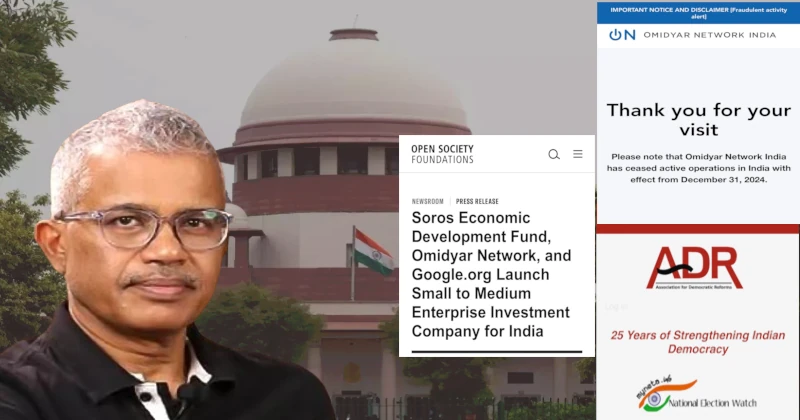
At the center of the controversy is the Association for Democratic Reforms (ADR), an NGO heavily funded by foreign entities, including Omidyar Network, which is linked to George Soros’s Open Society Foundation. The Bharatiya government banned Omidyar’s foreign funding in 2024, citing concerns over external interference in India’s electoral policies. Despite this, ADR has been aggressively pursuing legal action against the Modi government’s Chief Election Commissioner and Other Election Commissioners (Appointment Conditions of Service and Term of Office) Act, 2023.

ADR’s latest petition argues that the Act violates Article 14 of the Constitution, contending that the selection process should not be dominated by the executive. However, what ADR conveniently ignores is that prior to PM Modi ’s intervention, there was no formal selection process for Election Commissioners at all. The appointment was a closed-door affair controlled exclusively by the Prime Minister and the Law Ministry, with little to no opposition oversight.

ADR’s involvement raises pressing questions about its motivations. The organisation, which has consistently positioned itself as an advocate for electoral transparency, has itself been under scrutiny for receiving significant foreign funding from organisations with vested interests in Indian politics. The government’s move to block ADR’s key funder, Omidyar Network, highlights concerns that foreign entities are influencing India’s electoral framework under the guise of activism.

Notably, Prashant Bhushan, a career activist and Supreme Court lawyer, has been leading ADR’s legal crusade against the government. Bhushan has previously been associated with left-leaning movements and was a key figure in the 2020 anti-CAA protests, where he allegedly hosted a meeting attended by Sharjeel Imam and Umar Khalid—both accused of inciting the Delhi anti-Hindu riots.

Bhushan’s latest statement on X suggested that ADR’s petition will be heard on February 19, with any Chief Election Commissioner (CEC) appointment made after February 18 being subject to the Supreme Court’s final ruling. This comes after the court had already upheld the appointment process outlined in the new law and rejected ADR’s previous attempt to nullify the appointment of the current CEC, Rajiv Kumar.

ADR and Bhushan’s repeated interventions in court appear to be less about judicial oversight and more about obstructing the government’s electoral reforms. The Supreme Court itself, in a landmark judgment on March 2, 2023, had recommended that a selection panel including the Prime Minister, Leader of the Opposition, and the Chief Justice of India (CJI) should oversee the appointment process until Parliament passed a law.

When the Modi government followed this directive and passed the 2023 Act, ADR moved the court yet again—this time arguing that the selection process should include the CJI permanently, not just until a law was enacted. The irony? The Supreme Court had itself stated that its earlier directive was an interim measure and that Parliament had the right to legislate on the matter.

Despite ADR and Bhushan’s claims, the new appointment law actually makes the process more inclusive than before. Unlike previous governments, which appointed Election Commissioners in a completely unilateral manner, the Modi government’s reform ensures the participation of the Leader of the Opposition, making the process bipartisan.

Yet, ADR continues to challenge this move in court, raising concerns that its legal battle is less about democratic integrity and more about foreign-funded activism aimed at discrediting the PM Modi government. The Supreme Court, while hearing ADR’s plea, categorically rejected the NGO’s arguments, stating: “You cannot say that the Election Commission is under the thumb of the executive. At this stage, we cannot stay the legislation, and it will lead to only chaos and uncertainty.”

This was in direct response to Bhushan’s assertion that the government was “dominating” the appointment process. The bench, comprising Justices Sanjiv Khanna and Dipankar Datta, also noted that there were no allegations against the newly appointed Election Commissioners, Gyanesh Kumar and Sukhbir Singh Sandhu, thereby undercutting ADR’s claim of executive bias.

Topics: Narendra ModiSupreme CourtPM ModiCJIElection Commission appointments
ShareTweetSendShareSend
✮ Subscribe Organiser YouTube Channel. ✮
✮ Join Organiser's WhatsApp channel for Nationalist views beyond the news. ✮
Previous News

Telangana: Church leaders ostracise SC woman from village for refusing to convert to Christianity

Next News

Forced Conversion Case: Indore court hands 10-year sentence to Iliyas Qureshi and Prarthana for circumcising Jain minor

Related News

Prime Minister Narendra Modi

“Makes every Indian proud”: PM Modi hails India’s 7.7 per cent GDP growth in FY 2025-26

India slams Pakistan’s bid to hold elections in Gilgit-Baltistan, demands end to illegal occupation

Prime Minister Narendra Modi

PM Modi to launch Rs 21,770 cr mega projects in Surat & Daman; Infrastructure, healthcare among key projects

PM Modi to Overtake Nehru as India's Longest-Serving Elected Prime Minister on June 10

PM Modi set to surpass Nehru’s record, become India’s longest-serving elected Prime Minister

A decade transformed Indian Railways through electrification, speed, safety and modern infrastructure under PM Modi's vision

Same Tracks, New Destiny: How Modi government rewrote Indian Railways’ story after 2014

Himachal Municipal Election Results: BJP sweeps Dharamshala, Mandi & Solan; Congress retains Palampur

Load More

Latest News

New York anti-Hindu Bill fails to advance: How the bill fueled bias & espoused caste discrimination

Beyond Alignment: How India is Carving Its Own Strategic Space Amid Global Power Play

Beyond Alignment: How India is Carving Its Own Strategic Space Amid Global Power Play

Chinese President Xi Jinping, Russian President Vladimir Putin and Prime Minister Narendra Modi

China’s New Tone Towards India: Tactical shift or strategic necessity? What Beijing’s push for RIC ties really signals

Keralam’s 2026 Fiscal Health White Paper has unveiled a mounting debt burden of Rs 5.07 lakh crore, exposing deep structural challenges in the state’s economy

Keralam’s Financial Reality Check: White Paper exposes Rs 5.07 lakh crore debt crisis

Tamil Nadu: TVK government arrests YouTuber Maridhas; BJP alleges crackdown on dissent

‘Every grave or dargah is not automatically Waqf property’: Madras High Court’s landmark verdict

US Court strikes down Trump’s $100,000 H-1B fee as executive overreach; Lawmakers & Republicans welcome the verdict

Union Defence Minister Rajnath Singh

Uttar Pradesh: Defence land goes green; Rajnath Singh clears 250 MW solar project in Sitapur

Afghanistan Foreign Minister Amir Khan Muttaqi and External Affairs Minister Dr. S. Jaishankar(File Photo)

India extends gratis long-term business visas to Afghan traders; Slams Pakistan for “trade & transit terrorism”

How Modi's Zero-tolerance doctrine reshaped India's anti-terror policy (This is an AI generated image)

Twelve Years of Modi Government and the rise of India’s zero-tolerance doctrine against terrorism

Load More
  • Privacy
  • Terms
  • Cookie Policy
  • Refund and Cancellation
  • Delivery and Shipping

© Bharat Prakashan (Delhi) Limited.
Tech-enabled by Ananthapuri Technologies

  • Home
  • Search Organiser
  • Bharat
    • Assam
    • Bihar
    • Chhattisgarh
    • Jharkhand
    • Maharashtra
    • View All States
  • World
    • Asia
    • Africa
    • North America
    • South America
    • Europe
    • Australia
  • Editorial
  • Operation Sindoor
  • Opinion
  • Analysis
  • Defence
  • Culture
  • Sports
  • Business
  • RSS @ 100
  • Entertainment
  • More ..
    • Sci & Tech
    • Vocal4Local
    • Special Report
    • Education
    • Employment
    • Books
    • Interviews
    • Travel
    • Health
    • Politics
    • Law
    • Economy
    • Obituary
  • Subscribe Magazine
  • Read Ecopy
  • Advertise
  • Circulation
  • Careers
  • About Us
  • Contact Us
  • Policies & Terms
    • Privacy Policy
    • Cookie Policy
    • Refund and Cancellation
    • Terms of Use

© Bharat Prakashan (Delhi) Limited.
Tech-enabled by Ananthapuri Technologies