Colonial powers primarily exploited the colonised people economically, dominated them politically, and established their own cultures as superior to the colonised. Unfortunately, the formal end of colonialism in the mid-20th century did not allow the former colonies to establish their own governance and economic systems. Decades later, the question lingers: did colonialism genuinely end, or did it evolve? While the overt exploitation of colonies by imperial powers may have ceased, many argue that the West has merely replaced direct rule with more subtle mechanisms of control—chief among them, the concept of “development.”
Imposing Pro-West Conditions
While colonies gained political independence, Western powers, mainly liberals, utilised “development” as a strategic tool for continued influence. Institutions like the World Bank, IMF, and USAID played significant roles in shaping the economies of newly independent states, often framing them as needing Western intervention due to “underdevelopment.” They provided financial aid, technical assistance, and policy advice to developing countries, usually with conditions aligned with Western interests. Early successes helped the “development model” gain credibility. For instance, smallpox eradication, oral rehydration therapy, and the Green Revolution were good early wins. This created an entirely new academic field, with generations of Western bureaucrats who made their careers in this field and a vast amount of money flowing to control the power centers in these so-called third-world countries. Some countries like South Korea and Taiwan benefited, but many faced increased inequality, social unrest, and continued economic dependency.
Structural adjustment programmes, for instance, compelled countries to privatise industries, slash social spending, and open their markets to foreign corporations. USAID has successfully implemented Structural Adjustment Programs (SAPs) in various countries, particularly in Africa and Latin America. While these measures were sold as pathways to economic growth, they frequently entrenched dependency on Western loans. In certain instances, USAID’s aid has been linked to supporting authoritarian regimes that align with U.S. interests. By assisting these Governments, the US has secured strategic advantages without direct intervention, thereby maintaining a form of influence that resembles an evolved colonialism.
The influence of USAID extends beyond governmental structures. Through partnerships with non-governmental organisations (NGOs) and philanthropic entities, USAID has shaped social and governance frameworks in developing countries. About 10,000 USAID personnel exert influence in more than 160 countries. While these collaborations often aim to address pressing humanitarian issues, they can also lead to the imposition of external values and systems that may not align with local cultures or needs. USAID shapes the domestic policies of recipient nations. It intends to influence social structures and, ultimately, governance. USAID is a classic example of how a large, well-funded agency of the United States Government has indirectly become an unofficial NGO as it is not answerable to anyone, even within the US Government. This is because USAID’s programmes are 5, 10, and even 25 years long. Due to its field staff and reach inside the host country, it is more influential than the US State Department.
Reports have alleged USAID of funding religious conversion activities, funding groups associated with terrorist organisations like Hamas, and pursuing a partisan liberal political agenda of the US Democratic party in other countries to destabilise them
Due to its Liberal-cum-political ideology, it is almost an extension of the Democrat Party but funded by the US taxpayer. In the past, reports have alleged USAID of funding religious conversion activities, funding groups associated with terrorist organisations like Hamas, and pursuing a partisan liberal political agenda of the US Democratic party in other countries to destabilise them. USAID was established in 1961 by US President John F. Kennedy through the Foreign Assistance Act. The agency was created to administer civilian foreign aid and development assistance to promote economic growth, improve health and education, and foster democratic governance in developing countries. President John F. Kennedy believed that to confront communism, the US not only needed arms but should use economic aid as a tool in the war against communism. His support for independence movements is well known.
False Narrative
The portrayal of developing nations in liberal media often reinforces the narrative of these countries as perpetually in need of assistance. This perspective can perpetuate a cycle of dependency and justify continued intervention. By highlighting issues such as corruption or environmental mismanagement without sufficient context, media narratives can obscure the complex historical and structural factors at play, thereby simplifying the justification for ongoing aid and involvement. USAID has used these narratives. For instance, it funds the liberal media like the BBC. Outlets like the BBC reinforce stereotypes that justify ongoing Western involvement. Whether it’s questioning India’s space programme or criticising Brazil’s environmental policies, the narrative often overlooks the historical and structural factors contributing to these challenges. Instead, it focuses on sensational stories that align with Western interests, shaping public perception and policy in ways that maintain the status quo. For instance, whenever India achieves something significant in its space programme, such as the successful launch of the Mars Orbiter Mission (Mangalyaan), BBC often highlights the country’s poverty and questions the allocation of resources. Articles and reports frequently emphasise how the funds spent on space exploration could have been used to address poverty and improve living conditions. This narrative reinforces the idea that developing countries are irresponsible stewards of their resources.
USAID funds the liberal media like the BBC that justify ongoing Western involvement. Whether it’s questioning India’s space programme or criticising Brazil’s environmental policies. the fact is that bbc focuses on sensational stories that align with Western interests
In recent years, conservative movements in the West have seen a noticeable resurgence that favours direct interventions in foreign affairs and economic measures such as tariffs. This approach is characterised by a preference for overt actions that can quickly assert control or influence rather than the more subtle and long-term strategies associated with developmentalism. This resurgence of conservative movements represents a significant ideological shift from the liberal approach of using development as a tool for subjugation. Conservatives argue that direct interventions and economic measures are more effective in achieving their goals, while liberals continue to uphold developmentalism as a means of maintaining their power structures.
Paradigm Shift
With a national debt of about 36 trillion dollars, US President Donald Trump is in a bad spot. He realises that the US dollar may lose its world reserve status if things are not controlled. He has already expressed his adverse thoughts on a potential alternative BRICS currency. The Trump administration’s threat to impose tariffs on Mexico, Canada, and China and the move to dismantle USAID signals a shift from developmental aid to direct economic measures. The current turmoil in the US is expected to continue as long as Donald Trump is president. He has understood that with dollar power being questioned and the rise of rival military and resource-rich powers, he has to face the competition head-on. USAID has contributed what it could. In Trump’s era, it is direct shove-and-push, like how he is trying to regain control of the Panama Canal.

The days of concepts such as “good governance,” “democracy promotion,” and “human rights” that have been selectively used by Western powers to justify military interventions and regime changes are over. With the rise of conservative Western nationalism, Western powers are abandoning these principles. These narratives no longer align with “Make America Great Again” interests. The only way America can survive is to return to its “Manifest Destiny” doctrine, which Trump stated during his inauguration.
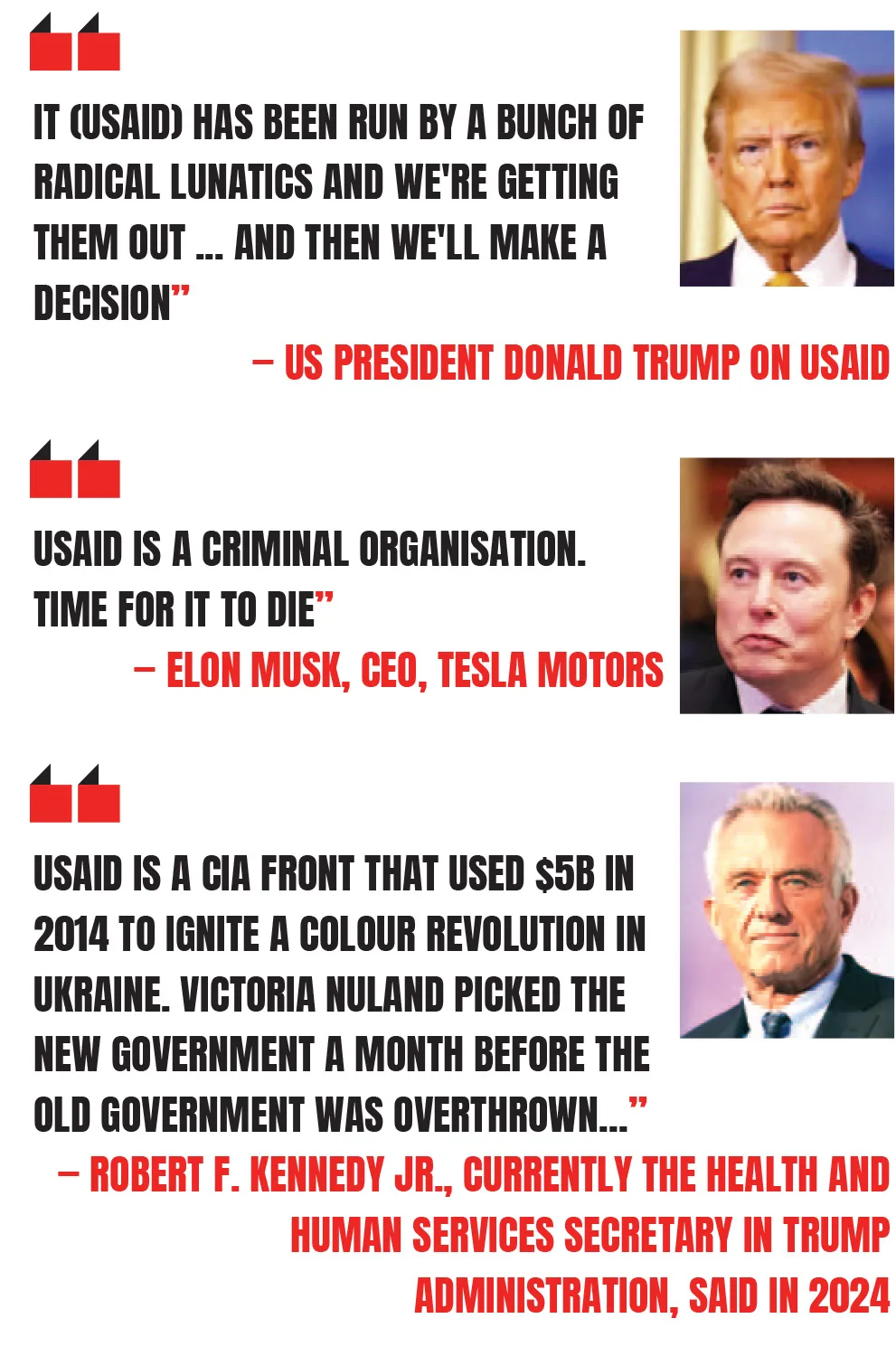
After accessing USAID’s data, Elon Musk wrote on “X,” “USAID is a criminal organisation.”
The question to ask is, when did this happen?