

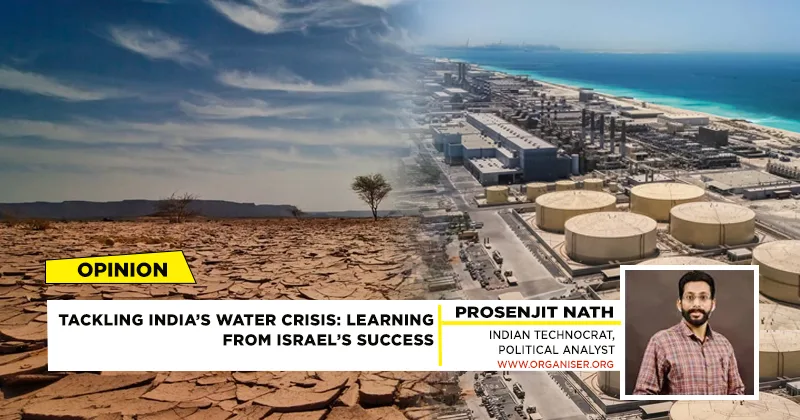
India faces an escalating water crisis that poses severe threats to its agricultural productivity, economic growth, and public health. According to NITI Aayog, nearly 600 million Indians are dealing with high to extreme water stress, and approximately 200,000 lives are lost annually due to inadequate access to safe water. Projections indicate that by 2030, water demand in India will exceed supply by 50 per cent. The urgency of this situation calls for transformative strategies, and India can draw valuable lessons from Israel, a nation that has overcome similar challenges despite its arid environment.
Israel, with over half its land classified as desert and an average annual rainfall of only 100 to 700 millimeters, has managed to achieve water surplus. The country’s success is a testament to its innovative approach to water management, which combines advanced technology, stringent policies, and public awareness. By adopting Israel’s strategies, India can address its water challenges and ensure sustainable development.
India’s water crisis stems from multiple factors. Population growth, with over 1.4 billion people, has created immense demand. The agriculture sector, which consumes over 80 per cent of India’s water resources, suffers from inefficiencies such as the cultivation of water-intensive crops and reliance on flood irrigation. Rapid urbanization has led to over-extraction of groundwater, and according to the Central Ground Water Board, 70 per cent of India’s groundwater is either contaminated or overused. Climate change further exacerbates the issue with irregular rainfall patterns, shrinking glaciers, and rising temperatures. Addressing these challenges requires a multi-faceted approach, and Israel’s strategies offer a compelling model.
Desalination is a cornerstone of Israel’s water management strategy. The country meets 80 per cent of its domestic water needs through seawater desalination. The Sorek Desalination Plant, one of the largest in the world, produces 627,000 cubic meters of drinking water daily using energy-efficient reverse osmosis technology. India, with its 7,517-kilometer-long coastline, has significant potential to adopt and expand desalination technology. While cities like Chennai have initiated desalination projects, these efforts meet only a fraction of the demand. Scaling up desalination infrastructure in coastal cities such as Mumbai, Chennai, and Visakhapatnam could alleviate pressure on inland freshwater sources and secure water supplies for millions.
Another critical area is wastewater recycling. Israel leads the world in wastewater recycling, treating and reusing 94 per cent of its municipal wastewater, with 86 per cent directed to agriculture. In contrast, India treats only 30 per cent of its wastewater, leaving the rest to pollute rivers, lakes, and groundwater. With over 38 billion cubic meters of wastewater generated annually, India has a vast untapped resource. Scaling up wastewater treatment and recycling could reduce the dependency on freshwater for agriculture, improve urban water quality, and provide additional revenue through industrial reuse. Israel’s model demonstrates how treated wastewater can sustain agriculture while preserving freshwater for other essential needs.
Drip irrigation is another Israeli innovation that has revolutionized water usage in agriculture. By delivering water directly to plant roots, drip irrigation reduces water usage by 50 per cent to 70 per cent while increasing crop yields. In India, where flood irrigation dominates, this technology has the potential to transform agricultural practices. Pilot projects in Maharashtra have already shown promising results, with sugarcane farmers reporting a 40 per cent reduction in water usage and a 20 per cent increase in yields. Expanding drip irrigation to water-intensive crops like rice and wheat across the country could significantly enhance water efficiency and agricultural productivity.
Smart water management systems have also played a crucial role in Israel’s success. The country uses real-time data analytics to monitor water distribution networks, detect leaks, and optimize usage. Companies like TaKaDu have pioneered technologies that reduce water losses by over 20 per cent. Digital metering ensures accurate billing and discourages overuse, promoting conservation. In India, nearly 40 per cent of piped water supply is lost due to leaks, theft, and inefficiency. Adopting smart water management technologies in urban areas could save millions of liters daily, addressing the growing demand in cities.
Rainwater harvesting and groundwater recharge are areas where India can benefit from Israel’s expertise. While India has implemented rainwater harvesting schemes, their adoption remains inconsistent. Israel’s innovative storage systems and recharge techniques maximize the utility of limited rainfall. With an average annual rainfall of 1,170 millimeters, India has substantial potential to harness rainwater. Integrating advanced harvesting systems could ensure that rainwater is effectively collected and stored for year-round use, reducing reliance on over-extracted groundwater.
Policy and governance have been instrumental in Israel’s water achievements. Comprehensive water laws regulate usage and pricing, ensuring accountability and sustainability. Public awareness campaigns educate citizens on conservation, resulting in per capita water usage as low as 100 liters per day compared to India’s urban average of 135 liters. Centralized water management under Mekorot, Israel’s national water company, ensures streamlined planning and execution. In contrast, India’s fragmented water governance with overlapping authorities hampers effective management. A unified and efficient governance framework inspired by Israel could significantly enhance India’s water management capabilities.
India and Israel have already established strong ties in water technology through various initiatives. The Indo-Israel Agricultural Project (IIAP) operates in 29 centers of excellence across India, promoting water-efficient farming techniques. The India-Israel Innovation Bridge fosters joint ventures in water management and agricultural technology. Gujarat’s partnership with Israeli firms to develop desalination plants and implement drip irrigation projects is another example of successful collaboration. Scaling such partnerships could accelerate the nationwide adoption of Israeli technologies and practices.
The impact of these measures could be transformative. Adopting drip irrigation on 50 per cent of India’s farmland could reduce water consumption by 30 per cent, saving 200 billion cubic meters annually. Reducing urban water loss by just 10 per cent could save 1 billion liters daily in cities like Delhi. Recycling 50 per cent of India’s wastewater could provide an additional 19 billion cubic meters of water annually for agriculture. These numbers underscore the immense potential for improvement and the critical role of technology and governance in addressing India’s water crisis.
India’s water challenges are daunting, but they are not insurmountable. By leveraging Israel’s technological expertise, policy framework, and innovative practices, India can transform its water management systems and secure a sustainable future. The stakes are high, but so are the opportunities. With the right investments, collaborations, and public-private partnerships, India and Israel can lead the way in solving one of humanity’s most pressing issues water security.