Makar Sankranti has always been a day of great upheaval in Indian history. In 1761, on Makar Sankranti, that feel on January 14 again that year, while the rest of the country celebrated the Uttarayan festival with traditional gaiety, the Maratha forces were engaged in a monumental clash with the Afghan invader Ahmed Shah Abdali at the Third Battle of Panipat. This historic event has been etched into the annals of Indian history, an epoch-making battle that held a mirror to Indians on what happens when we do not fight an outsider enemy unitedly.
Maratha Forces Versus Jihadi Forces Of Abdali
Led by General Sadashiv Rao Bhau, a member of the Peshwa family, the Marathas confronted a coalition comprising Afghan ruler Ahmed Shah Abdali, supported by Najibuddaulah, Rohilla chiefs Hafiz Rehmat and Dunde Khan, and the Nawab of Awadh Shujauddaulah. The battle unfolded on the sacred day of Makar Sankranti, marking the convergence of strategic dynamics and political machinations. My mid-eighteenth century, the great Maratha warrior Peshwa Bajirao’s legacy was still alive though he had passed away in 1740. The Marathas had conquered Delhi, subdued and diluted the Mughal Empire and placed a titular Mughal king there.
To quote from the book by VD Savarkar (The 6 Glorious Epochs of Indian History), “The Moghal Emperor had made Gazi-ud-din his chief minister (Vizier) who went all the way long to Sarhind in the Punjab in February 1756 to appoint Adinabeg as the chief imperial officer there. Gazi-ud-din acted in this case depending solely on the Maratha support, and this act of his clearly meant that the whole of the province of the Punjab which was reduced by Abdali was once again seized by the Moghal Emperor. Even in Delhi, the Afghan influence was ineffectual and Gazi-ud-din, strongly supported by the Marathas, spoke for the Moghal Emperor.
Under these circumstances Malik a Zamani, the old and crafty chief stewardess in the Moghal imperial household who was frightened out of her wits (at this all-enveloping Maratha hold on the Moghal Empire) and Nizibkhan Rohilla, who was then a prominent leader of all the Rohilla s and Pathans in India and who was the bitterest enemy of the Marathas, secretly wrote letters to Ahmadshah Abdali to the effect that if at all Muslim power in India was to be saved it was Abdali alone wh o could save it , and that as such he should forthwith march on India with a well-equipped army’… And he precipitately performed what the Pathans and Muslims of the time though t to be their first and foremost duty, according to the religious code of every Muslim Emperor.”
Najib even asked Abdali to come and massacre Delhi citizens ruthlessly so that they will learn a lesson for life for having sided with a non-Islamic force. “Unlike Ahmad Shah Abdali who subsequently raised a cry of jihad, the Marathas couldn’t mobilize their resources and make a common cause with the Hindoos in order to pay the Afghan Emperor in his own coin,” says another analysis of why the brave and powerful Marathas fought and lost an isolated battle outside the Maratha empire but within ‘Hindoostan’.
Maratha Legacy and Strategic Manoeuvres
Renowned Maratha history expert, Dr Uday Kulkarni, emphasizes the colossal scale and complexity of the Third Battle of Panipat. His extensive research has led to the creation of three insightful books on this pivotal historical event, shedding light on the valiant efforts of the Marathas to thwart the Afghan invader.
The legacy of the Peshwas, administrators and warriors who played a crucial role in shaping the Maratha Empire, adds depth to the historical narrative. Moropant Pingle, the first Peshwa appointed by Chhatrapati Shivaji, paved the way for subsequent hereditary Peshwas like Balaji Vishwanath Bhat and the formidable Baji Rao I, contributing to the decline of the Mughal Empire.
Dr Kulkarni’s research highlights the strategic manoeuvres leading up to the Third Battle of Panipat. Afghan warlord Ahmed Shah Abdali, notorious for repeated looting in northern India, faced resistance from the Marathas, who took it upon themselves to protect Delhi and the Indian terrain. The expedition in 1758 saw the Maratha flag flying high in crucial locations, but internal conflicts and betrayals complicated the situation.
The involvement of key figures like Najibuddaulah and the Nawab of Awadh, Shujauddaulah, added layers of complexity. Despite initial successes, the Marathas faced challenges in building a bridge over the Ganga due to the double-crossing of Najibullah. This set the stage for a confrontation that would shape the fate of the region.
A Fierce Battle and Tragic Aftermath
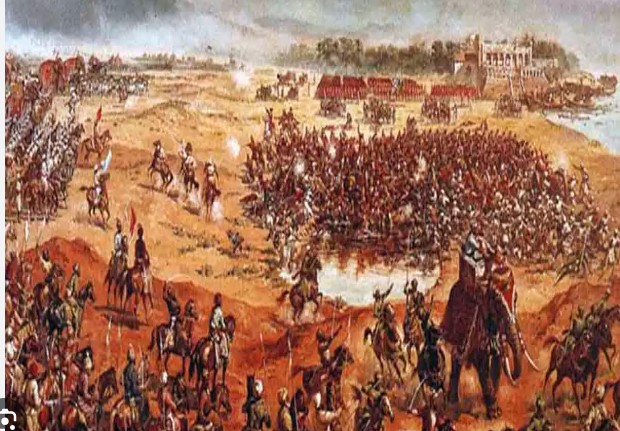
The morning of January 14, 1761, witnessed a fierce engagement between the Marathas and Abdali’s forces. The Marathas initially gained ground, with their center, led by Sadashiv Rao Bhau and Vishwas Rao, pushing back the Afghan center. However, the tide turned when Abdali’s fleeing soldiers were rallied back into the battle, altering the course of the conflict.
The battle continued for hours, with the Marathas facing setbacks, including the death of Vishwas Rao. The entry of two thousand Afghans, who had initially sought refuge with the Marathas, fighting against them further complicated the situation. Despite the valiant efforts of leaders like Sadashiv Rao Bhau, the Marathas ultimately suffered a defeat.
The aftermath was brutal, with thousands of men beheaded and pyramids of heads erected outside Afghan tents. Women faced captivity, and the son of Bajirao and Mastani, Shamsher Bahadur, succumbed to wounds sustained in battle. The Jats of Bharatpur offered refuge to the fleeing Marathas.
A Legacy of Sacrifice and Resilience
The Third Battle of Panipat, fought to protect India from repeated invasions and safeguard the Mughal dynasty, claimed over a hundred thousand brave Maratha lives. Despite the defeat, it marked the end of northern-western raids on Delhi. A decade later, the Marathas returned to Delhi and continued defending the city until its eventual loss to the East India Company in 1803.
The sacrifice of the Marathas at Panipat echoes through history, symbolising resilience and determination in the face of adversity. As we reflect on this momentous event, it serves as a testament to the indomitable spirit that shaped the course of Indian history.
‘Sankrant Kosall-li’ A Marathi phrase for ‘a disaster befalling…’
Vishwas Patil, the author of the phenomenally successful Marathi historical novel ‘Panipat’, said in a TV interview that since it was Uttarayan time, the Sun’s rays were directly incident on the eyes of the starving soldiers and horses of the Maratha cavalry. Uttarayan is a celestial event that happens on Makara Sankranti, and marks the transition of the Sun into the zodiac sign, Makar (Capricorn). Sadly, it became the Maratha army’s undoing. That is how the phrase for ‘A Sankrant befallen upon the Marathas’ evolved—signifying loss, defeat, a dark event.
(The article was first published on January 14, 2024)