
Maha Kumbh: Confluence of Cultural Continuity, Connectivity and Collectivity
June 25, 2026
  • Read Ecopy
  • Circulation
  • Advertise
  • Careers
  • About Us
  • Contact Us
Android AppiPhone AppArattai
Organiser
  • ‌
  • Bharat
    • Assam
    • Bihar
    • Chhattisgarh
    • Jharkhand
    • Maharashtra
    • View All States
  • World
    • Asia
    • Europe
    • North America
    • South America
    • Africa
    • Australia
  • Editorial
  • International
  • Opinion
  • RSS @ 100
  • More
    • Op Sindoor
    • Analysis
    • Sports
    • Defence
    • Politics
    • Business
    • Economy
    • Culture
    • Special Report
    • Sci & Tech
    • Entertainment
    • G20
    • Azadi Ka Amrit Mahotsav
    • Vocal4Local
    • Web Stories
    • Education
    • Employment
    • Books
    • Interviews
    • Travel
    • Law
    • Health
    • Obituary
  • Subscribe
    • Subscribe Print Edition
    • Subscribe Ecopy
    • Read Ecopy
  • ‌
  • Bharat
    • Assam
    • Bihar
    • Chhattisgarh
    • Jharkhand
    • Maharashtra
    • View All States
  • World
    • Asia
    • Europe
    • North America
    • South America
    • Africa
    • Australia
  • Editorial
  • International
  • Opinion
  • RSS @ 100
  • More
    • Op Sindoor
    • Analysis
    • Sports
    • Defence
    • Politics
    • Business
    • Economy
    • Culture
    • Special Report
    • Sci & Tech
    • Entertainment
    • G20
    • Azadi Ka Amrit Mahotsav
    • Vocal4Local
    • Web Stories
    • Education
    • Employment
    • Books
    • Interviews
    • Travel
    • Law
    • Health
    • Obituary
  • Subscribe
    • Subscribe Print Edition
    • Subscribe Ecopy
    • Read Ecopy
Organiser
  • Home
  • Bharat
  • World
  • Operation Sindoor
  • Editorial
  • Analysis
  • Opinion
  • Culture
  • Defence
  • International Edition
  • RSS @ 100
  • Magazine
  • Read Ecopy
Home Bharat

Maha Kumbh: Confluence of Cultural Continuity, Connectivity and Collectivity

Prafulla KetkarPrafulla Ketkar
Jan 13, 2025, 02:00 pm IST
in Bharat, Editorial
Follow on Google News
FacebookTwitterWhatsAppTelegramEmail

“The Kumbha has been rightly described as India’s ageless festival. It has been one of the greatest phenomena in which the collective urge of a race finds expression. The Kumbha draws not only the mystic and the pandit, the ignorant villager and the superstitious woman, the businessman and the politician, but evokes deep-rooted sentiments in persons of the calibre, education and outlook of Dilip Kumar Roy and the highly sensitive and psychic Indira Devi. That it should evoke sentiments and lend inspiration to persons of such varied equipment in every stratum of life shows that there is something fundamentally important in the Kumbha”.
– K M Munshi in a foreword to the Book Kumbha – India’s Ageless Festival by Dilip K Roy and Indira Devi, Bharatiya Vidya Bhawan, Bombay, 1955

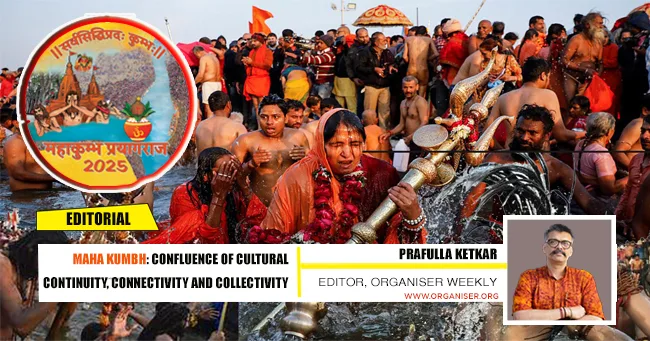
This year, the celestial transition of the Sun on the occasion of Makar Sankranti will also mark the beginning of the iconic and intangible heritage festival of Bharat – Maha Kumbh. The media will flash pictures of Naga Sadhus taking the holy dip at the Triveni Sangam. There will be a discussion about the preparations and debates about the rationale behind such a festival. Though religiosity and spirituality are integral to Kumbh, it also symbolises something beyond that.

The Maha Kumbh is a testament to the cultural continuity of Bharat. It is a festival that has been celebrated from time immemorial, drawing thousands of people to take a holy bath. Despite attempts by some historians to diminish its antiquity, the legend of Samudra Manthan is deeply ingrained in the beliefs of the people of Bharat and entire Southeast Asia. The Yuga Parv of Vedic tradition and Moksha Parv of Buddhist tradition both mark this auspicious occasion. The Maha Kumbh finds mention in all inscriptions from the reign of Ashoka to Samudragupta, and most of the Puranas describe it as the most wondrous cosmic fair of the world. The Chinese travelogue by Hiuen Tsang in the seventh century, the first documented version of the rituals and faith, clearly mentions the crystallisation of the Maha Kumbh attracting pilgrims from all over Bharat. In the ninth century, the great Shankaracharya gave it a more systematic shape by establishing the four well-known monasteries and ten orders associated with each of them. During the freedom struggle against Islamic invasions and European colonisation, the Maha Kumbh played a significant role in maintaining the cultural continuum and protecting Sanatan Dharma.

Along with continuity, the connectivity of the Bharatiya sects and traditions is also reflected in Kumbh. They all gather to present their findings about attaining the ultimate bliss, deliberate on contemporary challenges society faces, and devise solutions to address them. The regular assembly of all schools of thought ensures maintaining contact with the sadhus of other denominations and the fortification of the spiritual aspirants. The discourses that take place reignite the cultural and spiritual strength of the society. This consistent and systematic effort takes care of all the attempts to create disharmony through artificial divisions. The Kalpavasis and Sadhus become connecting points and messengers of this great civilisation. Thus, Kumbh is a platform for the religious and spiritual legislation of Lok Vyavahar and Lok Sangrah (public conduct and social order).

Another critical dimension of the Maha Kumbh is its role in nurturing collective consciousness. The pilgrimage is not just about individual immortality or Moksha; it is more about instilling a sense of collective identity and unity about the uniqueness and antiquity of this age-old Rashtra, nurtured by Rishi Parampara. People from all strata of society, from villages to metropolitans, from ascetic Sadhus to silent observers, from seekers to rational investigators, employ different means, from bare walks to aeroplanes, to join the congregation. The barriers of caste, sects, language, region, etc., submerge in the sea of people, reinforcing the collective consciousness that the Maha Kumbh fosters.

The growing means of communication and technological innovations have added different dimensions to the festival, enhancing its relevance in the modern world. Reviving knowledge traditions with modern means, providing healthcare at affordable costs, temple traditions linking with prosperity, addressing the evils like caste discrimination and intolerance towards Sanatana, promoting sustainability, etc., are the parallel efforts introduced by Sadhus, Dharma Sabha and organisations like Vishva Hindu Parishad (VHP). While experiencing this unique festival, we must celebrate and internalise this national festival of social cohesion, economic prosperity, knowledge tradition and cultural continuum.

 

Topics: Naga SadhusRishi Paramparaholy dipSanatan Dharmafestival of BharatMakar SankrantiTriveni SangamMaha Kumbh
Prafulla Ketkar
Prafulla Ketkar
Prafulla Ketkar, is the Editor, Organiser (Weekly) since 2013. He has a experience of over 20 years in the fields of research, media and academics. He is also Advisory Committee School of Journalism, Delhi University. He has been writing on issues related to International politics and foreign policy, with special reference to China and Democracy, Hindutva, and Bharatiya Civilisation. He was also a member of the Editorial team of the recently published Complete Works of Pt Deendayal Ji in 15 Volumes. He has 2 books, 29 academic articles, 2 entries in Encyclopedia of India and numerous articles to his credit. [Read more]
ShareTweetSendShareSend
✮ Subscribe Organiser YouTube Channel. ✮
✮ Join Organiser's WhatsApp channel for Nationalist views beyond the news. ✮
Previous News

Jammu & Kashmir: PM Modi inaugurates Z-Morh tunnel, enhancing connectivity to Ladakh and boosting tourism

Next News

Chhattisgarh: Minor girl injured in IED blast in Maoist-affected Sukma district

Related News

Kamakhya Mandir

Kamakhya Mandir’s Ambubachi Mela: The ancient tradition that honours the menstruation of mother Earth

Bangladesh Dhaka University Hindu students demand arrests after Islamists desecrate Bhagwan Ram’s murti in Gaibandha

Bangladesh: Dhaka University Hindu students launch protest over Islamist desecration of Bhagwan Ram’s murti

Shri Gireesh, Dr Mohan Bhagwat, Shri PV Prasad Bahu at Thrissur on June 13.

Bharat must prepare to guide the world through the principles of Sanatan Dharma – RSS Sarsanghchalak Dr Mohan Bhagwat

Sanatan Dharma teaches that spiritual growth is built through simple daily actions performed with sincerity, discipline, and devotion

Living Sanatan Dharma Every Day: 24 traditional habits that inspire a meaningful and virtuous life    

The Vedic age saw remarkable women sages, known as Rishikas, who composed hymns and shaped India's spiritual and philosophical heritage

Rishikas of Vedic Age: How Gargi, Maitreyi & other women shaped ancient India’s spiritual and philosophical tradition

Udhayanidhi Stalin, Leader of Opposition & DMK MLA, while speaking in Tamil Nadu Assembly on May 12

Sanatan Dharma and Politics: Understand before attacking

Load More

Latest News

Andhra Pradesh Chief Minister N. Chandrababu Naidu inaugurates the Jonnagiri Gold Mining Project in Kurnool district

Andhra Pradesh: CM Chandrababu Naidu lunches first major gold mining project in Kurnool district

AI-generated image for representation

Tamil Nadu: School teacher faces action over alleged humiliation of menstruating student

Cochin Shipyard (File Photo)

Keralam: ‘I Love Pakistan’ inscription found inside vessel at Cochin Shipyard; Central agencies launch probe

BJP national spokesperson Pradeep Bhandari

Karnataka: BJP accuses Kharge family of illegally acquiring government land worth over Rs 100 crore

Elomi Global Worship Centre in Omalloor, Pathanamthitta district ; Pastor Binu Vazhakkuttom (Left to Right)

Keralam: Child abuse allegations at Pentecostal worship centre in Pathanamthitta; locals demand Pastor Binu’s arrest

Modi Govt’s Tourism Revolution: 183 projects, Rs 9,225 crore investment & rise of India’s cultural & spiritual circuits

Padma Awards 2026: Tamil Nadu’s distinguished achievers receive national honours

India’s history is not merely a tale of foreign domination but also a remarkable story of resilience, resistance & civilisational continuity

Indian History: Not just foreign rule, but a timeless story of resistance, self-respect and civilisational resilience

From $10 Billion to $190 Billion: Indian Bioeconomy Touches New Heights in 12 Years

From $10 Billion to $190 Billion: India’s Bioeconomy leads a 12-Year science revolution

Nagpur | Acceptance of Bharatiya civilisational values is steadily increasing worldwide: Shanta Kumari

Load More
  • Privacy
  • Terms
  • Cookie Policy
  • Refund and Cancellation
  • Delivery and Shipping

© Bharat Prakashan (Delhi) Limited.
Tech-enabled by Ananthapuri Technologies

  • Home
  • Search Organiser
  • Bharat
    • Assam
    • Bihar
    • Chhattisgarh
    • Jharkhand
    • Maharashtra
    • View All States
  • World
    • Asia
    • Africa
    • North America
    • South America
    • Europe
    • Australia
  • Editorial
  • Operation Sindoor
  • Opinion
  • Analysis
  • Defence
  • Culture
  • Sports
  • Business
  • RSS @ 100
  • Entertainment
  • More ..
    • Sci & Tech
    • Vocal4Local
    • Special Report
    • Education
    • Employment
    • Books
    • Interviews
    • Travel
    • Health
    • Politics
    • Law
    • Economy
    • Obituary
  • Subscribe Magazine
  • Read Ecopy
  • Advertise
  • Circulation
  • Careers
  • About Us
  • Contact Us
  • Policies & Terms
    • Privacy Policy
    • Cookie Policy
    • Refund and Cancellation
    • Terms of Use

© Bharat Prakashan (Delhi) Limited.
Tech-enabled by Ananthapuri Technologies