UGC Draft Regulations to help higher education sector to become more dynamic and achieve international standards
August 21, 2026
  • Read Ecopy
  • Circulation
  • Advertise
  • Careers
  • About Us
  • Contact Us
Android AppiPhone AppArattai
Organiser
  • ‌
  • Bharat
    • Assam
    • Bihar
    • Chhattisgarh
    • Jharkhand
    • Maharashtra
    • View All States
  • World
    • Asia
    • Europe
    • North America
    • South America
    • Africa
    • Australia
  • Editorial
  • International
  • Opinion
  • RSS @ 100
  • More
    • Op Sindoor
    • Analysis
    • Sports
    • Defence
    • Politics
    • Business
    • Economy
    • Culture
    • Special Report
    • Sci & Tech
    • Entertainment
    • G20
    • Azadi Ka Amrit Mahotsav
    • Vocal4Local
    • Web Stories
    • Education
    • Employment
    • Books
    • Interviews
    • Travel
    • Law
    • Health
    • Obituary
  • Subscribe
    • Subscribe Print Edition
    • Subscribe Ecopy
    • Read Ecopy
  • ‌
  • Bharat
    • Assam
    • Bihar
    • Chhattisgarh
    • Jharkhand
    • Maharashtra
    • View All States
  • World
    • Asia
    • Europe
    • North America
    • South America
    • Africa
    • Australia
  • Editorial
  • International
  • Opinion
  • RSS @ 100
  • More
    • Op Sindoor
    • Analysis
    • Sports
    • Defence
    • Politics
    • Business
    • Economy
    • Culture
    • Special Report
    • Sci & Tech
    • Entertainment
    • G20
    • Azadi Ka Amrit Mahotsav
    • Vocal4Local
    • Web Stories
    • Education
    • Employment
    • Books
    • Interviews
    • Travel
    • Law
    • Health
    • Obituary
  • Subscribe
    • Subscribe Print Edition
    • Subscribe Ecopy
    • Read Ecopy
Organiser
  • Home
  • Bharat
  • World
  • Operation Sindoor
  • Editorial
  • Analysis
  • Opinion
  • Culture
  • Defence
  • International Edition
  • RSS @ 100
  • Magazine
  • Read Ecopy
Home Bharat

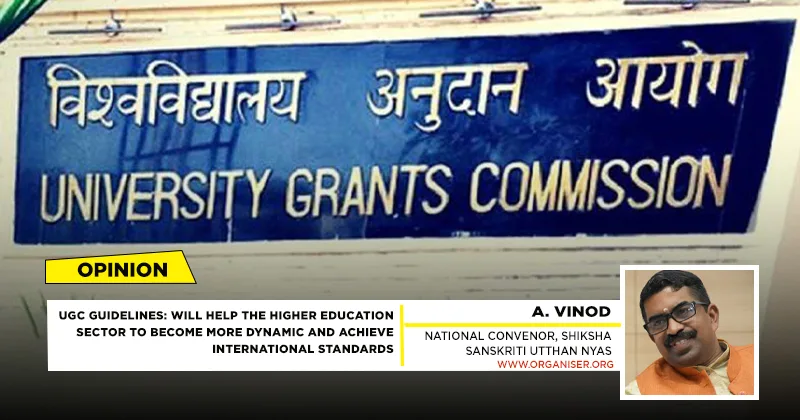
UGC Draft Regulations to help higher education sector to become more dynamic and achieve international standards

The University Grants Commission (UGC) has introduced new guidelines aimed at transforming India's higher education sector to align with global standards. These reforms are designed to make the system more dynamic, fostering innovation, inclusivity, and quality education

A VinodA Vinod
Jan 10, 2025, 05:30 pm IST
inBharat, Opinion, Education
Follow on Google News
Facebook
Twitter
WhatsAppTelegramEmail

The Union Education Minister released the draft regulations titled in the presence of the UGC Chairman last day, proposing major changes in the appointment of teachers, their promotions in higher education institutions and appointment of Vice Chancellors, with an aim of making the quality and social participation of higher education more efficient, in line with the National Education Policy. The UGC Regulations 2018, which had little modification in 2019, with minor amendments, is currently in place. The government is introducing the new draft by envisioning a more dynamic future for the higher education sector, especially at the college and university level, by making appointments more flexible, inclusive, and considering a diverse talent pool. Through these new guidelines, the government is trying to bring about a paradigm shift.

Major changes are being made in five main areas. These are college teacher appointments, promotions, appointment of Vice Chancellors, increasing the importance of Indian languages in higher education, and ensuring social justice in higher education by making appointments more flexible and inclusive. The most important qualification for college and university teacher appointments is currently studying the same subject in the undergraduate and postgraduate level and research in the same field, followed by the rank in the National Eligibility Test(NET/SET). This qualification criterion is fundamentally contradictory to the flexible and interdisciplinary approaches put forward by the new National education policy. Therefore, the most notable change is that teacher appointments can be made on the basis of the highest level of study and research. Accordingly, the ban that existed till now for a multi-faceted talent who has done physics at the degree level, mathematics at the postgraduate level and then research in the field of biology in the research field ends. For years, such talents have been considered as the qualification for teacher appointments in institutions like IITs and IIMs based on their highest level of knowledge. This will provide students who are interested in the teaching field with the opportunity to take up a wider variety of subjects at the undergraduate and postgraduate levels, making their studies enjoyable and their research field more interdisciplinary.

The Academic Performance Index, which is considered as the basis for the promotion of teachers today, is fostering a person-centered work culture among teachers. In order to give it a broader dimension of social commitment, it is about shifting from a numerical score index to a new system that takes into consideration the role played by teachers in teaching, research fundraising and the resulting results in teaching and research, and content creation in the digital arena, from a numerical score index to a comprehensive evaluation scheme. Apart from this, excellence in arts and sports, physical characteristics and proficiency in different fields will also be considered.

Appointments of university vice-chancellors are always subject to controversy and legal disputes. Nepotism and political exaggeration are very evident in this field. This greatly affects the free and efficient functioning of the university. The academic performance of universities, where vice-chancellors are appointed on political grounds, reflects very poorly in national and international rankings. As per the current rules, VCs are selected by a search committee of three to five members. Various influences and interactions are going on in this. The Vice Chancellor appointments in many states like Kerala, West Bengal have always created a lot of controversies. It is very necessary to have proper standards and procedures and to have a responsible center to clean up this field. In the new draft regulations, the responsibility for the appointment of the University Vice-Chancellor is fully vested in the Chancellor. A 3 members search committee constituted by the Chancellor, where all the members of the search cun selection Committee shall be eminent persons, who are not directly or indirectly connected with the particular University or Institution. He or She should be currently a Chancellor or Director or who have previously held such positions. The search committee will consist of a representative of the Chancellor as the chairman of the search committee, a representative of the UGC chairman and an eminent academician nominated by the highest executive forum of the university.

Today the qualification to be a Vice-Chancellor is stated as “a distinguished academician with the minimum of 10 years of experience as professor in a University system or 10 years of experience in an equivalent position in reputed research and /or academic administrative organisation.” Whereas the new regulations are more inclusive and flexible, considering candidates with diverse backgrounds. For example, the criteria for vice Chancellor appointments now includes individuals with at least 10 years of senior level experience in industry, public policy, public administration or public sector undertakings, provided they have a proven track record of significant academic or scholarly contributions. Additionally, it is no longer a necessary requirement for vice chancellors to be professors.

Based on the notification made at the national level, a short list is made from the applications received and after interacting with them, this committee may submit a panel of three to five names to the Chancellor. Out of which one person shall be appointed by the Chancellor as Vice-Chancellor. UGC will not accept any appointment in violation of this. The university will cancel the recognition of that institution. No financial and academic support are provided.

Another important proposal put forward by the National Education Policy is that higher education institutions may engage experts, professionals, practitioners from industries and other professions for teaching and research. They are called professions in practice. Now it is a defined structured position. University regulations as they stand today do not allow it. Keeping that in mind, the proposed regulations also include guidelines that require the appointment of eminent persons in different fields as professors of practice in universities.

There is no doubt that these proposals will provoke massive opposition from teachers who are in service and not ready to accept new concepts and reforms. But this type of structural and perspective transformation is the need of the hour to make our higher education sector more dynamic and of international standard by utilizing the diverse tastes and abilities of the young generation who dream of a Viksit Bharat. It is the responsibility of academics to contribute their opinions and participate in creating a clearer and more comprehensive system.


Topics: UGCUniversity Grants CommissionNational Education PolicyViksit Bharat
Share5
Tweet
SendShareSend
✮ Subscribe Organiser YouTube Channel. ✮
✮ Join Organiser's WhatsApp channel for Nationalist views beyond the news. ✮
Previous News

Pakistan ranked bottom on Henley passport index due to regular violation of immigration laws by its citizens

Next News

Uttar Pradesh: Akeel living in Saudi Arabia allowed friends to rape wife for money, filmed acts to watch personally

Related News

India’s journey from Swadhinta to Swatantrata begins with decolonising minds and embracing Bharatiya values (This image is generated by AI)

Decolonising the Mind: How citizens can embrace Bharatiya languages, traditions & values to realise absolute freedom

PM Modi addresses the nation on 80th Independence Day

Independence Day 2026: PM Modi pitches Sapta Dhara for Viksit Bharat; How 7 streams drive India’s growth story?

The President Smt. Droupadi Murmu addressing the Nation on the eve of the 80th Independence Day, in New Delhi on August 14, 2026.

On the eve of 80th Independence Day, President Murmu calls for collective efforts to build Viksit Bharat

PM Modi paid tribute to those affected by the 1947 Partition, recalling their courage, resilience and immense suffering

Partition Horrors Remembrance Day: PM Modi remembers partition victims, calls for harmony and brotherhood

UGC asks HEIs to encourage students, faculty and industry to join University Townships Survey

University Townships Initiative: UGC urges HEIs to encourage participation in MyGov survey

UGC Opens Door for One-Year Online Master's Courses

UGC allows eligible universities to offer one-year PG courses in online, ODL mode under NEP 2020

Load More

Latest News

Representative Image

Karnataka Congress Govt under fire as Rs 104 crore shoe-sock fund stays unreleased, lakhs of students wait

ESIC’s integrated model of healthcare, social security and medical education supports India’s Viksit Bharat vision

ESIC strengthens India’s workforce with healthcare, social security and medical education for Viksit Bharat 2047

The NIA has arrested absconding accused Bhairaw Tripathi in connection with the 2024 recovery of an AK-47 rifle and live ammunition in Bihar

Bihar AK-47 Smuggling Case: Who is Bhairav Tripathi, the absconding Muzaffarpur man arrested by NIA?

Representative Image

Armed men of Baloch Liberation Army blow up police station in Pishin; economic blockade against Pakistan continues

Woman who confronted security personnel in Ladakh apologises

“I Apologise to Indian Army”: Woman who confronted security personnel with Gen Z comment in Ladakh admits she was wrong

JPSC Exam Cancellation Row: How the Hemant Soren govt betrayed lakhs of Jharkhand aspirants to crush a 26-day protest

Karnataka: BJP’s R Ashoka demands B Nagendra’s resignation over Dalit Fund diversion, announces protest

Union Home Minister Amit Shah at the 31st Meeting of the Southern Zonal Council along with Andhra Pradesh Chief Minister N Chandrababu Naidu, Karnataka Deputy Chief Minister DK Shivakumar, Kerala Chief Minister VD Satheesan and Telangana Deputy Chief Minister Bhatti Vikramarka Mallu

Southern Zonal Council Meeting: Amit Shah highlights south India’s growth, seeks faster water dispute resolution

A voter-fraud investigation uncovers a trail involving identity misuse, disputed immigration records and an “accepted” ballot

US: Chinese national charged for using landlord’s identity to vote in 2024 presidential election in Massachusetts

HPU students protest fee hikes of over 25 per cent, raising questions over CJP’s silence in Congress-ruled Himachal Pradesh

HPU Students Protest: Massive fee hike sparks outrage in Congress-ruled Himachal Pradesh — CJP chooses silence!

Load More
  • Privacy
  • Terms
  • Cookie Policy
  • Refund and Cancellation
  • Delivery and Shipping

© Bharat Prakashan (Delhi) Limited.
Tech-enabled by Ananthapuri Technologies

  • Home
  • Search Organiser
  • Bharat
    • Assam
    • Bihar
    • Chhattisgarh
    • Jharkhand
    • Maharashtra
    • View All States
  • World
    • Asia
    • Africa
    • North America
    • South America
    • Europe
    • Australia
  • Editorial
  • Operation Sindoor
  • Opinion
  • Analysis
  • Defence
  • Culture
  • Sports
  • Business
  • RSS @ 100
  • Entertainment
  • More ..
    • Sci & Tech
    • Vocal4Local
    • Special Report
    • Education
    • Employment
    • Books
    • Interviews
    • Travel
    • Health
    • Politics
    • Law
    • Economy
    • Obituary
  • Subscribe Magazine
  • Read Ecopy
  • Advertise
  • Circulation
  • Careers
  • About Us
  • Contact Us
  • Policies & Terms
    • Privacy Policy
    • Cookie Policy
    • Refund and Cancellation
    • Terms of Use

© Bharat Prakashan (Delhi) Limited.
Tech-enabled by Ananthapuri Technologies