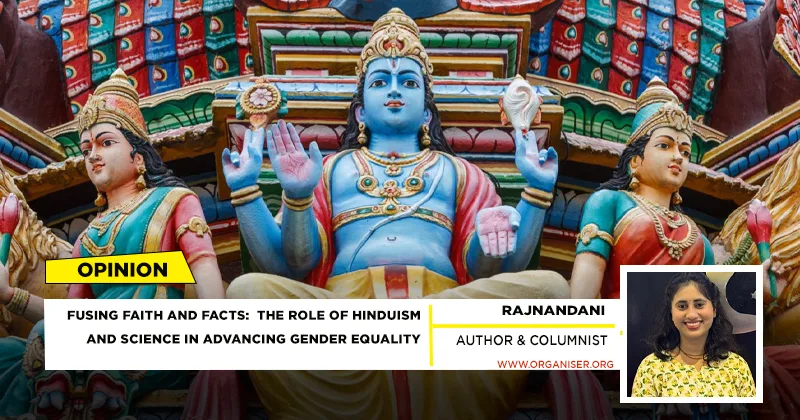
The investigation of gender equality in India through the perspectives of science and Hinduism presents a complex conversation between tradition and contemporary values. Hinduism, recognised as one of the oldest and most varied religious traditions globally, possesses a complex past regarding gender roles. Although Hindu philosophy and mythology provide opportunities for women’s empowerment, historical and cultural traditions. At the same time, contemporary science—via fields like biology, gender studies, and sociology—has contested these customs, providing fresh perspectives for comprehending gender and equality. This essay will investigate the link between science and Hinduism regarding gender equality, analyzing how religious doctrines and scientific findings can simultaneously enhance one another in promoting gender equality in India.
The Philosophical Basis of Hinduism and Gender Equality
Hinduism, being a multifaceted and ancient faith, presents different viewpoints on gender roles. At its essence, Hindu philosophy highlights the connection of contrasts and the interaction between male and female principles. The idea of Shakti (the divine feminine power) is fundamental in Hinduism and offers an equal perspective on gender. Shakti, frequently depicted as the goddess Durga or Kali, symbolises the creative and destructive energies of the cosmos and is honored as the origin of all existence and strength. From this perspective, femininity is incomparable than masculinity but is regarded as essential and complementary to the harmony of the cosmos.
This concept is also represented in the deity Ardhanarishvara, a combine embodiment of the god Shiva and his partner Parvati, which signifies the inseparable unity of masculine and feminine forces. Viewed from this angle, gender is not merely binary, and both masculine and feminine qualities are regarded as essential for balancing existence. Therefore, at its philosophical essence, Hinduism recognizes the intrinsic worth and strength of women.
While traditional practices in Hinduism have often placed women in Equal roles to men, we knows only negative things of manusmriti towards women but on other side the Manu Smriti also contains positive aspects that emphasize respect and reverence for women. It highlights the significant role of women in society, portraying them as the cornerstone of family and social harmony. In the Manu Smriti, the duties of women are seen as vital in maintaining the moral fabric of society, and the text acknowledges their importance as nurturers, educators, and custodians of culture. The Manu Smriti also stresses the value of treating women with care and respect, advocating for their protection and well-being. This more positive perspective offers a nuanced view of gender roles within Hindu tradition, reflecting both reverence for women and the belief in their integral role in spiritual and social life.
The scientific view regarding gender is based on the difference between biological sex and gender identity. Biological sex pertains to the physical characteristics that set apart males from females, such as genitalia, chromosomes, and hormones. Nonetheless, contemporary science, especially in the areas of genetics, psychology, and neuroscience, has demonstrated that gender identity—an individual’s internal perception of being male, female, or another gender—does not consistently correspond with their biological sex.
The acknowledgment of gender fluidity in science presents a significant challenge to strict, binary concepts of gender. Research in genetics and endocrinology has shown that chromosomes by themselves do not determine gender; environmental, hormonal, and genetic influences all contribute to forming an individual’s gender identity. For example, people who are born with intersex condition might have both male and female biological traits, questioning the concept of a rigid biological binary.
Hindu Feminism: Restoring Gender Equality via Spirituality
Hindu feminism aims to challenge the patriarchal structures embedded in Indian culture by reexamining Hinduism’s texts and practices. Contemporary Hindu feminists argue that the empowerment of women is deeply rooted in Hindu philosophy, even though historical interpretations and societal practices have marginalized women. They seek to reclaim the feminine divine and emphasize that the reverence for goddesses like Durga, Lakshmi, and Saraswati demonstrates the inherent equality of genders in the divine realm.
In Hinduism, the concept of the divine embraces both masculine and feminine energies. The goddesses Durga, Lakshmi, and Saraswati are key figures that symbolize power, wealth, and wisdom, respectively. These goddesses are central to Hindu worship and represent female strength, agency, and spiritual power. Durga, for instance, is a warrior goddess who protects the world from evil, while Lakshmi embodies prosperity and Saraswati signifies knowledge. Hindu feminists argue that the reverence for these goddesses reveals the original spiritual vision of gender equality, with women being not only respected but also essential in the cosmic order. By reclaiming the worship of these female deities, Hindu feminists contend that the tradition can be restored to reflect the equality of men and women, both in the divine sphere and in society.
The importance of the feminine divine is central to the feminist movement within Hinduism, as it challenges the male-centric interpretations that have dominated the narrative for centuries. Hindu feminists believe that by revisiting the role of female deities, the original egalitarian values of Hinduism can be restored, and women’s spiritual agency can be reasserted. This focus on the divine feminine allows Hindu feminists to combat societal norms that have relegated women to subservient roles by highlighting their vital position in spiritual and cosmic realms.
The Bhakti movement, which gained prominence in medieval India, further advanced the idea of gender equality within Hinduism. Bhakti, which emphasizes a personal and direct connection with the divine, rejected rigid social hierarchies, including those based on caste and gender. Women, in particular, found a voice within the Bhakti movement, as it offered a space where personal devotion and spiritual equality could flourish. Bhakti allowed women to engage in religious practices without the restrictions imposed by patriarchal social norms, thus challenging traditional gender roles.
Mirabai, a 16th-century Rajput princess and devotee of Krishna, is an iconic figure in the Bhakti tradition. Her poetry and songs, which expressed deep devotion to Krishna, defied the expectations placed on her as a royal woman. Mirabai’s rejection of traditional roles—such as marriage and royal duties—in favor of spiritual devotion demonstrated how Bhakti allowed women to transcend societal constraints. Her life exemplifies how devotion to the divine could empower women to challenge social norms and establish their spiritual autonomy.
Hindu feminism, by focusing on the divine feminine and figures like Mirabai, offers a framework for gender equality within the Hindu tradition. It seeks to reclaim and reinterpret Hinduism’s spiritual and cultural resources to empower women and challenge patriarchal structures. By revisiting the reverence for goddesses and the inclusive nature of the Bhakti movement, Hindu feminists are working to reassert the faith’s capacity for gender equality, ensuring that women are valued and recognized in both spiritual and societal contexts.
Gender Equality in Contemporary India: The Influence of Science and Hindu Philosophy
In contemporary India, the intersection of science and Hindu philosophy plays a pivotal role in shaping the feminist movement. Gender studies, utilising scientific methods to understand and challenge traditional gender norms, has become a powerful tool in advocating for women’s rights. This academic discipline scrutinizes how gender roles are constructed and reinforced in society, pushing for equality and social change.
At the same time, Hinduism’s flexibility allows for the reinterpretation of ancient practices to align with modern ideals of justice, equality, and human rights. The Indian Constitution guarantees equal treatment for all citizens, and many feminist scholars argue that Hinduism, in its true essence, supports gender equality. By emphasizing the spiritual equality of men and women and the reverence for female deities, Hindu philosophy offers a foundation for challenging gender discrimination.
Significant societal transformations, such as the ban on dowry, advancements in women’s education, and increasing political participation of women, have been supported by both scientific approaches and the reformed views within Hinduism. Reformist thinkers and activists within the Hindu tradition have advocated for a reinterpretation of sacred texts, arguing that Hinduism, at its core, values the dignity and equality of women. This perspective fosters a vision of gender equality that does not require the rejection of religion but instead calls for its reinterpretation in light of contemporary values.
Prime Minister Narendra Modi’s tenure from 2014 has further advanced the empowerment of women in India. His government has focused on several initiatives to promote gender equality. The “Beti Bachao, Beti Padhao” scheme, which encourages the education and protection of the girl child, and the “Pradhan Mantri Ujjwala Yojana,” which provides free LPG connections to women, are notable efforts that aim to uplift women in rural areas.
The “Nari Shakti Vandan Adhiniyam” (Women’s Empowerment Bill) passed in 2023 is a landmark achievement in Modi’s vision for gender equality, which seeks to ensure one-third reservation for women in the Lok Sabha and State Assemblies, thereby improving their representation in political decision-making. This legislative action embodies the government’s commitment to increasing women’s participation in public life.
Furthermore, initiatives like the MUDRA Yojana, which provides financial support to women entrepreneurs, and schemes for skill development in sectors traditionally dominated by men, reflect Modi’s emphasis on empowering women economically and socially. His vision is to create an India where women are not only equal in terms of rights but also active contributors to the country’s development.
The promotion of gender equality in India is a multifaceted effort that integrates scientific analysis with the reinterpretation of Hindu philosophy. It is complemented by political actions, including PM Modi’s vision for women’s empowerment, which reflects both traditional values and modern aspirations for a more inclusive society. The evolving feminist movement in India draws strength from these multiple sources, working towards a future of gender equality and empowerment.
The dialogue at the crossroads of science and Hinduism concerning gender equality is intricate and developing, challenging conventional ideas of gender roles while celebrating the spiritual strength of femininity. Hinduism provides abundant philosophical and spiritual insights for promoting gender equality; however, historical interpretations and societal practices frequently undermined these forward-thinking principles. Conversely, science offers contemporary frameworks that confirm the flexibility and equality of genders. Collectively, these influences can collaborate to tackle the entrenched disparities in Indian society and contribute to a future in which men and women are genuinely equal in every aspect of life.