One Nation, One Election: Reducing costs, boosting governance continuity
August 4, 2026
  • Read Ecopy
  • Circulation
  • Advertise
  • Careers
  • About Us
  • Contact Us
Android AppiPhone AppArattai
Organiser
  • ‌
  • Bharat
    • Assam
    • Bihar
    • Chhattisgarh
    • Jharkhand
    • Maharashtra
    • View All States
  • World
    • Asia
    • Europe
    • North America
    • South America
    • Africa
    • Australia
  • Editorial
  • International
  • Opinion
  • RSS @ 100
  • More
    • Op Sindoor
    • Analysis
    • Sports
    • Defence
    • Politics
    • Business
    • Economy
    • Culture
    • Special Report
    • Sci & Tech
    • Entertainment
    • G20
    • Azadi Ka Amrit Mahotsav
    • Vocal4Local
    • Web Stories
    • Education
    • Employment
    • Books
    • Interviews
    • Travel
    • Law
    • Health
    • Obituary
  • Subscribe
    • Subscribe Print Edition
    • Subscribe Ecopy
    • Read Ecopy
  • ‌
  • Bharat
    • Assam
    • Bihar
    • Chhattisgarh
    • Jharkhand
    • Maharashtra
    • View All States
  • World
    • Asia
    • Europe
    • North America
    • South America
    • Africa
    • Australia
  • Editorial
  • International
  • Opinion
  • RSS @ 100
  • More
    • Op Sindoor
    • Analysis
    • Sports
    • Defence
    • Politics
    • Business
    • Economy
    • Culture
    • Special Report
    • Sci & Tech
    • Entertainment
    • G20
    • Azadi Ka Amrit Mahotsav
    • Vocal4Local
    • Web Stories
    • Education
    • Employment
    • Books
    • Interviews
    • Travel
    • Law
    • Health
    • Obituary
  • Subscribe
    • Subscribe Print Edition
    • Subscribe Ecopy
    • Read Ecopy
Organiser
  • Home
  • Bharat
  • World
  • Operation Sindoor
  • Editorial
  • Analysis
  • Opinion
  • Culture
  • Defence
  • International Edition
  • RSS @ 100
  • Magazine
  • Read Ecopy
Home Politics

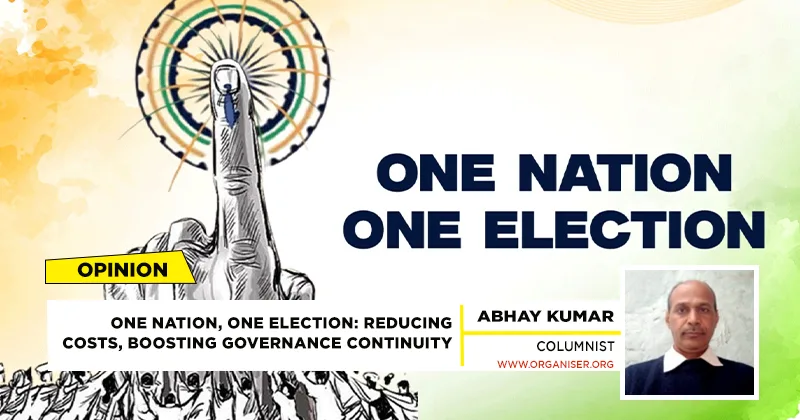
One Nation, One Election: Reducing costs, boosting governance continuity

The concept of "One Nation, One Election" offers a transformative approach to streamline India’s electoral process. By synchronizing elections for the Lok Sabha and state assemblies, it aims to reduce the financial burden on the exchequer, minimize the disruption to governance due to frequent election cycles, and enhance policy continuity

Abhay KumarAbhay Kumar
Dec 16, 2024, 06:30 pm IST
in Politics, Bharat, Opinion
Follow on Google News
FacebookTwitterWhatsAppTelegramEmail

One nation one election is a big and fore-sighted step of Narendra Modi’s dispensation. It is the demand of the time as Indian progress lags due to the perennial election season in India. Every year at least on two occasions elections were held for different States or UTs in India. These elections were held on schedule and were not out of turn.

India is the largest democracy in the world with the highest number of electorates in the world. India is a diverse country with 28 States and 8 Union Territories. It’s common in India as three to four states or UTs go to elections every year. Due to this electoral cycle, the country always remains  in the grip of elections. After the Lok Sabha elections in 2024, Assembly elections were held in Haryana, Maharashtra, and Jharkhand as per the completion of the tenures of these States Assemblies. Elections in the newly created Union Territory of Jammu and Kashmir had been conducted as per new schedule.

If we look at the State-wise elections in the last five years then we see that along with the   Lok Sabha elections  in 2019  voting took place in four States of  Andhra Pradesh, Odisha, Sikkim and Arunachal Pradesh in April. After that voting took place in Haryana and Maharashtra in the month of October. In 2019 too the  Assembly elections were held in Jharkhand in the month of November.

In 2020 Assembly elections were held in Delhi  in February  and in Bihar Assembly elections were held in the month of November. The continuous cycle of elections has always kept the political parties vigilant  towards the elections throughout the year.

In the year 2021, elections were held in the States of West Bengal, Assam, Kerala, Tamil Nadu, and Puducherry in the months of March and April.

In the year 2022, Assembly elections were held in five States of Uttar Pradesh, Manipur, Goa, Uttarakhand, and in Punjab in February-March, while in Gujarat and Himachal Pradesh Assembly elections were held  in November-December.

In the year 2023, elections were held thrice at different times. In February, Assembly elections were held in three states of Tripura, Meghalaya, and Nagaland, while in May Assembly elections were held in Karnataka. Then in the month of November of the same year, elections were held in the States of Rajasthan, Telangana, Madhya Pradesh, Chhattisgarh, and Mizoram.

In the year 2024, in April-May, Assembly elections were held along with Lok Sabha in the four States Odisha, Andhra Pradesh, Sikkim and Arunachal Pradesh as per 2004,2009, 2014, and 2019 schedule. In the month of October, Assembly elections were held in Haryana and the Union Territory of Jammu and Kashmir. In the month of November, elections were called in the States of Maharashtra and Jharkhand.

By these above illustrations we observe that every year a long span of time is spent by the government in conducting elections. Due to the model code of conduct (MCC) restrictions imposed by the Election Commission on the governments that they cannot announce or implement any new important policy. Not only this, but the ruling party hesitates to take any tough step because its party also has to seek the trust of the public in the electoral arena almost twice every year according to the elections. Due to the long duration of elections, the public has to face many problems.

In India, Lok Sabha and State Assembly elections were conducted simultaneously in the years of 1952 and 1957. This cycle was broken in 1959 when Jawaharlal Nehru for the first time-imposed President’s rule in Kerala by toppling the Communist Party government led by Elamkulam Manakkal Sankaran Namboodiripad. After this, elections were held in Kerala in 1960. Due to the weakening hold of the Congress party, non-Congress governments had been formed in many States by the year 1967. Not only this, but due to the increasing incidents of defection, State governments and Assemblies started becoming unstable, due to which it became necessary to conduct Assembly elections of many States separately from the Lok Sabha elections.

There will be many benefits of implementing the practice of one country one election (ONOE). Simultaneous elections will save huge money due to simultaneous elections or ONOE. Multiple kinds of expenditure in the conduct of elections can be settled in one go due to ONOE. The government can utilize that money for public welfare works like schools, roads, hospitals and other works. In the case of ONOE there will be less work pressure on the security forces. The security force personnel can get more time so that they can use it to spend time with their families.

Due to less enforcement of the model code of conduct, the government will be able to spend more time on development activities. Due to Lok Sabha and Assembly elections being held simultaneously, people will be more interested in the voting process and voting percentage will also increase. Due to simultaneous elections, the government will take decisions that have a long-term and good impact on the society instead of immediate benefits. In this situation, political parties will also have to spend less money on election campaigning or on other processes so that  small parties will also get a chance to compete with big parties on equal footing. Due to simultaneous elections, the period of implementation of the model code of conduct will be reduced and the government will do more public welfare work.

Topics: PM Narendra ModiOne Nation One ElectionONOE
Share1TweetSendShareSend
✮ Subscribe Organiser YouTube Channel. ✮
✮ Join Organiser's WhatsApp channel for Nationalist views beyond the news. ✮
Previous News

Priyanka Gandhi carries a bag with “Palestine” written in Parliament, BJP MP calls it appeasement

Next News

Andhra Pradesh: Evangelist Prof Ch. Chengiah removed as HOD at Sri Venkateswara University, LRPF seeks termination

Related News

Jagannath Puri Rath Yatra

Odisha CM Mohan Majhi seeks centre’s support for UNESCO Heritage tag for Puri Rath Yatra

PM inaugurates Viveka Memorial, Swami Vivekananda Cultural Centre in Mysuru; says youth are India’s greatest strength

PM Narendra Modi

‘Guide them, don’t punish them’: PM Modi on youth who abused him and his mother during CJP protest at Jantar Mantar

PM Modi's Late-Night Instagram Reel Sets World Record with 303 Million Views,

Mass Connect Continues: PM Modi’s Instagram reel sets a new 24-hour world record with 303 million views

JNU Cites SC Order, Urges Campus Community to Avoid Jantar Mantar

JNU issues advisory asking students, staff to avoid gatherings at Jantar Mantar, exercise restraint on social media

Prime Minister Narendra Modi

PM Modi promises ‘more strict actions against paper leaks’ amid CJP protests

Load More

Latest News

Representative Image

India creates healthcare history: Crosses 20,000 organ transplants in a year, emerges global leader donor transplants

Beyond the Noise: Why Bharat’s Gen Z must not be defined by street anarchy

Koukoor Dargah in Medchal district, Telangana

Telangana: Police arrest Nazar in Medak after wife alleges he posed as an orphan, used fake Hindu name to marry her

Seva Bharati karyakartas engaged in relief and rescue operations across flood-hit districts in Kerala.

Keralam Floods: Seva Bharati steps up relief and rescue operations across flood-hit districts

WA Groups under radar over Delhi Police as they probe CJP Protest

‘Chalo Sansad’ Probe Expands: Leaked WhatsApp chats reveal pre-planning to use Briar, BitChat if net was disrupted

Pakistan PM Shahbaz Sharif (Right)

Pakistan reportedly blocks Al Jazeera after PoJK election coverage, accuses network of “yellow journalism”

Bird-eye view of the Excavated remains at Sarnath (Source-Archaeological Survey of India)

Sarnath included in UNESCO World Heritage Site: Timeless message, lately recognition

US-based report exposes the reality of PoJK, raises serious questions over democracy, human rights and autonomy

Orphanage owner 'Brother' Mathew Albin

Keralam: Orphanage owner ‘Brother’ Mathew Albin arrested in sexual assault case filed by woman employee in Alappuzha

An injured Journalist (File Image)

Balochistan’s Silenced Voices: Journalists face bullets for reporting the truth; 42 reporters killed

Load More
  • Privacy
  • Terms
  • Cookie Policy
  • Refund and Cancellation
  • Delivery and Shipping

© Bharat Prakashan (Delhi) Limited.
Tech-enabled by Ananthapuri Technologies

  • Home
  • Search Organiser
  • Bharat
    • Assam
    • Bihar
    • Chhattisgarh
    • Jharkhand
    • Maharashtra
    • View All States
  • World
    • Asia
    • Africa
    • North America
    • South America
    • Europe
    • Australia
  • Editorial
  • Operation Sindoor
  • Opinion
  • Analysis
  • Defence
  • Culture
  • Sports
  • Business
  • RSS @ 100
  • Entertainment
  • More ..
    • Sci & Tech
    • Vocal4Local
    • Special Report
    • Education
    • Employment
    • Books
    • Interviews
    • Travel
    • Health
    • Politics
    • Law
    • Economy
    • Obituary
  • Subscribe Magazine
  • Read Ecopy
  • Advertise
  • Circulation
  • Careers
  • About Us
  • Contact Us
  • Policies & Terms
    • Privacy Policy
    • Cookie Policy
    • Refund and Cancellation
    • Terms of Use

© Bharat Prakashan (Delhi) Limited.
Tech-enabled by Ananthapuri Technologies